White Label Digital Wallet Solution: A Complete Guide
Explore white label digital wallet solutions and platforms, compare software providers, and see how to launch your own branded e-wallet app fast and quickly.
By CloneAppz Team13 min read
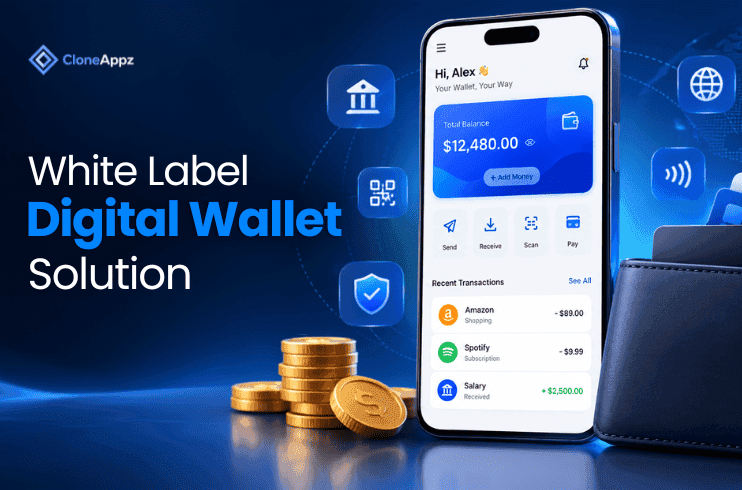
Every fast-growing bank, telecom, retailer, and marketplace platform seems to be asking the same question right now:
Should we build our own digital wallet, or keep relying on someone else's payment app?
It's no longer a niche fintech debate. Payments have quietly become the most important touchpoint a business has with its customers, and whoever controls that touchpoint controls the data, the loyalty, and a meaningful slice of recurring revenue.
The instinctive next question is build versus buy. Building a wallet from scratch means months of engineering, a compliance team, and a long list of integrations before a single customer sees a login screen.
That is where a white label digital wallet solution changes the equation. It lets a business launch a fully branded, fully functional e-wallet without carrying the entire engineering and regulatory burden alone.
This guide walks through what a white label digital wallet platform actually includes, why businesses across industries are adopting one, how to evaluate a provider, and what a realistic path to launch looks like.
Whether you are exploring this for the first time or comparing white label digital wallet software providers, the goal here is to give you a genuinely useful decision-making framework.
What is a White Label Digital Wallet Solution?
A white label digital wallet solution is a pre-built e-wallet platform that a business can rebrand, configure, and launch under its own name. The underlying technology, including the ledger, payment rails, security architecture, and compliance tooling, is already built and tested.
What changes is the branding, the feature configuration, and the way the wallet is positioned to the end customer.
In practice, this means a bank, telecom company, or retail business does not have to build payment infrastructure from scratch. They can choose a platform, add their logo and branding, select the features they need, and launch much faster than with a custom build.
How White Label Differs from Custom-Built and Open-Source Wallets
Custom-built wallets are designed and coded from scratch for one specific business. They offer complete control but demand significant time, capital, and an in-house or dedicated engineering team to maintain.
Open-source wallet frameworks offer a middle ground. The code is free to use, but the business must handle security, testing, compliance, and maintenance itself. If something goes wrong, there may also be no vendor to take responsibility.
A white label digital wallet solution works differently. A specialist provider handles the core development, security testing, and regulatory requirements. The business focuses on branding, marketing, and the features its customers need, while the provider manages and supports the platform.
Why "White Label" Matters More Than "From Scratch" for Most Businesses in 2026
Speed has become a genuine competitive advantage in digital payments. A business that can launch a branded wallet in a matter of months, rather than a couple of years, gets to test the market, gather real usage data, and iterate while competitors are still finalising their technical architecture.
For most businesses outside of pure FinTech, the wallet is not the product; it is a feature that supports the product. That makes "from scratch" development difficult to justify when a white label digital wallet platform can deliver the same customer experience with far less risk.
Why Businesses are Racing to Launch Their Own Digital Wallet Platform
The shift toward wallet-led payments is not a passing trend. Customers increasingly expect to store value, move money, and pay bills from within the apps they already use daily, rather than switching between a banking app, a separate payment app, and a loyalty app.
Businesses that recognise this are treating the wallet as a strategic asset rather than a checkout feature.
The Shift from Card-Led to Wallet-Led Payments
Card-based payments still dominate volume today, but the growth curve belongs to wallets. Digital wallets reduce friction at the point of payment, support a wider range of value types beyond currency, such as loyalty points or credits, and keep the entire transaction experience inside a business's own branded environment.
For a business, that means more visibility into customer behaviour and more opportunities to build recurring engagement.
Who is Building Wallets Right Now
The businesses adopting white label digital wallet platforms span far beyond traditional FinTech. Banks and neobanks use them to modernize account experiences and add mobile-first features without rebuilding their core systems.
Telecom operators use wallets to give unbanked or underbanked customers an alternative to a traditional bank account, using mobile balances as the entry point.
Retailers and marketplaces use wallets to hold stored value, manage refunds, and enable peer-to-peer transfers between buyers and sellers. Super app builders use wallets to connect services like ride-hailing, food delivery, and shopping through one payment system.
Real-World Use Cases Where a Branded Wallet Adds Revenue
A few patterns show up consistently across industries.
- Loyalty programmes built on wallet infrastructure let businesses issue prepaid balances, gift cards, and bonus points while tracking every transaction in real time.
- Marketplace platforms use wallet-based escrow to hold funds securely until a buyer confirms satisfaction, reducing disputes and building trust.
- Remittance and money transfer businesses rely on wallets to offer instant, low-friction cross-border transfers.
- Gaming and entertainment platforms use in-wallet balances to increase engagement and reduce drop-off at the payment step.
In each case, the wallet is not just infrastructure; it is a new, ownable revenue stream.
What a White Label Digital Wallet Platform Should Actually Include
Not every white label wallet is built the same way, and the difference between a shallow product and a genuinely capable one usually comes down to what sits underneath the branding.
Before evaluating providers, it helps to understand the functional categories a serious platform needs to cover.
Core Wallet Infrastructure
Multi-Currency and Multi-Asset Accounts
A capable wallet platform should support more than a single currency or a single type of value. Businesses increasingly need accounts that can hold fiat currencies, loyalty points, bonus credits, or other digital assets side by side, all managed through the same underlying account structure.
Ledger and Transaction Engine
At the centre of every wallet is a ledger that records every movement of value accurately and in real time.
This transactional core needs to be resilient enough to handle high volumes without errors, since even small discrepancies in a financial ledger create outsized problems for both the business and its customers.
Payments and Money Movement
P2P Transfers, Bill Pay, and Top-Ups
Customers expect to move money between wallets instantly, pay recurring bills such as utilities or mobile top-ups directly from the wallet, and add funds through familiar payment methods.
A platform that only handles basic transfers, without bill payment or flexible top-up options, will feel incomplete against modern expectations.
Card Issuing and QR Payments
Many businesses add virtual or physical cards to their wallets. This lets customers spend their wallet balance wherever cards are accepted. QR-based payments have also become a standard expectation, particularly for in-store and small merchant transactions.
Compliance and Trust Layer
KYC/KYB Onboarding
Digital wallets move real money, which means onboarding has to verify who a customer is before they can transact meaningfully. A strong platform supports both automated identity verification through integrated vendors and manual review through a back-office interface, so businesses can adapt their onboarding flow to their risk appetite and regulatory environment.
AML and Fraud Monitoring
Beyond onboarding, an ongoing wallet needs the ability to flag suspicious transactions, freeze accounts when necessary, and maintain a clear audit trail for investigations. This is not optional infrastructure; it is what keeps a wallet business compliant and its customers' funds safe.
Business and Back-Office Controls
Fee Configuration and Settlement
Every wallet business needs the flexibility to define its own commercial model, whether that means percentage-based fees, flat fees, or a combination, and to decide who bears each fee.
Clear settlement and reconciliation tools also matter enormously once transaction volume grows, since unresolved discrepancies quietly erode trust and margin.
Admin Dashboards and Reporting
A wallet platform is only as manageable as its back office. Administrators need visibility into customer activity, transaction history, and system-wide reporting, all from a single dashboard, without needing to query a database directly.
White Label vs. Custom Digital Wallet Development: Making the Right Call for Your Business
Once the feature landscape is clear, the build-versus-buy decision becomes more concrete. Both paths can work, but they suit different businesses at different stages.
Time-to-Market and Cost Comparison
Custom wallet development typically takes well over a year once design, engineering, security testing, and regulatory review are accounted for, and the cost scales accordingly.
A white label digital wallet solution compresses that timeline dramatically, since the core engineering and compliance groundwork are already in place. For most businesses, that difference in time-to-market translates directly into a difference in competitive position.
When Custom Development Actually Makes Sense
Custom development still has a place, particularly for businesses whose wallet functionality is genuinely core to their competitive differentiation, or whose regulatory environment demands an entirely bespoke architecture.
If a business's product is the wallet itself, at a scale where every architectural decision affects its market position, the case for custom development strengthens considerably.
The Middle Path – White Label with Room to Customize
For nearly everyone else, the more practical answer sits between the two extremes: a white label digital wallet platform with genuine room to customize the design, feature set, and configuration. This gives a business the branding and flexibility it needs without asking it to absorb the full engineering risk of a ground-up build.
How to Choose the Right White Label Digital Wallet Software Provider
With the functional groundwork covered, the next challenge is choosing the right partner. This is where many businesses default to comparing feature checklists, when the more useful approach is to ask a smaller set of sharper questions.
Questions to Ask Before You Sign a Contract
How Customizable is the UI and Feature Set?
Some white label platforms offer only cosmetic branding, such as a logo swap, while others allow deeper configuration of features, flows, and design. Before committing, it's worth asking exactly how far customization goes, and whether feature-level configuration requires additional development work or is available out of the box.
What Compliance Coverage Comes Built In?
Compliance requirements vary significantly by region and industry, so it matters whether a provider's KYC/KYB and AML tooling is genuinely built into the platform or added on as a costly extra. Ask specifically which jurisdictions the provider has experience supporting, and how updates to regulatory requirements are handled over time.
What Does Post-Launch Support Actually Look Like?
Launch day is the easy part. The real test of a provider relationship shows up in the months afterward, when a business needs a new integration, a bug fixed quickly, or help scaling for a traffic spike. It's worth getting specific commitments on support response times and the scope of what's included before signing anything.
Red Flags That Signal a Rigid or Unreliable Platform
A few warning signs can predict trouble later. Vague answers about customization limits usually mean the platform is more rigid than advertised. If a provider describes compliance features only in general terms and does not specify the vendors or jurisdictions they support, ask for more details.
Also, if a provider refuses to demonstrate the back office or admin experience before signing a contract, the business would commit to a platform it has never actually seen in action.
Why Businesses Choose CloneAppz as their White Label Digital Wallet Platform
CloneAppz approaches white label wallet development with a simple premise: businesses shouldn't have to choose between speed and control.
Our white label digital wallet software gives businesses a fully functional, brandable e-wallet app that's ready to configure and launch, without asking them to compromise on the depth of features their customers expect.
Ready-to-Brand E-Wallet App, Built for Fast Deployment
The CloneAppz white label e-wallet app comes with the design and technical foundation already built, so branding and configuration take weeks rather than the many months a ground-up build would require.
Businesses apply their own identity, from logo and color palette to app naming, while the underlying engineering stays proven and stable.
Flexible Enough to Fit Banking, Telecom, Retail, or Marketplace Models
Because the platform is modular, it adapts to a wide range of business models. A telecom operator can configure it around mobile balance transfers and bill payments, while a marketplace can lean on escrow-style holding and peer-to-peer transfers.
That same flexibility means a business isn't locked into a single use case as its strategy evolves.
What's Included Out of the Box
The CloneAppz platform ships with the core wallet infrastructure discussed earlier in this guide: multi-currency account support, a real-time transaction ledger, P2P transfers and bill payments, KYC/KYB onboarding, AML monitoring tools, and a full back-office dashboard for fee configuration and reporting.
Businesses configure what they need rather than building it from zero.
Getting Started: What Launching Your White Label E-Wallet App with CloneAppz Looks Like
Understanding the platform is one thing; understanding the path to launch is what actually helps a business plan.
From Onboarding to Go-Live: The Typical Timeline
The process typically begins with a discovery conversation to understand the business's use case, target market, and regulatory environment.
From there, the CloneAppz team maps the required features against the platform's existing modules, applies branding, and configures the compliance settings relevant to the business's jurisdiction.
Testing and refinement follow before go-live, with the overall timeline shaped far more by branding and configuration decisions than by ground-up engineering work.
Support After Launch
Launch is the starting point, not the finish line. CloneAppz continues to support businesses after go-live, whether that means adding new integrations as the business grows, adjusting configurations as regulatory requirements shift, or troubleshooting as transaction volume increases.
The goal is a long-term platform relationship, not a one-time handover.
Final Thoughts: Your Wallet, Your Brand, Someone Else's Engineering Risk
The businesses winning the wallet race in 2026 aren't necessarily the ones with the biggest engineering budgets. They're the ones that recognized early that owning the wallet layer doesn't require building every line of it themselves.
A white label digital wallet solution, such as a cashapp clone, allows businesses to launch a branded payment platform while maintaining control over their customer relationships and business strategy, with an experienced development partner handling the underlying technology, infrastructure, and compliance complexities.
The question worth asking isn't whether your business should have its own wallet. Increasingly, across banking, telecom, retail, and marketplace models, that answer is already yes. The real question is how quickly you can get there without taking on more risk than the opportunity is worth.
Frequently Asked Questions
01What is a white label digital wallet solution?
A white label digital wallet solution is a pre-built e-wallet platform that businesses can rebrand and launch under their own name. It includes the core wallet infrastructure, payment features, and compliance tooling already developed, so businesses save the time and cost of building from scratch.
02How much does it cost to build a white label e-wallet app?
Costs vary depending on the level of customisation, compliance requirements, and feature set a business needs. However, a white label approach is generally significantly less expensive than custom development, since the core engineering and infrastructure costs are shared across the platform rather than borne entirely by one business.
03How long does it take to launch a white label digital wallet platform?
Timelines depend on the scope of customisation and the complexity of a business's compliance requirements, but white label platforms typically launch in a matter of months rather than the year or more custom development usually requires.
04Is a white label digital wallet secure?
A well-built white label digital wallet platform includes bank-grade security measures, including encryption, KYC/KYB verification, AML monitoring, and fraud detection, as standard. Security depends heavily on the specific provider, so it's worth evaluating a platform's security architecture directly before committing.
05Can I fully customize a white label digital wallet software?
Customisation depth varies by provider. Some platforms only allow surface-level branding, while others, including CloneAppz, support deeper configuration of features, flows, and design so the wallet genuinely reflects a business's own product strategy.
06What's the difference between a white label wallet and a white label neobank?
A white label wallet focuses specifically on storing, moving, and managing value, such as transfers, bill payments, and top-ups. A white label neobank typically offers a broader set of banking services, including accounts, cards, and sometimes lending, built on top of similar underlying infrastructure.
07Do white label digital wallet software providers handle regulatory compliance?
Most established providers build core compliance tooling, such as KYC/KYB onboarding and AML monitoring, directly into the platform. However, the business using the wallet remains responsible for meeting the regulatory requirements of its own jurisdiction, so it's important to confirm exactly what compliance coverage a provider includes.