White Label App Cost Breakdown: Features, Tech & Pricing
Explore white label app costs for taxi, food, grocery, ecommerce, and AI apps. Learn pricing, features, tech stack, and scalability.
By CloneAppz Team10 min read
The global mobile app industry is evolving rapidly, and in 2026 businesses are focusing more on faster product launches, scalable infrastructure, and lower development risks instead of spending years building applications from scratch. Startups, SaaS founders, ecommerce brands, taxi businesses, grocery delivery companies, and digital entrepreneurs are now aggressively investing in white label solutions because they offer a faster and more cost-efficient path to market.
Traditional app development has become increasingly expensive due to rising engineering costs, AI integration requirements, cloud infrastructure expenses, and enterprise-level security expectations. Building a scalable application from the ground up often requires massive investments in backend architecture, UI/UX systems, DevOps infrastructure, APIs, testing environments, and long-term maintenance.
This is one of the biggest reasons why the demand for understanding white label app cost has increased globally. Businesses want to know how much they need to invest, which features affect pricing, and whether white label ecosystems are more practical than custom app development.
Modern white label solutions are no longer basic template apps. Today’s platforms support advanced AI features, real-time analytics, cloud-native infrastructure, payment gateways, subscription models, GPS tracking, automation systems, and multi-vendor ecosystems. Businesses can launch quickly while still maintaining scalability and enterprise-grade performance.
Industries such as food delivery, taxi booking, grocery delivery, OTT streaming, dating platforms, ecommerce, and fitness technology are rapidly adopting white label app ecosystems because they reduce operational complexity and accelerate revenue generation.
The biggest advantage is speed. Instead of spending 12–18 months on custom app development, startups can launch within weeks using scalable white label architecture and begin validating markets much faster.
What Is a White Label App?
A white label app is a ready-made software solution that businesses can customize and launch under their own brand identity. Instead of developing an entire application from scratch, companies use an existing infrastructure that already includes backend systems, user management, APIs, admin dashboards, payment architecture, and operational workflows.
Businesses can customize:
- App design
- Branding
- Features
- User experience
- Payment systems
- Monetization models
- AI integrations
- Business logic
This dramatically reduces development time and lowers technical complexity.
In 2026, white label ecosystems have become highly advanced. Many platforms now support enterprise-level scalability, AI automation, cloud-native deployment, predictive analytics, and multi-platform compatibility.
For startups, this approach minimizes financial risk. For enterprises, it accelerates digital transformation while reducing infrastructure overhead.
White Label Apps vs Custom App Development
One of the most important decisions businesses face is whether to choose white label solutions or custom app development.
Custom app development focuses on building everything from scratch. This gives businesses complete control over workflows, architecture, and infrastructure. However, it also requires higher investment, larger engineering teams, longer timelines, and significantly more operational management.
White label development focuses on speed, scalability, and efficiency. Businesses use pre-built infrastructure while customizing the platform according to their operational needs.
Factor | White Label Apps | Custom App Development |
Development Timeline | 2–8 Weeks | 8–18 Months |
Initial Cost | Lower | Very High |
Time to Market | Fast | Slow |
Technical Complexity | Moderate | Extremely High |
Maintenance Cost | Lower | Higher |
Risk Level | Lower | Higher |
ROI Speed | Faster | Slower |
For most startups and growing businesses, white label solutions offer a much more practical and scalable business model.
White Label App Cost Breakdown in 2026
The total white label app cost depends on app complexity, feature requirements, infrastructure, integrations, cloud scalability, and customization depth.
A basic startup application with standard features costs significantly less than a large-scale enterprise platform with AI automation, real-time analytics, and multi-vendor ecosystems.
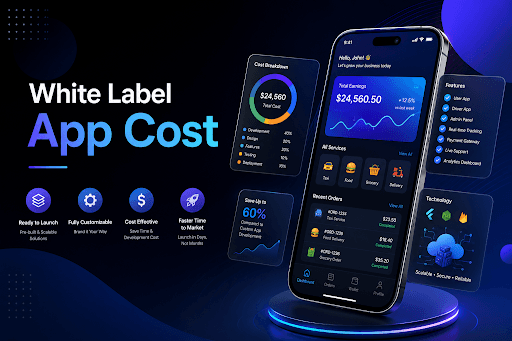
In 2026, the average white label app cost typically ranges between $4,000 and $40,000 depending on the business model and scalability requirements.
App Type | Estimated Cost |
Basic White Label App | $4,000 – $8,000 |
Mid-Level Business App | $8,000 – $18,000 |
AI-Integrated White Label App | $15,000 – $30,000 |
Enterprise White Label Platform | $25,000 – $40,000 |
The pricing difference depends heavily on backend infrastructure, AI functionality, cloud deployment requirements, and feature complexity.
Major Factors Affecting White Label App Cost
App Complexity
The more complex the business workflow, the higher the development cost. A simple booking application is far less expensive than a multi-vendor marketplace supporting real-time tracking, subscriptions, analytics, and AI-powered automation.
Complex applications require stronger backend systems, scalable databases, advanced APIs, and larger testing environments.
Feature Requirements
Features directly affect pricing because every additional functionality increases engineering hours, backend logic, testing cycles, and infrastructure complexity.
Features such as:
- Real-time chat
- GPS tracking
- AI recommendations
- Wallet systems
- Video streaming
- Subscription billing
- Multi-vendor management
can significantly increase total development cost.
UI/UX Design
Businesses today compete heavily on user experience. Modern SaaS applications require clean interfaces, responsive design systems, onboarding flows, and intuitive navigation.
Premium UI/UX increases pricing because it involves:
- Wireframing
- User research
- Responsive optimization
- Interactive design systems
- User journey planning
Backend Infrastructure
Backend architecture is one of the biggest pricing factors in modern white label ecosystems.
Scalable backend systems require:
- Cloud deployment
- Database optimization
- API orchestration
- Security frameworks
- Real-time synchronization
- Server scaling
The stronger the scalability requirement, the higher the infrastructure cost.
AI & Automation Features
AI is becoming a major part of modern applications. Businesses increasingly want:
- AI chatbots
- Smart recommendations
- Predictive analytics
- AI automation
- Personalized user experiences
These features increase development pricing because they require advanced APIs, cloud processing, data pipelines, and automation logic.
White Label App Features That Increase Development Cost
Real-Time Chat
Real-time communication systems require socket architecture, notification systems, media handling, and synchronized databases.
Estimated Cost Impact: $2,000 – $5,000
GPS & Live Tracking
Taxi apps, grocery delivery platforms, and logistics systems rely heavily on real-time location tracking.
Estimated Cost Impact: $3,000 – $7,000
AI Recommendations
AI-powered recommendation systems personalize customer experiences and improve retention.
Estimated Cost Impact: $4,000 – $8,000
Payment Gateway Integration
Modern apps require secure payment infrastructure supporting wallets, subscriptions, and multiple payment methods.
Estimated Cost Impact: $1,500 – $4,000
Multi-Vendor Architecture
Marketplace applications supporting multiple vendors require advanced backend management and operational workflows.
Estimated Cost Impact: $5,000 – $10,000
Analytics & Reporting
Advanced reporting systems help businesses track growth, revenue, user behavior, and operational performance.
Estimated Cost Impact: $2,000 – $6,000
White Label App Cost by Industry
White Label Taxi App Development Cost
The white label taxi app development cost usually ranges between $8,000 and $25,000 depending on features such as GPS tracking, fare calculation, driver management, wallet systems, and route optimization.
Modern taxi platforms require scalable real-time infrastructure because location synchronization and driver tracking increase backend complexity.
White Label Food App Development Cost
The white label food app development cost generally falls between $10,000 and $30,000 depending on restaurant onboarding systems, delivery tracking, payment gateways, loyalty programs, and subscription modules.
Food delivery businesses require scalable cloud infrastructure because order volumes fluctuate heavily during peak hours.
White Label Grocery App Development Cost
The white label grocery app development cost ranges between $12,000 and $35,000 because grocery applications require inventory synchronization, delivery scheduling, multi-vendor systems, and real-time stock management.
These platforms are operationally more complex than standard ecommerce apps.
White Label Dating App Cost
White label dating applications with AI matchmaking, real-time chat, profile verification, and recommendation systems generally cost between $15,000 and $40,000.
AI-based recommendation engines and communication systems significantly affect pricing.
White Label OTT App Cost
OTT streaming applications generally cost between $20,000 and $40,000 depending on video infrastructure, subscription systems, CDN integration, and streaming scalability.
White Label Ecommerce App Cost
Ecommerce applications with multi-vendor systems, analytics, payment gateways, AI recommendations, and scalable inventory management generally range between $10,000 and $35,000.
Best Tech Stack for White Label Apps
Choosing the right technology stack directly affects both scalability and development pricing.
Frontend technologies such as Flutter and React Native are widely preferred because they reduce development time by allowing cross-platform deployment from a single codebase.
Backend technologies such as Node.js, Python, Laravel, and Firebase are commonly used because they support scalable APIs, real-time systems, AI integrations, and rapid deployment.
Cloud infrastructure platforms such as AWS, Google Cloud, and Azure provide scalable hosting, global deployment flexibility, CDN systems, database scaling, and enterprise-grade security.
Modern AI-powered applications also rely heavily on:
- OpenAI APIs
- Predictive analytics
- Recommendation engines
- Automation workflows
- AI-powered support systems
The more advanced the tech stack, the higher the infrastructure and operational cost.
Hidden Costs Businesses Often Ignore
Many businesses only focus on initial development pricing while ignoring operational expenses that grow over time.
Cloud hosting becomes more expensive as traffic increases. API providers often charge based on request volume, AI usage, or bandwidth consumption.
Businesses also need to account for:
- App maintenance
- Security updates
- Performance optimization
- Database scaling
- Customer support systems
- App store fees
- Monitoring infrastructure
Ignoring these costs can create serious operational challenges later.
How to Reduce White Label App Development Cost
One of the best ways to reduce white label app cost is to start with MVP features instead of building every possible functionality initially.
Businesses should prioritize:
- Core workflows
- Revenue-generating features
- Essential automation
- Scalable architecture
Using cross-platform frameworks like Flutter or React Native can also significantly reduce engineering costs.
Another important strategy is leveraging existing APIs instead of building everything manually. Payment gateways, AI systems, communication APIs, and analytics platforms can dramatically reduce development complexity.
Most importantly, businesses should work with experienced development companies capable of building scalable infrastructure from the beginning. Poor architecture decisions create technical debt that becomes far more expensive later.
Why White Label Apps Offer Faster ROI
White label applications offer faster ROI because they reduce launch timelines and operational overhead.
Businesses can:
- Launch faster
- Acquire users earlier
- Validate markets quickly
- Reduce engineering costs
- Scale gradually
- Monetize sooner
This lower-risk approach is especially valuable for startups operating under limited budgets and aggressive market competition.
Instead of spending years building infrastructure, businesses can focus on marketing, customer acquisition, and revenue generation.
Why Businesses Search for White Label Apps for Sale
The growing demand for white label app for sale solutions is primarily driven by businesses seeking faster market entry and lower technical risk.
Ready-made app ecosystems help businesses:
- Reduce launch timelines
- Avoid massive development investment
- Minimize engineering complexity
- Scale faster
- Rebrand easily
- Validate markets quickly
This approach is especially attractive for startups, SaaS founders, ecommerce brands, delivery businesses, and digital agencies.
Why Choose CloneAppz for White Label App Development?
CloneAppz specializes in scalable, enterprise-grade white label app development solutions designed for startups, entrepreneurs, and growing businesses.
Our development approach focuses on:
- Faster deployment
- AI-powered infrastructure
- Scalable cloud architecture
- Startup-friendly pricing
- Enterprise-grade security
- Multi-industry expertise
We help businesses launch:
- Taxi applications
- Food delivery platforms
- Grocery delivery apps
- Ecommerce marketplaces
- OTT streaming platforms
- Dating applications
- Fitness ecosystems
Unlike basic template providers, CloneAppz focuses on scalable architecture capable of supporting long-term business growth.
Our team builds high-performance white label ecosystems using modern technologies such as Flutter, Node.js, AWS, Firebase, and AI-powered automation systems.
We also provide:
- UI/UX customization
- Post-launch maintenance
- API integrations
- Cloud deployment
- Security optimization
- Scalability consulting
Conclusion
The demand for white label applications is growing rapidly because businesses now prioritize speed, scalability, and cost efficiency over lengthy traditional development cycles.
Understanding white label app cost requires evaluating multiple factors including features, infrastructure, AI integrations, backend complexity, cloud scaling, and operational requirements.
Compared to custom app development, white label ecosystems provide:
- Faster launch timelines
- Lower investment risk
- Better operational efficiency
- Faster ROI
- Easier scalability
Whether it is a taxi platform, food delivery app, grocery ecosystem, OTT platform, ecommerce marketplace, or AI-powered SaaS application, white label architecture allows businesses to launch faster without sacrificing scalability or performance.
For startups and enterprises looking to build scalable digital products in 2026, white label solutions represent one of the smartest and most cost-efficient development strategies available today.
Frequently Asked Questions
01How much does a white label app cost in 2026?
The average white label app cost in 2026 generally ranges between $4,000 and $40,000 depending on feature complexity, infrastructure requirements, cloud scalability, AI integrations, and customization depth.
02Why is custom app development more expensive?
Custom app development requires building everything from scratch including backend architecture, APIs, databases, UI systems, cloud infrastructure, and operational workflows. This significantly increases engineering time and development costs.
03What is the white label taxi app development cost?
The white label taxi app development cost usually ranges between $8,000 and $25,000 depending on GPS tracking, payment systems, driver management, route optimization, and scalability requirements.
04What is the white label food app development cost?
The white label food app development cost typically ranges between $10,000 and $30,000 depending on restaurant onboarding, delivery systems, analytics, subscriptions, and payment infrastructure.
05What is the white label grocery app development cost?
The white label grocery app development cost usually falls between $12,000 and $35,000 because grocery applications require inventory synchronization, vendor systems, and delivery scheduling infrastructure.
06Are white label apps scalable?
Yes. Modern white label ecosystems built using scalable cloud architecture can support large user bases, real-time operations, and enterprise-level growth.
07Why should businesses choose CloneAppz?
integrations, enterprise-grade security, startup-friendly pricing, faster deployment, and long-term scalability support for multiple industries.
08Why do startups prefer white label solutions?
Startups prefer white label solutions because they reduce technical risk, lower development costs, accelerate market entry, and improve ROI timelines.