How to Launch a White Label Dating App in 2026?
Discover how startups can launch scalable white label dating apps with AI-powered matchmaking, modern features, and faster time-to-market.
By CloneAppz Team27 min read
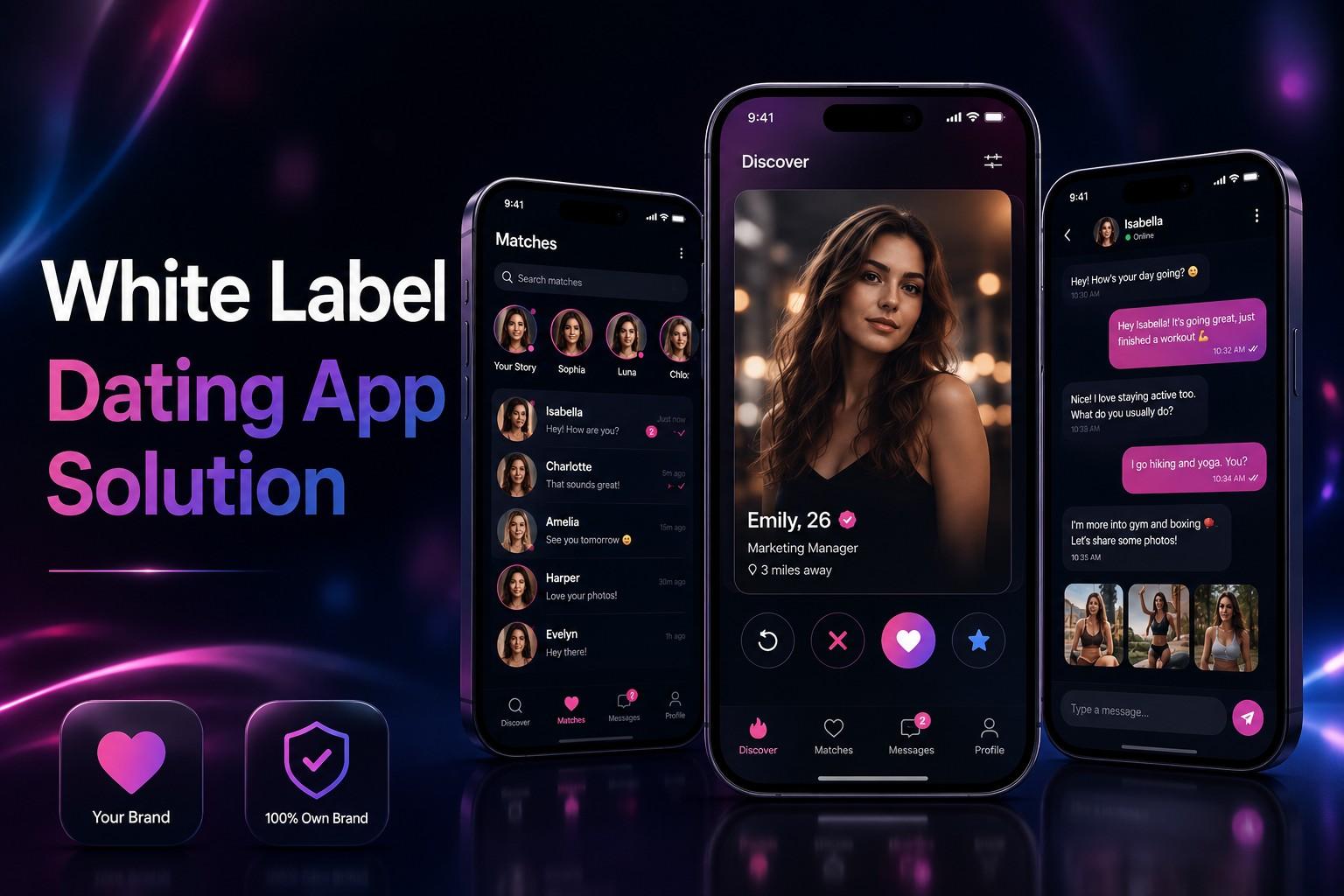
The global online dating industry is no longer a niche experiment. It's a multi-billion-dollar ecosystem that is growing faster than most tech verticals. According to recent market reports, the online dating market is projected to surpass $14 billion by 2027, driven by rising smartphone penetration, behavioral shifts in how people form relationships, and the explosive growth of AI-powered matchmaking.
For startup founders, entrepreneurs, and SaaS investors who are watching this space, 2026 is arguably the most strategic moment to enter the market. The barriers to entry have dropped dramatically. You no longer need a $500K development budget or a 12-month runway just to validate your dating app idea.
Why? Because white label dating app solutions have fundamentally changed the equation.
Today, you can take a proven, feature-rich dating app platform, brand it completely as your own, customize it for a specific niche or demographic, and launch it to market in a fraction of the time it would take to build from scratch. That is the core promise of white label app development with AI matchmaking, real-time video, and behavioral analytics baked right into modern platforms, the opportunity has never been more compelling.
This guide is built for founders who are serious about entering the online dating app business. We will walk you through everything from market trends and feature sets to technology stacks, cost structures, and step-by-step launch strategies. By the time you finish reading this, you will have a clear picture of exactly what it takes to build a scalable, profitable, AI-powered dating platform in 2026.
The Growing Demand for White Label Dating Apps in 2026
The dating app market is not just growing, it is diversifying at a remarkable pace. Users are increasingly leaving generalist platforms in favor of apps that speak directly to their identity, values, and lifestyle. This behavioral shift is creating a wave of opportunity for niche-focused dating app startups.
Online Dating Market Growth Is Accelerating
The numbers tell a clear story. The global online dating market saw consistent double-digit growth through 2022–2025, with mobile-first users now accounting for more than 85% of total engagement. The average adult now spends over 30 minutes per day across social and matchmaking platforms, and the demand for more meaningful, personalized connections is driving users away from swipe-fatigue apps toward smarter, AI-powered alternatives.
Venture capital has taken note. Dating app startups raised over $1.4 billion globally between 2022 and 2025, with investors particularly bullish on niche platforms serving underserved communities, think faith-based dating, professional matchmaking, LGBTQ+-specific platforms, and apps tailored to specific cultural backgrounds.
AI Matchmaking Is Redefining the Category
Artificial intelligence is no longer just a marketing term in the dating app space. It is the core infrastructure that separates great products from forgettable ones. Modern AI-powered matchmaking engines analyze hundreds of behavioral signals swipe history, message sentiment, profile engagement, time-on-screen metrics to deliver recommendations that feel genuinely intuitive.
This is where 2026 becomes a pivotal year. The cost of building AI infrastructure has dropped by orders of magnitude. What once required a dedicated data science team and months of model training can now be integrated into a white label dating app platform in days. For startups, this means you can compete directly with Tinder and Hinge on the quality of the core product experience without their development budgets.
Why Niche Dating Apps Are Winning
The era of one-app-fits-all dating is winding down. Today's most successful new dating platforms are built with radical specificity. Apps for farmers, pet owners, gamers, professionals over 40, vegans, and fitness enthusiasts are all demonstrating that niche audiences are not just willing to pay — they are intensely loyal when a platform genuinely serves their needs.
This is exactly the kind of market segmentation that makes a white label dating app strategy so powerful. You can take a fully built, technically robust platform and position it with surgical precision for the audience you know best, whether you are a community leader, a media brand, or a startup founder with domain expertise in a specific vertical.
What Is a White Label Dating App?
Before going deeper into strategy and execution, it is worth making sure the core concept is crystal clear, because there is still a lot of confusion around the term, even among technically sophisticated founders.
The White Label App Concept Explained
A white label app is a fully developed software product created by one company and then licensed to other businesses, who rebrand and sell it as their own. Think of it like private-label consumer goods, the product is manufactured in one place, but the branding, packaging, and distribution are entirely controlled by the buyer.
In the context of a white label dating app, this means a development company has already built the core infrastructure - user authentication, matching algorithms, messaging systems, subscription management, admin dashboards, and more — and you simply come in, apply your brand, configure your preferences, and deploy it to your users.
How White Label Dating App Solutions Work
The process typically looks like this. You license the platform from a white label dating app development company. They provide you with the full codebase or a hosted version of the product. You customize the UI to match your brand identity - colors, fonts, logo, onboarding flows. You configure key settings like matching algorithm preferences, subscription tiers, and geographic targeting. Then you submit to the app stores under your own developer account and launch.
The result is an app that looks, feels, and functions exactly like your product, because it is, by every meaningful definition.
Custom App vs. White Label App: What's the Real Difference?
This is one of the most common questions startup founders ask, and the answer depends heavily on your goals, timeline, and capital.
Building a dating app from scratch means starting with a blank codebase. You hire engineers, architects, and designers. You define your technical specifications from the ground up. You spend 9–18 months in development before you have anything to show users. And you accept the full technical risk of building complex systems real-time messaging, matching algorithms, payment infrastructure, without any proven track record.
A white label dating app solution, by contrast, gives you a tested, proven product with an established technical foundation. The matching logic works. The messaging is stable. The payment integrations are certified. Your job is to bring the market insight, the brand, and the go-to-market strategy.
Faster Go-to-Market Benefits
Speed matters enormously in startup competition. When a new dating niche opens up — say, a popular podcast creates a community around a specific lifestyle, the window to launch a branded app and capture that audience can be weeks, not months. White label solutions can compress your time-to-market from 12+ months to 8–12 weeks. That is a competitive moat in itself.
Business Scalability Advantages
White label platforms are typically built with enterprise-grade architecture from day one. This means you inherit the scalability benefits — load balancing, database sharding, microservices architecture, without having to engineer them yourself. As your user base grows from 1,000 to 100,000 to 1 million users, the platform is designed to scale with you.
Why Startups Prefer White Label Dating App Development
The strategic logic here is straightforward, but it deserves to be laid out clearly for founders who are weighing their options.
Faster Launch Means First-Mover Advantage
In almost every niche dating market, the first credible platform to launch wins a disproportionate share of the early user base. Early users are your most valuable assets — they generate the social proof, the reviews, and the word-of-mouth that makes organic growth possible. Getting to market 9 months before a competitor who decided to build from scratch can be a defining advantage.
Dramatically Reduced Development Cost
A custom-built dating app with a full feature set can cost anywhere from $150,000 to $500,000 or more, depending on complexity. A quality white label dating app solution typically costs a fraction of that — often in the $15,000 to $80,000 range for customization, setup, and licensing, depending on the platform and the level of customization required.
For seed-stage startups and early-stage investors, that cost differential is the difference between running a meaningful experiment and betting the entire company on a single product build.
Lower Technical Risk
Building a real-time dating platform from scratch is technically complex. Getting matching algorithms right, building reliable WebSocket-based chat infrastructure, handling media uploads at scale, managing payment flows across multiple regions — each of these is a significant engineering challenge on its own. White label solutions have already solved these problems. You inherit the solutions along with the platform.
Investor-Friendly MVP Strategy
When you are raising early funding, investors want to see traction. They want to see real users engaging with a real product. A white label approach lets you get to a credible MVP faster, which means you can generate the usage data that supports your fundraising narrative. A working app with 500 active users is infinitely more fundable than a Figma prototype and a pitch deck.
Scalable Infrastructure from Day One
Modern white label dating app platforms are built on cloud-native infrastructure AWS, Google Cloud, or Azure with auto-scaling built in. You are not starting with a monolithic system that will need to be refactored the moment you get traction. You start with architecture that is designed to grow.
Key Features of a Modern White Label Dating App
Feature completeness is not just about having a long list of capabilities. It is about having the right features, implemented correctly, in a way that drives genuine user engagement and long-term retention. Here is what a best-in-class white label mobile dating app should include in 2026.
AI-Powered Matchmaking Engine
The core of any modern dating platform. AI matchmaking goes beyond simple demographic filters. It analyzes user behavior, who they swipe on, how long they look at profiles, which conversation starters they respond and continuously refines recommendations to increase the probability of meaningful connections.
Swipe Matching Interface
The swipe mechanic popularized by Tinder has become a universal UX pattern. Users expect it. A modern white label dating app should implement it fluidly, with smooth animations and fast server-side processing so there is no noticeable lag even on older devices.
Geolocation-Based Discovery
Location-aware matching is table stakes for any dating app in 2026. Users want to find people who are genuinely close to them. The feature should support configurable radius settings, location spoofing protection, and the ability to disable location sharing for privacy-conscious users.
Video Calling and Voice Chat
Post-pandemic user behavior has permanently elevated expectations for in-app communication. Users want to move from text to voice to video without leaving the app. Integrating WebRTC-based video and voice capabilities is no longer optional, it is a standard feature that directly impacts match conversion rates.
Real-Time Messaging
The messaging infrastructure is often the most technically demanding component of a dating platform. It needs to support high concurrency, message delivery receipts, typing indicators, media sharing, and emoji reactions all in real time. Quality white label platforms handle this with battle-tested WebSocket or long-polling architectures.
Profile Verification System
Trust is the foundation of any successful dating platform. Profile verification via phone number, email, ID document, or selfie matching dramatically reduces fake account creation and builds confidence among legitimate users. AI-powered liveness detection is increasingly common in premium platforms.
Subscription System and In-App Purchases
Monetization flexibility is critical. A quality platform should support multiple subscription tiers free, premium, and elite as well as one-time purchases like message credits, profile boosts, and virtual gifts. Integration with Stripe, Apple Pay, and Google Pay should be seamless.
Safety Features and Reporting Tools
Dating apps carry unique safety responsibilities. Essential features include user blocking, conversation reporting, automated content moderation, and increasingly real-time AI screening for abusive language and inappropriate content. Platforms that take safety seriously retain users longer and attract better press coverage.
Admin Dashboard and Analytics
Operators need full visibility into platform health. A robust admin panel should include user management, content moderation queues, subscription analytics, revenue reporting, and engagement metrics all accessible from a single interface.
Push Notification Engine
Timely, relevant push notifications drive re-engagement. A good platform should support deep linking from notifications, personalized message previews, and smart throttling to prevent notification fatigue.
AI Features That Will Dominate Dating Apps in 2026
Artificial intelligence is not just enhancing dating apps. it is fundamentally restructuring how they work. Here are the AI capabilities that will define the best-performing platforms over the next two years.
Behavioral Analytics and Dynamic Matching
The next generation of matchmaking does not rely on static profiles. It watches how users behave over time, which profiles they engage with longest, what kinds of conversations lead to phone number exchanges, how user preferences evolve as they gain experience on the platform and uses this data to continuously refine recommendations.
AI Chat Assistants and Icebreaker Suggestions
One of the most persistent problems in online dating is the blank-page problem, users match, and then nobody knows what to say. AI chat assistants that analyze both users' profiles and suggest personalized, contextually appropriate conversation starters are proving to dramatically increase message response rates.
Smart Profile Recommendations
AI recommendation engines can go beyond matching users to each other. They can recommend profile improvements, better photo selections, more engaging bio language, optimal times to be active on the platform - that increase a user's overall match rate.
AI-Powered Fraud Detection
Fake profiles and romance scam accounts are among the most damaging problems a dating platform can face. Modern AI fraud detection systems analyze account creation patterns, behavioral anomalies, and image fingerprints to identify and remove fake profiles before they interact with real users.
Predictive Matchmaking Models
Rather than waiting for users to swipe on each other, predictive models can proactively surface connections that have a high probability of mutual interest even before either user has encountered the other. This dramatically improves the efficiency of the matching process and increases the perceived value of the platform.
AI Content Moderation
Automated moderation of profile photos, messages, and user-generated content is becoming essential as platforms scale. AI vision models can flag inappropriate images for human review, and natural language processing can identify abusive or harassing messages in real time.
Hyper-Personalized User Experiences
In 2026, the best dating apps will feel genuinely personal to each user. AI personalization touches everything, the order in which profile cards are displayed, the timing and content of push notifications, the pricing of subscription prompts, and even the visual layout of the interface based on demonstrated user preferences.
White Label Dating App vs. Tinder Clone vs. Hinge Clone: Strategic Comparison
One of the first decisions you will face as a dating app startup founder is how to frame your product development approach. Here is a clear breakdown of the three most common options.
Factor | White Label Dating App | Tinder Clone | Hinge Clone |
Development Time | 4–10 weeks | 3–6 months | 4–7 months |
Cost Range | $15K–$80K | $80K–$250K | $100K–$300K |
Feature Completeness | Comprehensive, ready-to-deploy | Needs customization | Needs customization |
Scalability | Enterprise-grade from day one | Depends on build quality | Depends on build quality |
Branding Flexibility | Full white-label customization | Full custom | Full custom |
Monetization Options | Multiple, pre-integrated | Requires custom dev | Requires custom dev |
Startup Suitability | MVP to growth stage | Growth to scale | Growth to scale |
Technical Risk | Low (tested platform) | High (new build) | High (new build) |
AI Integration | Pre-integrated or plug-in | Requires custom integration | Requires custom integration |
Time to First Revenue | Weeks | Months | Months |
Strategic Insight for Founders
A tinder clone or hinge clone development approach makes sense when you have specific, non-negotiable product requirements that diverge significantly from any existing platform, and when you have both the capital and the timeline to execute a full custom build. These approaches give you maximum control but come with maximum risk and cost.
A white label dating app platform makes sense for the vast majority of early-stage dating app startups. You get to market faster, you spend less capital on infrastructure, and you can focus your resources on what actually matters in the early stage, acquiring users, building community, and refining your niche positioning.
Many successful dating platforms started with white label foundations and then invested in custom differentiation over time, as revenue and user data justified the additional development investment.
Business Models for White Label Dating Apps
Monetization strategy is one of the most underrated components of dating app planning. The good news is that dating apps are one of the few consumer app categories where users are genuinely willing to pay both for subscriptions and for in-app purchases. Here are the models that work in 2026.
Subscription Plans and Premium Memberships
The subscription model is the backbone of most successful dating app businesses. A tiered structure free access with limited swipes, premium access with unlimited matching, and an elite tier with concierge features allows you to convert users at multiple price points. In 2026, annual subscription packages are particularly effective, as they dramatically reduce churn and improve LTV.
In-App Purchases and Feature Unlocks
Beyond subscriptions, one-time purchases are powerful revenue drivers. Profile boosts (appear at the top of discovery queues for 30 minutes), super likes, message credits for pay-per-message models, and profile highlights all convert well among users who want targeted advantages without a full subscription commitment.
Virtual Gifts and Social Currency
Virtual gift economies are particularly effective in markets like Southeast Asia and Latin America. Users purchase digital tokens and send virtual roses, chocolates, or animations to other users. The gifting mechanic drives engagement and creates a meaningful social layer on top of the matching experience.
Advertising and Sponsored Content
For free-tier users, tastefully integrated advertising — particularly from brands that align with the dating context (restaurants, fashion, fitness) can generate meaningful revenue without degrading the user experience. Programmatic ad integrations should be configured carefully to avoid disrupting the core matching flow.
Pay-Per-Match and Concierge Models
Premium positioning in specific markets particularly professional matchmaking for users over 35 can support a pay-per-introduction or pay-per-curated-match model at significantly higher price points. This positions your app as a premium service rather than a mass-market product.
Creator Economy Integrations
An emerging trend in 2026 is the integration of creator economy mechanics into dating apps. Verified creators, relationship coaches, lifestyle influencers, matchmakers can offer premium content, group video events, and one-on-one sessions through the platform, taking a revenue share. This creates a content moat that is difficult for competitors to replicate quickly.
Technology Stack for White Label Dating App Development
Understanding the technology architecture behind a modern dating platform helps you ask the right questions when evaluating white label dating app development companies, and helps you make informed decisions about customization priorities.
Frontend Technologies
React Native is the dominant choice for cross-platform mobile development in 2026, offering near-native performance with a single codebase that targets both iOS and Android. Flutter is a strong alternative, particularly for teams with strong Dart expertise. The key requirements are smooth animation performance (critical for swipe interfaces), fast image loading, and reliable real-time state management.
Backend Technologies
Node.js with Express or Fastify handles high-concurrency API workloads efficiently. Python is increasingly common for AI and ML service layers. GraphQL is growing as the API layer of choice for complex, data-rich dating app frontends. Microservices architecture with separate services for user management, matching, messaging, and payments provides the modularity needed for safe, independent scaling.
Cloud Infrastructure
AWS is the most common cloud provider for dating app infrastructure, with Google Cloud a close second. Key services include EC2 or ECS for compute, RDS or Aurora for relational data, DynamoDB or Redis for session and cache layers, S3 for media storage, and CloudFront for global content delivery. Load balancing with Application Load Balancers and auto-scaling groups ensure the platform handles traffic spikes gracefully.
AI and Machine Learning Stack
TensorFlow and PyTorch power the training pipelines for matching models. Scikit-learn handles lighter classification and clustering tasks. OpenAI API integrations are increasingly common for natural language features like chat assistants, bio suggestions, and sentiment analysis. Vector databases like Pinecone or Weaviate are emerging as critical infrastructure for similarity-based matching at scale.
Real-Time Chat Stack
WebSocket-based messaging typically built on Socket.io for Node.js applications provides the foundation for real-time communication. For platforms expecting millions of concurrent connections, Apache Kafka handles the message queue layer, ensuring reliable delivery even under extreme load. Firebase Realtime Database is a viable option for earlier-stage platforms.
Payment Gateway Integration
Stripe is the global standard for web-based payment processing, with strong support for subscriptions, one-time charges, and multi-currency billing. Apple In-App Purchase (IAP) and Google Play Billing are mandatory for native mobile apps. Revenue Cat is an increasingly popular middleware layer that simplifies cross-platform subscription management significantly.
Security Stack
SSL/TLS encryption across all communications is baseline. API authentication via OAuth 2.0 and JWT tokens is standard. AWS WAF or Cloudflare handle DDoS protection and bot mitigation. GDPR and CCPA compliance tooling consent management, data deletion workflows, audit logging is non-negotiable for platforms targeting European or North American markets.
Step-by-Step Process to Launch a White Label Dating App
Here is a practical, experienced-operator roadmap for taking your dating app from concept to launch in 2026.
Step 1: Conduct Deep Market Research
Before committing to a niche, validate it rigorously. Analyze existing apps in your target category. Read user reviews obsessively the 1-star and 2-star reviews are your product roadmap. Identify the most common complaints and unmet needs. Use Google Trends, Reddit communities, and niche Facebook groups to gauge the depth of the market opportunity. Define your target demographic with precision age, location, income, lifestyle, and relationship goals.
Step 2: Define Your Niche and Positioning
Generic dating apps are a venture graveyard. Niche apps win. Your niche should be specific enough that users feel the app was built for them, but large enough to support a viable business. Good niche examples include: professionals in specific cities, hobby communities with large followings, religious groups underserved by mainstream apps, and age-specific segments (50+, 30-45 professionals).
Step 3: Select Your White Label Dating App Platform
Evaluate platforms on four dimensions: feature completeness, customization flexibility, scalability ceiling, and vendor support quality. Ask potential partners for references from live deployments. Review their architecture documentation. Understand exactly what is and is not customizable. Clarify intellectual property ownership before signing any agreement.
Step 4: UI/UX Customization and Brand Design
This is where your app becomes distinctly yours. Work with the development team to apply your brand identity - logo, color system, typography, illustration style, and photography guidelines consistently throughout the interface. Invest in great onboarding flows; first impressions drive activation rates more than almost any other product decision.
Step 5: AI Feature Integration and Configuration
Configure the AI matching parameters for your specific niche. A faith-based dating app will weight different behavioral signals than a fitness-focused platform. Work with the development team to set initial model parameters and establish a feedback loop for continuous improvement as user data accumulates.
Step 6: Branding and Content Strategy
Your app brand extends beyond the UI. Create a clear brand voice and content strategy for your app store listing, social media presence, and in-app copy. First-time users should feel immediately that this platform was built for people like them in the language, the imagery, and the overall aesthetic.
Step 7: Quality Assurance and Beta Testing
Run structured QA across devices, operating system versions, and connection types. Beta test with a small cohort of real users in your target demographic 50 to 200 people is typically sufficient to surface the most critical issues. Pay particular attention to the matching flow, the messaging experience, and the subscription purchase flow.
Step 8: App Store Submission and Deployment
Prepare your App Store and Google Play listings carefully. App store optimization (ASO) keyword-rich titles and descriptions, high-quality screenshots, a compelling preview video significantly impacts organic discoverability. Submit for review with adequate lead time; Apple reviews can take 1–5 business days.
Step 9: Marketing Launch Strategy
Plan a coordinated launch across your most relevant channels. For niche dating apps, community-specific channels typically outperform generic digital advertising dramatically. Podcast sponsorships in adjacent niches, influencer partnerships with authentic followings in your target demographic, and targeted Reddit or Facebook group outreach can drive highly qualified early user acquisition.
Step 10: Scaling Strategy and Growth Operations
After launch, your focus shifts to growth economics. Track your key metrics obsessively daily active users, match rate, message rate, subscription conversion rate, and 30-day retention. Use these metrics to inform product iteration decisions. Invest in the features and improvements that measurably move the metrics that matter most to your business.
How Much Does White Label Dating App Development Cost in 2026?
Cost transparency is important. Here is an honest breakdown of what you should expect to invest at different stages.
Development Stage | Cost Range | What's Included |
MVP / Basic White Label | $4,000 – $8,000 | Core matching, messaging, profiles, basic subscription |
Standard Launch Package | $8,000 – $15,000 | Full feature set, AI matching, video chat, admin panel |
Advanced AI Platform | $15,000 – $25,000+ | Custom AI models, behavioral analytics, fraud detection |
Enterprise / Custom Build | Custom Pricing | Full custom architecture, proprietary AI, multi-region |
Monthly Maintenance | $500 – $2,500/month | Bug fixes, security updates, feature additions |
Cloud Infrastructure | $200 – $2,000/month | Scales with user base and media storage needs |
Marketing & UA | $1,000 – $15,000+/month | Highly variable based on channels and market |
The most important insight here is that the white label path dramatically compresses the cost of getting to market with a quality product. An MVP that would cost $250,000 to build from scratch can be deployed for $25,000–$50,000 using a quality white label dating app platform.
The investment difference is capital that stays in your marketing budget, your community building efforts, and your runway.
Challenges in Dating App Development
No honest guide would be complete without addressing the real challenges you will face. Forewarned is forearmed.
User Retention Is the Hardest Problem
Dating apps have a uniquely self-defeating success model — when the app works and users find a relationship, they leave. The best platforms offset this with social features, community content, and relationship maintenance tools that keep users engaged even after matching.
Fake Profiles and Trust Infrastructure
Fake profiles erode user trust rapidly and are particularly damaging in the early days when your community is small. Invest in verification infrastructure early, even if it adds friction to the onboarding process. Users will accept friction for safety; they will not tolerate fake matches.
User Acquisition Is Capital-Intensive
Dating apps are two-sided marketplaces with a notorious cold-start problem. You need both men and women (or both sides of any demographic equation) simultaneously to create value. This typically requires significant upfront user acquisition investment in parallel with launch.
Monetization Competition From Free Alternatives
Your subscription model competes against apps with massive free tiers. The key is to make your premium value proposition so compelling and so aligned with your niche that users feel the upgrade is genuinely worthwhile not just access to the same features with the ads removed.
Security and Data Privacy Obligations
Dating apps collect some of the most sensitive personal data imaginable. GDPR compliance in Europe, CCPA in California, and equivalent regulations in dozens of other markets create real legal obligations. Build compliance into your architecture from day one, not as an afterthought.
Scaling Without Degrading Experience
A sudden viral moment a feature in a major publication, a celebrity mention and can send your user registration rate through the roof in 24 hours. Ensure your infrastructure is ready to handle 10x your expected launch volume without service degradation.
Why Choose CloneAppz for White Label Dating App Solutions?
Choosing the right technology partner can define the success or failure of your dating app startup. In a market where speed, scalability, user experience, and AI-driven personalization matter more than ever, founders need more than just a development agency — they need a long-term product partner.
At CloneAppz, we help startups, entrepreneurs, and SaaS businesses launch scalable, AI-powered white label dating app platforms designed for real-world growth. From Tinder-style swipe experiences to advanced matchmaking ecosystems inspired by platforms like Hinge, our team focuses on building products that are not only visually polished but also technically prepared for long-term scale.
Proven Expertise in Dating App Development
Our team understands the unique infrastructure challenges behind dating platforms — real-time messaging, matchmaking logic, profile verification, subscription systems, push notifications, and user engagement optimization. Instead of starting from scratch, we provide feature-rich white label dating app solutions that significantly reduce development time and launch risk.
Fully Customized Branding & UI/UX
A successful dating app should never feel generic. CloneAppz helps businesses create a completely customized user experience tailored to their niche audience. Whether you are building a professional matchmaking platform, a faith-based dating app, or a community-focused social dating product, we customize the UI, onboarding flows, branding, and feature experience to match your vision.
AI-Powered Matchmaking Features
Modern dating apps are increasingly driven by behavioral intelligence and AI personalization. Our platforms support advanced AI features such as smart matchmaking, behavioral recommendations, engagement analytics, fraud detection, and intelligent user suggestions designed to improve retention and match quality.
Scalable Architecture Built for Growth
Many startups fail because their infrastructure cannot handle rapid growth. CloneAppz develops white label dating app platforms using scalable cloud architecture designed to support growing user bases, high concurrency, media-heavy engagement, and real-time communication without performance bottlenecks.
Faster Time-to-Market for Startups
Building a dating app from scratch can take months of development and significant upfront investment. Our white label dating app development approach helps startups launch faster with proven infrastructure, pre-built core features, and reduced technical complexity — allowing founders to focus on growth, branding, and user acquisition.
Ongoing Support & Feature Enhancement
Launching the app is only the beginning. Our team provides ongoing maintenance, technical support, feature upgrades, performance optimization, and scalability assistance to help businesses evolve their platform as market demands change.
Flexible Solutions for Startups & Enterprises
Whether you need a lightweight MVP, a Tinder clone, a Hinge-inspired relationship app, or a fully customized AI-powered matchmaking platform, CloneAppz offers flexible development solutions tailored to your business goals, target audience, and scaling strategy.
Future Trends in White Label Dating Apps
The platforms being built today in 2026 will look quite different from those of 2024 — and the ones built in 2028 will look different again. Here are the trends that sophisticated founders should be tracking and planning for.
AI Relationship Assistants
The next evolution beyond AI matchmaking is AI relationship assistance — tools that help matched users build better connections, navigate difficult conversations, and develop relationship skills. Apps that take this role seriously will create a category that is fundamentally different from traditional dating apps.
AR/VR and Metaverse Dating Experiences
Spatial computing is finding its first genuine consumer use cases, and dating is one of them. Virtual date environments shared spaces where matched users can explore digital experiences together are moving from novelty to meaningful product feature. As hardware costs decline, this will become a meaningful differentiator.
Voice-First Interactions
Voice interfaces are growing in importance across consumer software, and dating apps are no exception. Voice-first features audio profiles, voice messages, AI voice matching and add a dimension of authenticity that text and photos cannot capture. Platforms that integrate voice well will see higher match quality and engagement.
Blockchain Identity Verification
Blockchain-based identity verification promises a future where profile authenticity is cryptographically guaranteed rather than simply encouraged. While still early-stage for mainstream dating apps, platforms serving premium or professional audiences are beginning to integrate decentralized identity tools.
Hyper-Personalization at Every Touchpoint
The direction of travel is clear: every aspect of the dating app experience will become increasingly personalized to the individual user. The profiles they see, the notifications they receive, the premium features they are offered, and the content surfaced in their feed will all be dynamically shaped by AI models that understand each user's unique preferences and behavioral patterns.
Conclusion
The opportunity to build a thriving dating app business in 2026 is real, and it is significant. The market is large, growing, and actively diversifying into niches that are waiting for the right product with the right brand to serve them.
White label dating app solutions have lowered the barrier to entry to the point where a focused entrepreneur with a genuine market insight and a reasonable starting budget can launch a credible, feature-complete, AI-powered dating platform in weeks rather than years.
The founders who will win in this space are not the ones who spend the most money on engineering. They are the ones who understand their audience most deeply, move fastest to serve that audience, and build real community around their platform rather than just a matching algorithm.
The technical infrastructure is available. The market is ready. The AI tools are more powerful and accessible than they have ever been.
2026 is not a moment to wait and see. It is a moment to build.
Frequently Asked Questions
01What is a white label dating app and how does it work?
A white label dating app is a fully developed, ready-to-deploy dating platform that you can license, brand as your own, and launch to your target audience. The core infrastructure — matching engine, messaging, profiles, subscriptions — is already built. You customize the brand identity, configure the product settings, and launch under your own name without building from scratch.
02How long does it take to launch a white label dating app?
Most white label dating app solutions can be customized, tested, and deployed to app stores in 4–10 weeks, depending on the level of customization required. This compares to 9–18 months for a fully custom-built dating app.
03Can I build a niche dating app using a white label platform?
Absolutely. White label dating app platforms are designed for brand and configuration customization. You can position the app for any niche — faith-based dating, professional matchmaking, LGBTQ+ communities, specific age groups, hobby groups — while leveraging the same underlying technical infrastructure.
04How do white label dating apps make money?
The most effective monetization models for dating apps include tiered subscriptions (free, premium, elite), in-app purchases (boosts, super likes, virtual gifts), advertising for free-tier users, pay-per-match for concierge models, and creator economy features like coaching sessions. Most successful apps combine two or three of these models.
05Is it possible to launch a dating app without technical experience?
Yes. Working with a quality white label dating app development company means you do not need engineering expertise to launch. The development team handles all technical architecture, deployment, and ongoing maintenance. Your focus should be on market strategy, community building, and user acquisition.
06Can a white label dating app scale to millions of users?
Yes, when built on enterprise-grade infrastructure. Quality white label platforms use cloud-native architecture with auto-scaling, load balancing, and distributed database systems designed to handle millions of concurrent users. Discuss scalability architecture explicitly with your development partner before committing to a platform.