On-Demand Delivery Platforms: A B2B Launch Guide
Launch on-demand delivery platforms faster with white-label apps. See how they work, their costs, revenue models, and verticals. Get a quote from CloneAppz.
By CloneAppz Team11 min read
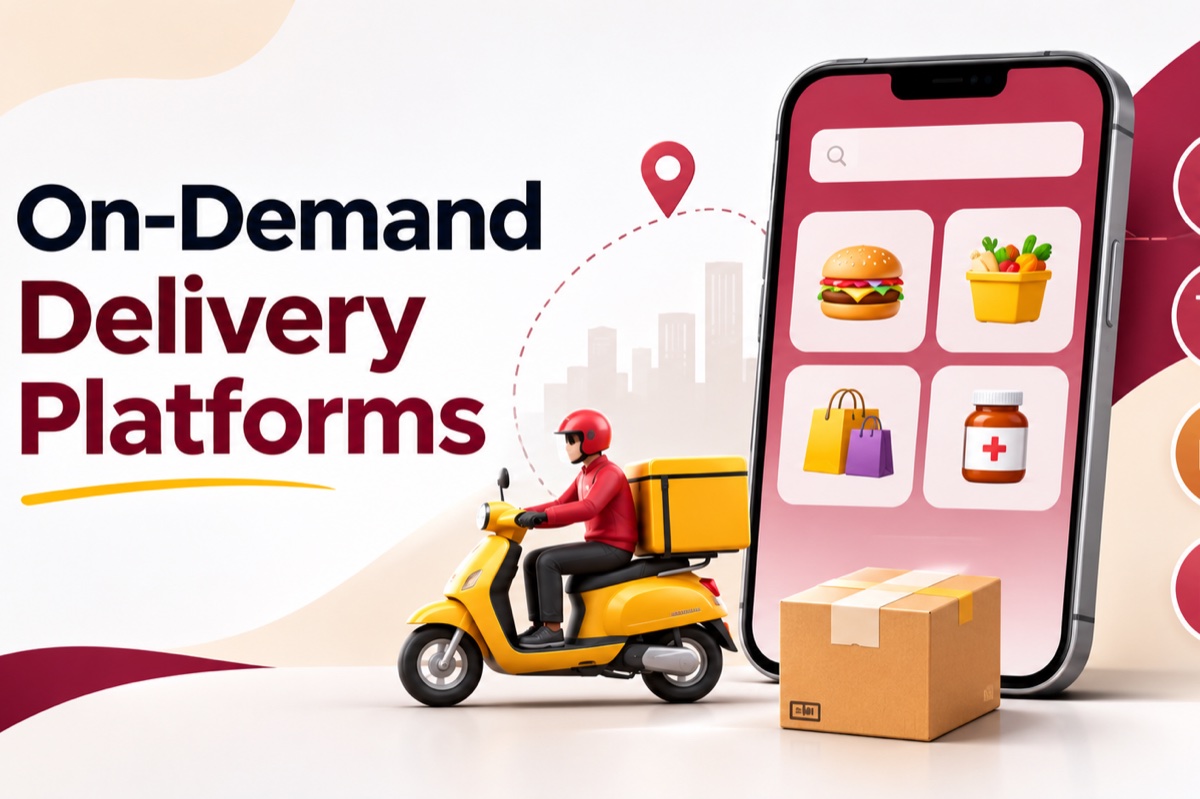
Buyers now expect doorstep fulfillment in minutes. It is a prime reason why on-demand delivery platforms are in demand. The global delivery market is projected at about $1,415B by 2034. Food delivery alone is expected to increase to $1,854.5B by 2029.
While delivery-based businesses are growing, the majority of service providers are not getting enough ROI. The major reason behind this is that the aggregators that provide delivery services charge 15 to 30% commission, and some operators report 25 to 35%.
Along with charging a major stake, aggregators also keep the customer data, so you can't build retention.
The roadblock for delivery-based businesses is the higher development and maintenance cost of custom building the software. Maintenance cost usually runs 15–20% of the original development cost per year.
So, what's the solution here? Launch branded on-demand delivery apps on a white label base, then add APIs and AI as you grow. If you are a founder, retail chain, pharmacy, logistics firm or agency, then this blog is for you.
Understanding On-Demand Delivery Platforms, and Why Do Businesses Invest in Them
On-demand delivery platforms connect customers, merchants, couriers and admins for time-bound orders. Restaurants, grocers, pharmacies, liquor retailers, courier firms and reselling agencies use on-demand delivery apps to fulfil orders.
What is the reason why businesses invest in these platforms? The answer is simple, because consumers demand it. 52% of US consumers, including 67% of millennials and 63% of Gen Z adults, say that order delivery and takeout is essential to their lifestyle.
Remember, on-demand delivery platforms are different from ecommerce platforms. These platforms are built around real-time operations, not catalogues and checkout.
What are the Pains and Gains of On-Demand Delivery App Development?
- Business pains: dependence on aggregators for orders and visibility.
- Business gains: you keep margin, customer data and the brand relationship.
Read along to find out how an on-demand delivery platform works.
How On-Demand Delivery Apps Work: One Platform, Four Connected Apps
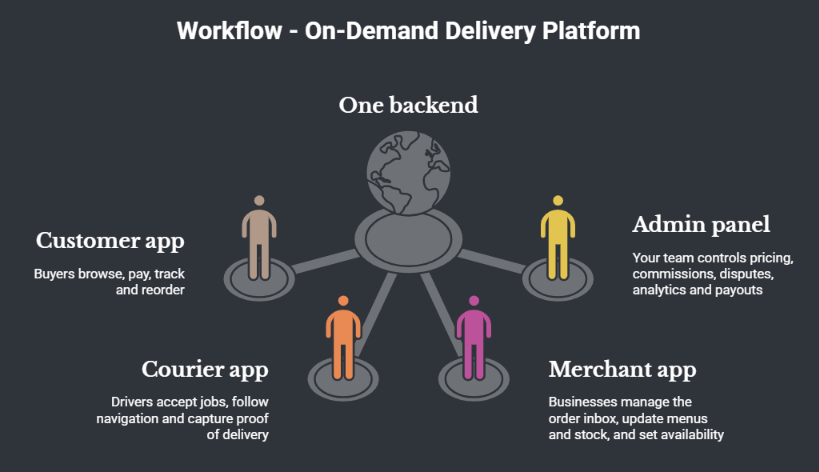
On-demand delivery apps work as four connected layers. Each layer serves one group, and a shared backend keeps them in sync. Together, they form a complete on-demand delivery platform.
- Customer app: Buyers browse, pay, track and reorder.
- Courier app: Drivers accept jobs, follow navigation and capture proof of delivery.
- Merchant app: Businesses manage the order inbox, update menus and stock, and set availability.
- Admin panel: Your team controls pricing, commissions, disputes, analytics and payouts.
Here is how an order moves through these layers.
- First, the customer places an order and pays.
- Next, the system dispatches the best available courier.
- Then live tracking updates both the customer and the merchant.
- After delivery, the platform settles payment and pays out the courier and merchant.
- If something goes wrong, the admin panel handles the refund or dispute.
Real-time technology holds this flow together. GPS tracks couriers, WebSockets stream live updates, and push notifications keep everyone informed.
This visibility also helps retention. Customers who can see where their order is tend to forgive a late delivery more easily than customers left guessing.
Most platforms build the customer and courier apps separately. Their needs differ. One app favours quick ordering, while the other favours fast task handling.
Which Businesses Can Launch a White Label Delivery App?
You must know that a white label delivery app is a ready platform launched under your brand. You own the branding, pricing, catalogue and customer relationship.
If you are one of the following, then consider investing in on-demand delivery app development:
- Startups
- Chains
- Pharmacies
- Agencies
- Logistics firms
However, the industry you serve changes the development, as the compliance, inventory and verification rules differ for each vertical.
Some features stay the same everywhere. These include live tracking, payments, notifications and the admin panel. The vertical adds the rest: prescription checks for medicine, age verification for liquor, stock sync for grocery.
You can also start in one category and add others later on the same platform.
Let's look at four verticals, starting with food.
White Label Food Delivery App
On-demand food delivery platforms are highly useful for restaurant chains, cloud kitchens, and local aggregators. Cut the aggregator commission and have complete control over customer data with on-demand food delivery platforms.
The core features in a white-label food delivery app are menu management, combos and bundle offers, flexible delivery time slots, real-time order inbox, and loyalty and rewards programs.
Smooth integration and synchronization of delivery platforms with point-of-sale systems is one of the major technical risks and challenges. We at CloneAppz aim to solve it by checking which billing system the restaurant uses. Then we connect the app to it, test real orders, fix mistakes, and keep watching so orders never go missing.
Check out how we develop an Uber clone.
Busy hours can overwhelm any kitchen. A good delivery app handles this by hiding slow items or moving them lower on the menu when orders pile up. Customers then see dishes the kitchen can make quickly, which means fewer delays and fewer cancelled orders.
This matters even more for cloud kitchens, since they have no dining room, so every sale comes through the app. They need ordering that is lean, quick to set up and easy to scale as demand grows.
White Label Grocery Delivery App
Get a white label grocery delivery app if you are a supermarket, grocer, or subscription milk and staples seller. With real-time inventory sync across stores, an on-demand grocery delivery platform reduces the chances of order cancellations, as the stock is always enough.
Grocery orders change by the minute, so the app has to keep up. When an item runs out, the app suggests a similar one. The customer can then accept or decline it, which avoids unpleasant surprises at the door. Scheduling works the same way.
Shoppers pick a delivery time that suits them, and the app saves their usual list for next time. Fruit, vegetables and meat are sold by weight, so the app also needs to price items by weight and handle baskets of any size.
Speed matters just as much. For ultra-fast delivery, the app sends each order to the nearest small warehouse that has the items in stock. As a result, orders arrive sooner and fewer items go missing.
Monthly plans add another benefit. Daily milk or weekly staples, for instance, bring steady income every month.
Best of all, these features build loyalty. After the first order, a one-tap reorder brings customers back without any extra marketing cost.
White Label Medicine Delivery App
Pharmacies, pharmacy chains, or health retailers are concerned about regulations, trust and accuracy more than delivery speed.
Considering the same, white label medicine delivery apps must have a provision and workflow to upload and validate prescriptions by licensed pharmacists before dispatch.
The platform must remind procurement or inventory managers about stock refills and repeat prescriptions. Additionally, the platform must cater to GDPR, DPDP or HIPAA regulations, depending on the region.
White Label Liquor Delivery App
More than any other kind of business, licensed liquor stores, breweries, and beverage distributors need a white label liquor delivery app.
Selling alcohol online carries real legal risk. If an age check fails, the business can face fines or even lose its licence. A good app therefore checks age twice. First, it verifies the customer at sign-up. Then the courier checks again at the doorstep by scanning an ID or taking a photo as proof.
The app also follows local licence rules. It shows only the stock each area is allowed to sell, and it blocks orders from places where delivery is not permitted. Delivery times can match local rules as well. In some places, payment options are limited too, such as cash on delivery.
However, rules vary by state and country. Check your local law before launch.
Strong safety tools also protect your brand. Every verified order shows customers and regulators that you take compliance seriously, which builds trust and keeps your reputation safe.
Build Custom, Buy Ready-Made, or Go White Label
Your approach to on-demand delivery app development shapes your budget, speed and control. You can build custom, buy ready-made, or go white label. Custom development suits businesses with a unique idea and a big budget. Meanwhile, ready-made software works for quick, basic launches. White label sits in between, giving you a tested base under your own brand.
Agencies report about $30,000 to $80,000 for a feature-rich MVP, and $60,000 to $80,000 for typical food delivery builds. Running costs follow, since maps, SMS and upkeep, often 15 to 20% of build cost yearly, add up.
Some agencies warn that white label limits standing out. That risk is fair. However, an extensible base lets you add features later without starting over.
Choose white label if speed matters most. Choose custom if your idea needs unique features. Next, we compare both routes.
White Label vs Custom Delivery App Development
Factor | White Label | Custom Development |
Speed to launch | Faster, since the core platform is already built | Slower, since everything is built from scratch |
Upfront cost | Lower | Higher |
Brand control | Full control over name, logo, colours and look | Full control over every part of the experience |
Code ownership and customisation depth | Depends on the provider; usually deep changes within the existing base | Complete ownership and freedom to change anything |
Scalability | Scales well if the base is built to grow | Scales as far as your team builds it |
Compliance flexibility by vertical | Strong when the provider offers rules for each vertical | Fully tailored, but you build every rule yourself |
Integration freedom | Good with supported tools; new ones may need extra work | Open to any tool you choose |
Differentiation risk | Higher, since the base is common | Lower, since the product is unique |
Best for | Startups, chains, pharmacies and agencies that want to launch fast and test demand | Businesses with a unique idea and a larger budget and timeline |
How Do On-Demand Delivery Platforms Make Money?
Here are the revenue models and how to choose the right mix.
Commission on Every Order
The platform keeps a share of each order, often 15 to 30%. DoorDash, for example, charges restaurants within that range. It is simple, scales with sales, and suits marketplace models.
Delivery and Service Fees
Customers pay a delivery fee, either flat or based on distance. Many platforms add a small service fee too. Together, these fees cover courier costs and add steady extra income.
Subscriptions for Free Delivery and Perks
Customers pay a monthly fee for free delivery and special perks. Regular shoppers enjoy the savings. This builds loyalty, encourages repeat orders, and gives the business predictable income every month.
Promoted Listings and In-App Ads
Merchants can pay to appear higher in search results and win more orders. Brand partners can also advertise inside the app. Both add income without raising customer prices at all.
Surge Pricing During Busy Hours
Prices rise slightly when demand spikes, such as during rain or a dinner rush. This draws more couriers onto the road and helps the platform keep delivery times fast for everyone.
White Label Licensing for Agencies
Agencies can license a white label platform and resell it to clients under each client's brand. This creates a fresh and steady revenue stream without building the product from scratch.
Choosing the Right Mix for Your Vertical
Large marketplaces usually combine commission with ads. Niche local players often prefer fees plus subscriptions. Whatever you pick, build flexible billing so you can change models later without a rebuild.
Conclusion: Turn Your Delivery Idea Into a Launch Plan
Launching on-demand delivery platforms comes down to three decisions: your revenue model, your vertical and your build route.
A white label base saves time and cost while keeping your brand fully yours. From there, launch an MVP first, add integrations next, and bring in AI when you are ready. Compliance-heavy verticals like medicine and liquor need extra care, so plan for them early.
Start with three steps: pick a vertical, define your MVP development scope and shortlist your integrations. Because you scale only after proof, risk stays low.
Explore our white label delivery app solutions and see what's possible. Your launch plan starts now. Check out the right cost for your on-demand delivery app development.
Build it with CloneAppz
White Label Delivery App
Multi-industry on-demand delivery platform
Frequently Asked Questions
01What are on-demand delivery platforms?
On-demand delivery platforms are digital systems that connect customers, merchants and couriers for fast orders. They run on four apps: customer, courier, merchant and admin. Common verticals include food, grocery, medicine and liquor.
02How do on-demand delivery apps make money?
They earn through commission on each order, delivery and service fees, and monthly subscriptions. Many also sell ads and promoted listings. The best mix depends on the vertical, so choose models that fit your customers.
03How much does it cost to build an on-demand delivery app?
We can develop an on-demand delivery platform for you at a cost of $5,000 to $35,000. Features, vertical rules, integrations and upkeep drive the cost. For an exact number, request a custom quote.
04What is a white label delivery app?
A white label delivery app is a ready-made platform you launch under your own brand. You can customize the name, logo, colours and workflows. It saves time and cost compared with building from scratch.
05White label or custom delivery app: which is better?
Choose white labelling for speed and budget, and custom for unique features. A hybrid path works well: launch white label, then add custom features. Some agencies warn of a later rebuild, so pick an extensible base.
06What features must an on-demand delivery app have?
Customers need browsing, payments and live tracking. Couriers need job alerts, navigation and proof of delivery. Merchants need an order inbox and stock controls. An admin panel ties it together with pricing, payouts and reports.
07How long does it take to launch a delivery app?
Agencies often cite three to four months for an MVP, though this varies by features and vertical. Launch lean first, then expand. See our launch roadmap for the full steps.
08Can I add AI and API integrations to a white label delivery app?
Yes. Start with an MVP, add integrations such as payments, maps and messaging next, and bring in AI when you are ready. Examples include smart dispatch, delivery time estimates and personalised offers.