Fitbit Clone App Development: A B2B Buyer's Guide
Partner with CloneAppz, a white label fitness app & clone app development company, to build or develop an app like Fitbit fast. Connect for a free consultation.
By CloneAppz Team12 min read
Wearable fitness has stopped being a gadget trend; more than anything else, it is now a business model. How?
- Gyms use it to keep members from cancelling.
- Insurers use it to price risk.
- Corporates use it to cut absenteeism.
A growing number of founders are asking one very specific question: how do we build an app like Fitbit, minus the two years and the seven-figure budget?
That question is why this guide exists. We are not going to sell you a dream here; instead, we are going to walk you through what actually goes into Fitbit clone app development, what it costs, how long it takes, and where the real decisions are made.
If you read one blog before you brief a development team, make it this one.
The Business Case For A Fitbit Clone In 2026
Let's start with the numbers, because numbers tend to convince finance teams faster than adjectives do.
The global wearable technology market crossed the 60-billion-dollar mark in recent years, and fitness trackers remain one of its biggest categories. Fitbit alone has shipped over 100 million devices since launch, according to Google's own disclosures after the acquisition.
That is not a niche. That is a habit millions of people have already built into their mornings.
Here is the part most blogs skip. Fitbit's real value was never the hardware. It was the daily engagement loop: check your steps, check your sleep, get a reminder, feel a little proud, open the app again tomorrow.
Businesses that copy this loop, even without shipping a physical device, can borrow the same stickiness for their own fitness, healthcare, or wellness product.
Why Wearable Fitness Fits The Subscription Economy
Subscription businesses live and die by retention. A fitness app with daily check-ins gives you a reason to message users every single day without sounding desperate.
Compare that to a typical SaaS tool people open twice a month. A fitness tracker gets opened multiple times a day, often before the user has even had coffee. That kind of frequency is gold for any business trying to build a recurring revenue model, because habit strength predicts renewal far better than feature lists do.
Who is Actually Buying This?
It is not just fitness startups.
- Gyms and boutique studios want branded apps that keep members engaged between sessions.
- Corporate wellness vendors want a white-label tool to sell into HR departments.
- Health insurers in several markets now offer premium discounts for step tracking, and they need a platform to run it on.
- Even telehealth platforms are bolting on fitness modules because patients recover faster when they stay active, and insurers like seeing that data.
So when we talk about a "Fitbit clone," we are really talking about a flexible engagement engine that different industries are repurposing for very different goals.
How a Fitbit Clone App Actually Works
Most explanations of this stop at "users track steps and get tips." That is true, but it skips the mechanics that actually determine whether your app feels smart or feels like a glorified pedometer.
The Data Flow From Sensor To Dashboard
It starts with a wearable device or a phone's built-in sensors, an accelerometer and a gyroscope, mostly.
- These sensors log raw motion data in tiny bursts, sometimes hundreds of times a second.
- That raw data is noisy on its own, so the app runs it through algorithms that filter out things like a bumpy car ride and correctly count things like an actual walking step.
- That cleaned data syncs to the cloud, usually over Bluetooth Low Energy first and then Wi-Fi or mobile data.
- Once it lands on the backend, the app cross-references it against the user's profile: age, weight, goals, past activity. Only then does it turn into something the user sees: a ring closing, a streak counter, a sleep score.
The lag between "you took a step" and "the app shows it" needs to be near-instant, or users lose trust in the number fast. This is one of the most underrated engineering challenges in the entire build.
Core Logic Behind Goal Setting and Recommendations
Once the app knows what a user did today, it needs to decide what to tell them to do tomorrow. This is where many clone apps quietly fall short: they either hardcode generic advice or overcomplicate it with unnecessary AI.
Rule-Based Versus AI-Driven Personalization
A rule-based system is simpler to build and cheaper to maintain. If steps are below target three days running, nudge the user with a reminder. If sleep drops below six hours twice a week, suggest an earlier bedtime. It works, and for a first version, it is often the smarter business decision.
An AI-driven system studies patterns over weeks, not days, and starts predicting things like when a user is likely to skip a workout before it happens.
Sleep researcher Dr. Matthew Walker has pointed out that consistency, not intensity, is what actually changes long-term health outcomes.
A good recommendation engine should be built around that idea rather than just pushing users to do more, faster.
For most businesses, starting rule-based and layering in machine learning once you have real usage data is the pragmatic path. Building a sophisticated AI model on day one, before you even know your users' habits, is how budgets quietly disappear.
Must-Have Features for a Competitive Fitbit-Like App
Feature lists are everywhere online. What is missing is context on which features actually move the needle and which ones just look good in a pitch deck.
Features Users Expect
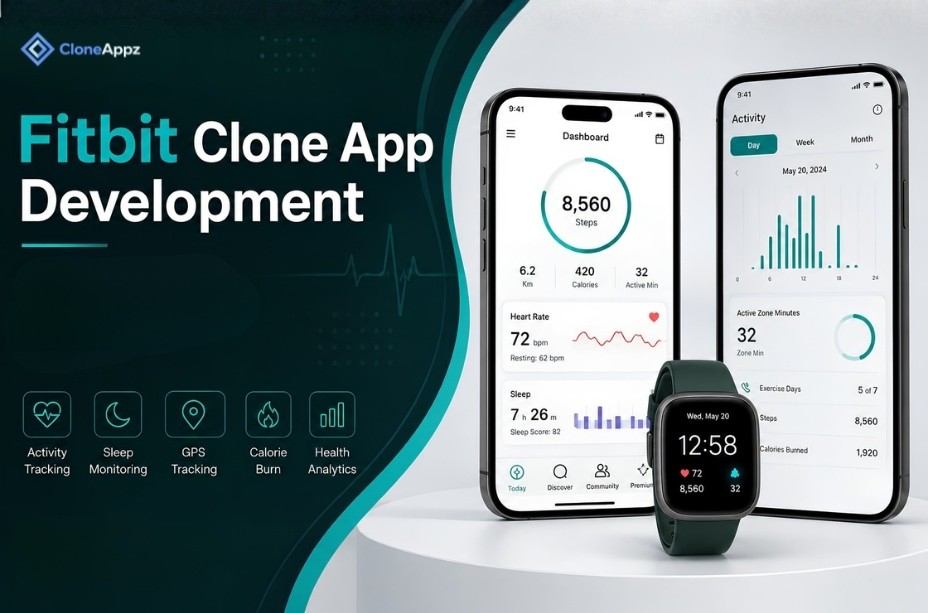
Activity and Sleep Tracking
This is table stakes. Users expect steps, distance, calories burned, and sleep stages: light, deep, and REM. Fitbit, Apple, and Garmin have set that expectation, so an app that misses any of these features will feel incomplete on first use.
Nutrition and Calorie Logging
Food logging is unglamorous, but it is one of the highest-retention features when done well. A searchable food database with barcode scanning cuts logging time down to seconds, and shorter logging time is directly tied to how long people stick with the habit.
Social and Community Layers
Fitbit's step challenges between friends were, honestly, a masterstroke of behavioural design. Competition and light accountability drive far more engagement than any push notification ever will. Even a simple leaderboard among five friends can lift weekly active usage noticeably.
Features Admins and Operators Need
Analytics Dashboards
Operators need to see engagement trends, not just individual user data. Which cohort is dropping off in week two? Which notification actually gets opened? This is where the business, not just the user, gets value from the app.
Subscription and Monetization Controls
Whether you are running a freemium model, a corporate licence, or a straightforward subscription, the admin panel needs clean control over billing, trials, and refunds. This part rarely gets attention in feature lists, but it is where the app actually pays for itself.
Build vs White Label: The Real Cost-Benefit Breakdown
This is the section most agency blogs gloss over, probably because an honest comparison does not always favour a big custom build.
What Building from Scratch Actually Costs
A fully custom Fitbit-style app, built from a blank page, typically needs a product manager, two to three developers, a designer, and a QA person for six to nine months minimum. At average agency rates, that alone can run past 80,000 dollars before you have a single paying user.
That number assumes nothing goes wrong, which, in software, is rarely how things go. There is also opportunity cost. Every month spent building is a month a competitor spends acquiring your future customers.
What a White Label Fitbit Clone Saves You
A white label build starts from a proven, already-tested core: the tracking logic, the sync architecture, the admin panel. You are customizing and branding rather than inventing from zero.
That typically compresses both the cost and the timeline by more than half, and because the underlying code has already been through real-world usage, there tend to be fewer surprises during QA.
When Customization Still Makes Sense
If your business genuinely needs something Fitbit-style apps do not typically offer, deep integration with proprietary hospital equipment, for instance, a heavier custom build might be worth it.
For the vast majority of gyms, wellness brands, and corporate programmes, though, the core app experience does not need to be reinvented. The brand, the content, and the go-to-market strategy are where the real differentiation should happen.
The Development Journey From Blueprint To Launch
Discovery and Market Positioning
Before you create an app like Fitbit, the smart move is figuring out exactly who it's for. A corporate wellness buyer and a boutique gym owner want very different things from the same core product, even though the underlying tracking features barely change.
Design and Prototyping
Wireframes come first. Keep them low-fidelity and quick so the team can focus on the layout before anyone gets attached to colours. Once the team agrees on the flow, test a clickable prototype with real users.
Ideally, test it with five to eight people to catch the most obvious usability issues.
Development Sprints and QA
Work typically runs in two-week sprints, with the front end and back end being built in parallel rather than one after the other. Automated tests catch the routine bugs, while manual testing catches the ones automation misses, especially weird edge cases like a user switching time zones in the middle of a sleep cycle.
Launch, Compliance, and Post-Launch Support
Handling HIPAA and Data Privacy For Health Data
If the app touches health data in the US market, HIPAA compliance is not optional, and it needs to be designed in from the start rather than bolted on before launch. Encryption at rest, encryption in transit, and strict access logging are the baseline, not the bonus.
Getting this wrong does not just risk fines; it risks the entire business's credibility with users who are trusting you with sensitive information.
Choosing the Right Technology Stack
You do not need to become an engineer to make good decisions here, but knowing the basics helps you ask better questions of whoever you hire.
Native vs Cross-Platform Considerations
Native development: Swift for iOS, Kotlin for Android - gives the smoothest performance and the best access to device sensors, which matters a lot for something reading motion data constantly.
Cross-platform frameworks like React Native cut development time and cost, and for most fitness apps, the performance difference is small enough that the cost savings win out.
Backend and Wearable Integration Standards
A cloud backend built on something like AWS, paired with a database such as PostgreSQL or MongoDB, gives the flexibility to scale as your user base grows. Wearable integration usually relies on standard protocols like Bluetooth Low Energy, plus SDKs from device manufacturers, so the app can talk to a wide range of hardware rather than locking users into one brand.
What it Costs to Build a Fitbit Clone App
Straight answer first: a white label Fitbit clone typically starts around $5,000 to $35,000 dollars, and can run considerably higher depending on customisation depth.
Key Cost Drivers
The biggest swing factors are the number of custom features, the level of design customisation, whether you need HIPAA-level compliance work, and how many platforms you are launching on at once, iOS, Android, or both.
Typical Investment Ranges by App Complexity
A basic version with core tracking and a simple admin panel sits at the lower end. A version with AI-driven recommendations, deep wearable integrations, and a full corporate dashboard sits meaningfully higher. Most businesses land somewhere in the middle once they scope realistically instead of asking for everything on day one.
Why Businesses Choose CloneAppz For Fitbit Clone Development
Various providers offer Fitbit clone app development, so what makes CloneAppz the best Fitbit clone partner?
Proven White Label Framework
As a clone app development company, CloneAppz builds on a tested foundation rather than starting from a blank file every time. That means the tracking accuracy, the sync speed, and the admin tools have already been through real usage, not just a demo environment.
Post-Launch Partnership, Not Just Delivery
A launched app is the start of the work, not the end of it. CloneAppz stays involved after go-live, with updates, bug fixes, and support as your user base grows and your needs change.
If you are weighing whether to build custom or go white label, or you just want a clear-eyed cost estimate for your specific use case, it is worth having that conversation before you commit a budget either way.
Book a free consultation with the CloneAppz team and get a straight answer on what your Fitbit clone app would actually take to build.
Frequently Asked Questions
01How much does it cost to build a Fitbit clone app?
A white label Fitbit clone typically starts around 10,000 to 15,000 dollars for a solid MVP. Costs rise with custom features, deeper wearable integrations, and compliance requirements like HIPAA.
02How long does it take to develop an app like Fitbit?
A white label build usually takes eight to twelve weeks. A fully custom app built from scratch can take six to nine months or longer, depending on features, integrations, design complexity, testing, and platform requirements.
03Can a Fitbit clone app work without a physical wearable device?
Yes. Most smartphones already have the sensors needed for basic step and activity tracking, so the app can function without a dedicated wearable, though accuracy improves with one.
04Is white label fitness app development legally safe?
Yes, provided the app is built as an original product inspired by market features rather than copying any brand's trademarks, code, or exact design. A reputable development partner will handle this correctly by default.
05What is the difference between a Fitbit clone and a custom fitness app?
A Fitbit clone starts from an existing, tested feature set and framework that gets customized and branded. A custom app is built entirely from scratch based on a unique specification, which costs more and takes longer.
06Which businesses benefit most from a Fitbit-like app?
Gyms, corporate wellness programmes, health insurers, telehealth platforms, and D2C wellness brands see the strongest returns, largely because daily engagement supports retention and upsell goals across all of them.
07Does CloneAppz provide ongoing support after launch?
Yes. CloneAppz offers post-launch support including updates, bug fixes, and feature additions as your business and user base evolve. This support also helps maintain app performance, security, compatibility, and reliability as platforms and technologies change.