How Much Does It Cost to Build a White Label Grocery Delivery App?
The cost of a white label grocery delivery app ranges from $5,000–$30,000+ based on features, customization, integrations, and scalability requirements.
By CloneAppz Team9 min read
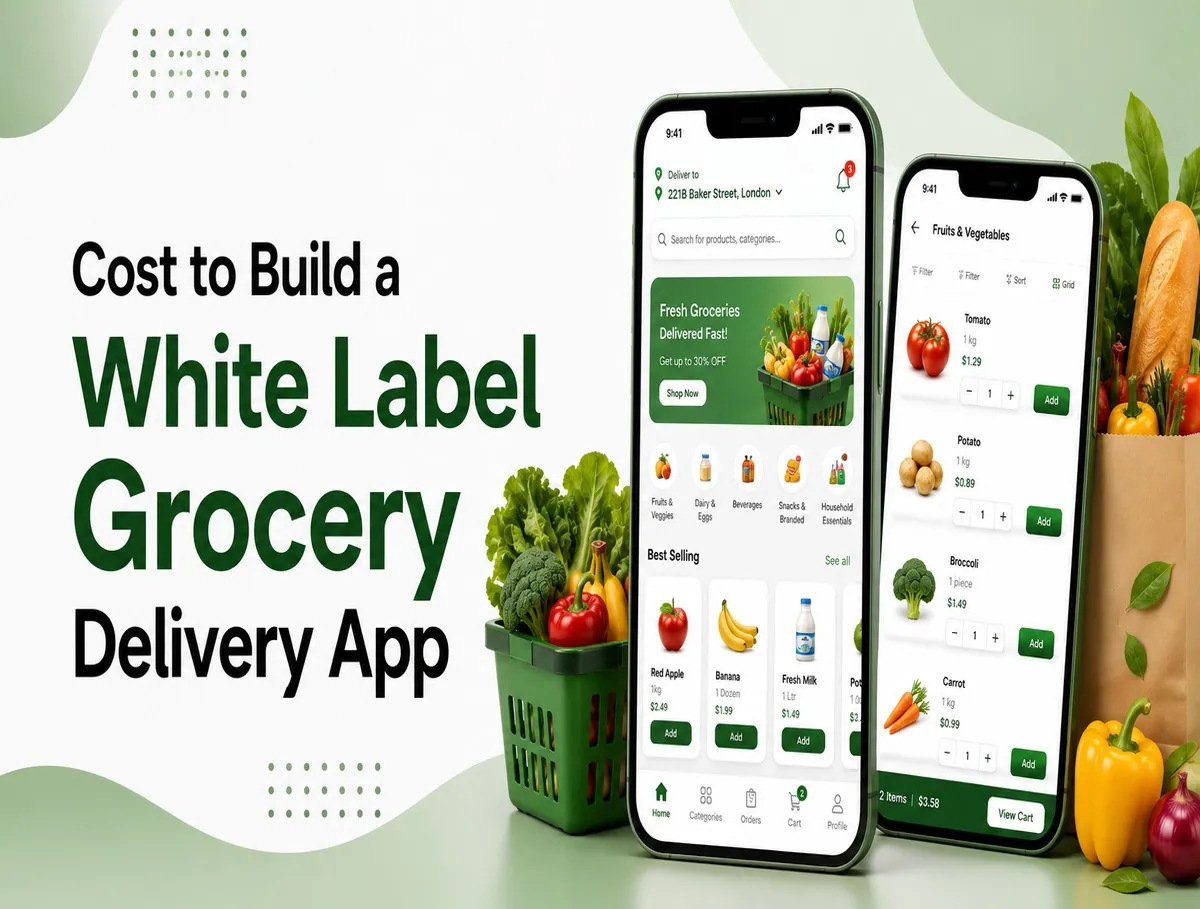
The grocery delivery industry has experienced massive growth over the last few years as consumers increasingly prefer online grocery shopping over traditional store visits. Modern customers expect faster deliveries, easy ordering experiences, secure online payments, and real-time tracking systems. This growing demand has encouraged startups, supermarkets, retail chains, and entrepreneurs to invest in digital grocery delivery platforms.
However, building a grocery delivery application from scratch requires significant investment, technical expertise, long development cycles, and continuous maintenance. For many businesses, custom app development becomes expensive and time-consuming during the early growth stage.
A white label grocery delivery app offers a faster and more cost-effective alternative for businesses looking to enter the market quickly. These pre-built solutions allow companies to launch fully branded grocery delivery platforms with essential features, scalable architecture, and advanced management systems without developing everything from the beginning.
Businesses now prefer white label apps for sale because they reduce development complexity, lower operational risks, and help companies focus more on customer acquisition and business growth. Understanding the complete white label app cost structure is important before selecting the right grocery delivery solution for your business.
What Is a White Label Grocery Delivery App?
A white label grocery delivery app is a ready-made grocery ordering and delivery software solution that businesses can customize and launch under their own brand identity. The application comes with pre-developed features, dashboards, delivery systems, and backend infrastructure required to manage grocery operations efficiently.
Instead of investing months in development, businesses can customize the application with their logo, brand colors, business workflows, and additional features according to operational requirements.
These applications usually include customer apps, delivery partner apps, admin dashboards, store management systems, payment integrations, inventory management tools, and analytics panels to streamline grocery delivery operations.
Core Components of a White Label Grocery Delivery App
Module | Purpose |
Customer App | Grocery browsing and online ordering |
Delivery App | Driver order and route management |
Admin Dashboard | Platform and operations management |
Store Panel | Product and inventory management |
Payment System | Secure online payment processing |
Analytics Dashboard | Business insights and reports |
Why Businesses Choose White Label Grocery Delivery Apps
Businesses are increasingly choosing white label grocery delivery app solutions because they provide faster deployment, lower development costs, proven technology infrastructure, and scalable business models for long-term growth.
Unlike custom development, white label solutions are already tested and optimized for real-world grocery operations. This minimizes technical risks and ensures smooth performance after launch.
Major Benefits for Businesses
- Faster market launch
- Reduced white label app cost
- Lower development risk
- Faster return on investment
- Multi-platform support
- Easy customization options
- Scalable infrastructure
- Reduced maintenance complexity
Faster Time to Market
Building a grocery app from scratch may take several months or even years depending on feature complexity. A white label grocery delivery app significantly reduces launch timelines because the core architecture is already developed and tested.
Lower Initial Investment
Custom app development involves higher expenses for design, development, testing, server setup, and deployment. White label apps for sale reduce upfront investment and help businesses manage budgets more effectively.
Proven Technology Infrastructure
Most white label grocery delivery app solutions are built using scalable and tested technologies. Businesses can avoid technical instability and launch with confidence.
Average White Label App Cost
The total white label app cost depends on several factors including app complexity, customization requirements, feature modules, platform selection, integrations, and operational scalability.
Businesses can choose development packages based on their budget and business requirements.
Cost Breakdown Based on App Complexity
App Complexity | Features Included | Estimated Cost |
Basic Grocery App | Ordering, payments, tracking | $5,000 – $10,000 |
Mid-Level Grocery App | Loyalty programs, analytics, multi-store support | $10,000 – $20,000 |
Enterprise Grocery App | AI systems, warehouse management, cloud scaling | $20,000 – $30,000+ |
Basic White Label Grocery App
Basic applications usually include essential grocery delivery features such as product listing, user registration, cart management, secure payments, and basic order tracking systems.
These applications are suitable for startups and local grocery stores entering the digital market for the first time.
Mid-Level Grocery Delivery App
Mid-level applications support advanced operational features including loyalty systems, promotional offers, delivery scheduling, real-time tracking, and multi-store management capabilities.
These solutions are suitable for growing businesses planning regional market expansion.
Enterprise Grocery Delivery Platform
Enterprise-level white label grocery delivery app solutions support advanced infrastructure and large-scale operations including AI-powered recommendations, smart inventory management, predictive analytics, and cloud scalability systems.
These applications are designed for supermarket chains and large grocery enterprises.
Factors Affecting White Label App Cost
Several technical and operational factors directly influence the overall development budget of grocery delivery applications. Businesses should carefully evaluate these factors before selecting a development approach.
Platform Selection
Developing applications for Android, iOS, and web platforms increases overall development costs because each platform requires separate optimization, testing, and deployment.
UI/UX Design Customization
Modern grocery applications require responsive layouts, smooth navigation systems, and simplified checkout experiences. Custom UI/UX design increases development time and white label app cost.
Third-Party Integrations
Third-party integrations improve functionality but increase development complexity due to API configuration and testing requirements.
Common Third-Party Integrations
- Payment gateways
- SMS notification systems
- GPS tracking tools
- Push notification services
- CRM integrations
- ERP software
- Inventory management systems
Cloud Hosting Infrastructure
Cloud infrastructure supports application scalability, high traffic management, real-time data synchronization, and business continuity. Advanced cloud architecture increases operational expenses.
Security and Compliance
Security systems such as SSL encryption, secure payment gateways, multi-factor authentication, and compliance standards increase development costs but improve customer trust and data protection.
Essential Features in a White Label Grocery Delivery App
A successful white label grocery delivery app requires advanced customer, delivery, admin, and store management functionalities to improve operational efficiency and customer satisfaction.
Features for Customers
Customer applications focus on delivering seamless ordering experiences, faster product discovery, and secure online transactions to improve engagement and customer retention.
Customer App Features
- Smart product search
- Real-time order tracking
- Secure payment options
- Wishlist functionality
- Delivery scheduling
- Push notifications
- Order history
- Product recommendations
Features for Delivery Partners
Delivery modules help drivers manage deliveries efficiently through centralized tracking and route optimization systems.
Delivery App Features
- GPS navigation
- Route optimization
- Delivery status updates
- Earnings management
- Availability controls
- Order assignment systems
Features for Admin Dashboard
Admin dashboards help businesses manage users, orders, inventory, analytics, commissions, and platform operations through centralized control systems.
Admin Dashboard Features
- User management
- Inventory management
- Order monitoring
- Sales analytics
- Commission management
- Delivery tracking
- Revenue reports
Technology Stack Used in Grocery Delivery App Development
A scalable technology stack ensures stable performance, security, and operational efficiency for grocery delivery applications across mobile and web platforms.
Frontend Technologies
Technology | Purpose |
Flutter | Cross-platform mobile app development |
React Native | Interactive mobile interfaces |
React.js | Web application frontend |
HTML5 & CSS3 | Responsive UI design |
Backend Technologies
Technology | Purpose |
Node.js | Backend application services |
Laravel | Web application framework |
Django | Scalable backend systems |
GraphQL APIs | Data communication systems |
Cloud Infrastructure Providers
Cloud platforms improve uptime, scalability, and performance management for modern grocery delivery applications.
Popular Cloud Providers
- AWS
- Google Cloud Platform
- Microsoft Azure
Hidden Costs Businesses Should Consider
Many businesses underestimate additional operational expenses associated with maintaining and scaling grocery delivery applications after launch.
Common Hidden Expenses
- App store publishing fees
- Cloud hosting charges
- API subscription costs
- Maintenance services
- Security monitoring
- Marketing campaigns
- Technical support expenses
White Label Grocery Delivery App vs Custom Development
Businesses often compare white label apps for sale with fully custom development before selecting the right business model for long-term scalability and operational efficiency.
Comparison Between White Label and Custom Development
Aspect | White Label Grocery Delivery App | Custom Grocery App Development |
Development Time | Faster deployment within weeks | Development may take several months |
Initial Investment | Lower and budget-friendly | Higher development investment |
Customization Flexibility | Moderate to advanced customization | Fully customizable architecture |
Technical Complexity | Lower technical involvement | Higher technical management |
Scalability | Easily scalable infrastructure | Fully scalable with custom architecture |
Maintenance Requirements | Lower maintenance responsibility | Higher maintenance and support needs |
Market Entry Speed | Faster market launch | Slower deployment process |
Development Risk | Lower operational and technical risk | Higher development and testing risk |
Which Option Is Better?
A white label grocery delivery app is suitable for startups and growing businesses seeking faster deployment, lower investment, and reduced development complexity compared to fully custom-built applications.
Monetization Models for Grocery Delivery Apps
Businesses can generate revenue using multiple monetization strategies depending on customer behavior, delivery operations, and long-term business goals.
Popular Revenue Models
- Delivery charges
- Commission-based earnings
- Subscription plans
- Featured product listings
- Promotional advertisements
- Convenience fees
- Vendor onboarding fees
Why Choose CloneAppz for White Label Grocery Delivery App Development?
CloneAppz provides scalable and business-ready grocery delivery solutions designed to help startups, supermarkets, and enterprises launch faster with reliable technology infrastructure and advanced operational capabilities.
Proven White Label Expertise
CloneAppz specializes in white label app development with extensive experience building scalable grocery delivery applications for businesses across multiple industries and operational models.
Faster Development and Deployment
Our pre-built grocery delivery solutions significantly reduce development timelines and help businesses launch quickly without technical complications or long development cycles.
High-Level Customization
We provide flexible customization options for branding, UI/UX design, workflows, payment systems, delivery modules, and business-specific operational requirements.
Scalable Technology Infrastructure
CloneAppz develops grocery delivery platforms using scalable technologies capable of handling increasing users, orders, products, and business expansion requirements.
Advanced Security Systems
Our solutions include secure payment systems, encrypted data protection, authentication mechanisms, and compliance-ready security infrastructure for safe operations.
Dedicated Technical Support
We provide end-to-end technical assistance including deployment, updates, maintenance, performance optimization, and post-launch support services.
Cost-Effective Development Solutions
CloneAppz helps businesses reduce overall white label app cost while maintaining enterprise-grade quality, advanced features, and scalable operational performance.
Future Trends in Grocery Delivery App Development
Emerging technologies are transforming grocery delivery platforms by improving automation, customer personalization, and operational efficiency.
Emerging Technologies
- Artificial intelligence
- Predictive analytics
- Voice commerce
- Smart inventory systems
- Automated delivery technologies
- AI-powered recommendations
Conclusion
The cost of building a white label grocery delivery app depends on app complexity, customization level, platform requirements, integrations, and scalability goals. Basic grocery delivery applications may start around $5,000, while enterprise-grade platforms with advanced infrastructure can exceed $30,000.
Businesses increasingly prefer white label grocery delivery app solutions because they reduce development costs, accelerate market entry, and provide scalable technology infrastructure for long-term growth. Choosing reliable white label apps for sale with strong customization capabilities and ongoing support can help businesses build competitive grocery delivery platforms efficiently.
Build it with CloneAppz
Grocery Delivery App
Hyperlocal grocery ordering and delivery
Frequently Asked Questions
01What is a white label grocery delivery app?
A white label grocery delivery app is a pre-built grocery ordering platform customized with business branding, workflows, and operational features before launching under a company identity.
02What is the average white label app cost?
The average white label app cost ranges between $5,000 and $30,000+ depending on features, integrations, customization, and scalability requirements.
03Are white label apps for sale customizable?
Yes, most white label apps for sale support customization for branding, payment systems, delivery workflows, dashboards, and additional feature integrations.
04How long does it take to launch a grocery delivery app?
Most white label grocery delivery app solutions can be launched within 2 to 8 weeks depending on feature customization and deployment complexity.
05Which features are important in grocery delivery apps?
Important features include order tracking, payment gateways, inventory management, delivery systems, push notifications, analytics dashboards, and customer management tools.
06Is a white label grocery delivery app suitable for startups?
Yes, startups prefer white label grocery delivery app solutions because they reduce investment costs, lower development risks, and support faster market entry.
07Can grocery delivery apps support multiple stores?
Yes, advanced grocery delivery platforms support multi-store management, centralized dashboards, and scalable order processing systems.
08Why should businesses choose CloneAppz?
CloneAppz provides scalable white label grocery delivery app solutions with advanced customization, secure infrastructure, dedicated support, and cost-effective development services.