White Label Banking App Development: Launch a Ready-to-Brand Fintech Solution
Explore white label banking app development, key features, benefits, costs, integrations, and how to launch a secure, scalable branded fintech solution.
By CloneAppz Team18 min read
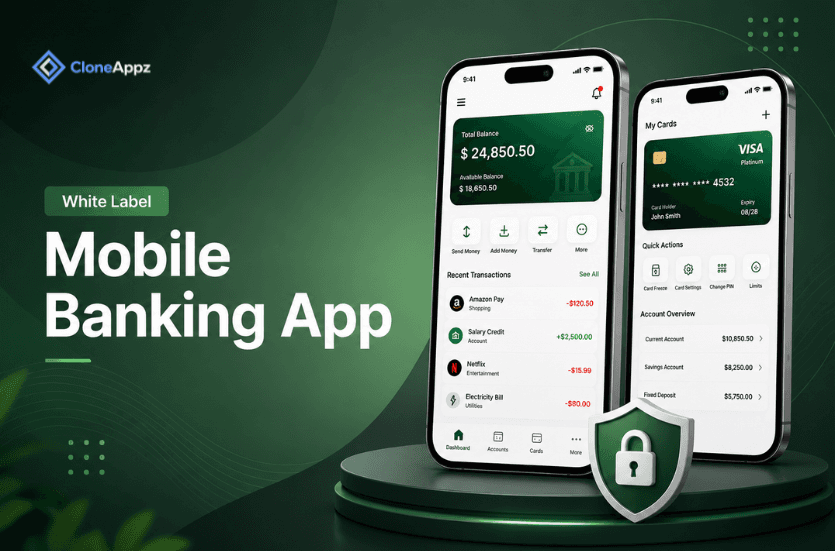
The demand for digital banking is growing as customers expect fast, secure, and convenient financial services through mobile applications. Building such a platform from scratch, however, can require significant time, development resources, integrations, and compliance planning.
White label banking app development provides a faster alternative by offering a ready-made fintech foundation that businesses can customize with their own branding, features, and financial integrations. This enables startups, fintech companies, and established businesses to launch a branded banking solution while reducing the complexity of developing core functionality from the ground up.
CloneAppz helps businesses build customized white label banking solutions with scalable architecture, modern interfaces, third-party integrations, and features tailored to their business requirements.
What Is a White Label Banking App and How Does It Work?
A white label banking app is a pre-developed financial application that can be customized, rebranded, and deployed by another business as its own digital banking product. The underlying technology is developed by a technology provider, while the purchasing company can modify elements such as branding, colours, interface components, selected features, integrations, and customer workflows.
The concept separates product ownership from technology development. A business does not necessarily need to build the entire banking technology stack from the ground up. Instead, it can use an established application foundation and configure it around its commercial requirements.
For example, a fintech startup may require:
- Digital customer registration
- KYC and identity verification
- Digital wallet functionality
- Bank account connectivity
- Peer-to-peer transfers
- Bill payments
- Debit or prepaid card management
- Transaction notifications
- Spending analytics
- Admin dashboards
- Fraud monitoring
- Customer support
- API-based financial integrations
Rather than developing each component independently, the business can start with an existing white label architecture and extend it where necessary.
It is important to understand that a white label banking application does not automatically make a business a bank. Banking, payment, money transmission, lending, card issuing, and other regulated activities may require appropriate licences, partnerships, compliance procedures, and regulatory approvals depending on the target market.
Why Businesses Are Choosing White Label Banking Solutions
The fintech market is highly competitive, and speed can influence whether a new financial product gains an early advantage. Traditional custom development can involve months or years of product engineering before a complete platform becomes commercially usable.
A white label approach can shorten the technology development cycle because common banking capabilities are already available within the underlying platform. Development teams can then concentrate on customisation, integrations, security, compliance requirements, testing, and business-specific functionality.
Another advantage is controlled development expenditure. Instead of allocating resources to building every basic component, businesses can invest more heavily in differentiated capabilities such as financial analytics, customer experience, loyalty programmes, embedded finance, automation, or specialised payment services.
The approach can also support multiple business models. A startup could launch a consumer-focused fintech application, while an established company could introduce financial services alongside an existing product ecosystem.
Core Components of a White Label Banking App Architecture
A reliable banking application requires more than an attractive mobile interface. Its architecture must support financial transactions, sensitive information, third-party integrations, authentication, monitoring, compliance processes, and high availability.
A typical architecture may contain several interconnected layers.
Mobile Application Layer
The mobile layer provides the customer-facing experience. It can be developed for Android, iOS, or both platforms using native technologies or cross-platform frameworks such as Flutter and React Native.
Common application screens include:
- Registration and login
- KYC onboarding
- Home dashboard
- Account information
- Balance overview
- Transaction history
- Send and receive money
- Cards
- Beneficiaries
- Bills and payments
- Notifications
- Profile and security settings
- Help and support
The mobile interface should communicate important financial information clearly. Transaction amounts, account balances, payment status, fees, and security notifications need to be presented in a way that minimises confusion.
Backend Application Layer
The backend manages business logic and communicates with external financial services. It processes authentication requests, transaction instructions, user profiles, account data, notifications, and other application operations.
A scalable backend can be implemented using technologies such as Node.js, Java, Python, PHP, or other enterprise-grade technologies depending on the project requirements.
The backend should be designed around secure APIs and modular services so individual components can scale independently as user volume increases.
Database Layer
Financial applications generate large amounts of structured transactional and customer data. The database layer stores user information, transaction records, account information, beneficiary details, card metadata, configuration data, and audit information.
Depending on requirements, technologies such as PostgreSQL, MySQL, MongoDB, or other database systems may be considered. Financial transaction data requires careful handling to preserve consistency, integrity, availability, and traceability.
API and Integration Layer
The integration layer connects the banking application with financial institutions, payment processors, card networks, identity verification providers, notification services, analytics platforms, and other external systems.
API integration becomes particularly important when the application needs to communicate with multiple financial providers. A well-designed integration layer can prevent the mobile application from becoming tightly coupled to individual service providers.
Security and Compliance Layer
Security must be considered throughout the architecture rather than added after development. Authentication, encryption, access control, device verification, session management, transaction monitoring, audit logging, and fraud detection can form part of the security architecture.
Depending on the target market and financial services being offered, the platform may also need to support KYC, AML, data protection, payment security, and other regulatory requirements.
Essential Features to Include in a White Label Banking App
The feature set of a banking platform should be selected according to its target audience, geographic market, regulatory environment, and financial services model. However, several capabilities are commonly expected.
Digital Account Creation and Onboarding
Digital onboarding allows customers to create accounts without visiting a physical branch. The workflow may include personal information collection, identity verification, document submission, biometric verification, terms acceptance, and account activation.
An efficient onboarding experience should minimise unnecessary steps while maintaining the required compliance checks.
KYC and Identity Verification
Know Your Customer processes help financial businesses verify customer identities and reduce risks associated with fraudulent or prohibited activity.
A banking application can integrate third-party identity verification providers to support:
- Identity document verification
- Facial verification
- Address verification
- Database checks
- Risk assessment
- Customer screening
The exact process should be designed according to applicable regulatory requirements.
Digital Wallet and Account Management
Customers should be able to view balances, manage accounts, review transactions, and perform supported financial operations from the application.
For businesses building specialised financial products, wallet functionality can also serve as the foundation for additional services.
Peer-to-Peer Payments and Transfers
Money transfer functionality allows users to send funds to other users or supported bank accounts. The system should provide clear transaction confirmation, status tracking, beneficiary management, and transaction history.
Transaction processing should also include appropriate validation, limits, authentication, and monitoring.
Card Management
Modern fintech applications frequently include card-related functionality. Customers may be able to:
- Request a card
- Activate cards
- Freeze or unfreeze cards
- View card details
- Set spending controls
- Manage transaction limits
- Track card transactions
- Manage virtual cards
Card functionality generally requires integration with appropriate issuing and processing partners.
Bill Payments
Bill payment functionality can expand the usefulness of a banking application by allowing users to pay supported utilities, subscriptions, telecom services, and other recurring expenses.
The implementation depends heavily on the target country and the available payment networks.
Transaction History and Statements
Customers should have access to detailed transaction records. Useful information can include transaction date, amount, recipient, payment method, reference number, status, and applicable fees.
Digital statements can also support customer service, accounting, and financial management.
Push Notifications and Alerts
Real-time notifications can inform users about:
- Successful transactions
- Failed payments
- Account activity
- Login attempts
- Card transactions
- Security events
- Balance changes
- Promotional offers
Notification preferences should be configurable to avoid overwhelming customers with unnecessary messages.
Admin Dashboard
The administrative panel provides operational control over the platform. Administrators may need to manage customers, transactions, verification requests, support tickets, system settings, reports, and risk alerts.
Role-based access control is particularly important because not every employee should have access to sensitive financial information or high-risk administrative functions.
How White Label Mobile Banking App Development Works
The development process usually begins with business and technical discovery rather than immediate coding. The development team needs to understand the financial services being offered, target market, regulatory environment, business model, third-party providers, and expected user volume.
A typical development lifecycle includes the following stages.
Business and Technical Requirement Analysis
The first stage defines the application's objectives, target customers, supported financial services, monetisation strategy, geographical market, compliance requirements, and technical constraints.
The team can then create a feature roadmap separating essential launch functionality from future enhancements.
UI/UX Design and Branding
The application's interface is customised according to the company's brand identity. This can include:
- Logo
- Colour palette
- Typography
- Icons
- Navigation
- Dashboard structure
- Customer onboarding
- Transaction workflows
- Notifications
- Brand-specific content
The objective is to ensure that the application feels like a genuine financial product rather than a generic software template.
Backend and API Development
Developers configure or extend the backend services, database architecture, authentication systems, transaction workflows, and external service connections.
API integration is generally required for financial institutions, payment gateways, KYC providers, card processors, notification platforms, analytics tools, and other services.
Financial Service Integration
The application is connected with the required banking or payment infrastructure. Depending on the business model, this may include banking-as-a-service providers, payment processors, card issuers, open banking providers, identity verification services, and financial data platforms.
Security Implementation
Security controls are implemented across mobile, backend, database, API, and infrastructure layers. Authentication mechanisms such as passwords, PINs, OTPs, biometrics, device authentication, and multi-factor authentication can be incorporated according to the application's requirements.
Testing and Quality Assurance
Financial applications require extensive testing because transaction failures or security vulnerabilities can directly affect customers.
Testing may cover:
- Functional testing
- API testing
- Security testing
- Performance testing
- Load testing
- Compatibility testing
- Device testing
- Payment testing
- User acceptance testing
- Regression testing
Deployment and Launch
After testing and compliance checks, the application can be prepared for production deployment. Cloud infrastructure, monitoring, backups, logging, analytics, and incident management should be configured before the public launch.
Post-Launch Maintenance
Banking software requires continuous maintenance. Payment providers can change APIs, operating systems receive updates, security vulnerabilities emerge, and regulatory requirements evolve.
Ongoing maintenance can therefore include security patches, API updates, performance optimisation, bug fixing, infrastructure monitoring, and feature improvements.
White Label Banking App vs Custom Banking App Development
Both approaches can support fintech businesses, but they involve different development strategies.
Factor | White Label Approach | Custom Development |
Initial development time | Usually shorter | Usually longer |
Starting technology | Pre-built foundation | Built from the ground up |
Initial investment | Generally lower | Generally higher |
Branding | Customisable | Fully custom |
Feature flexibility | High, depending on platform | Very high |
Maintenance | Provider plus custom development | Fully managed by development team |
Launch speed | Faster | Slower |
Scalability | Depends on architecture | Designed specifically for requirements |
A business that needs highly specialised financial infrastructure may prefer complete custom development. However, companies that want to launch faster and reduce the complexity of building common fintech functionality can consider a white label model.
What Makes the Best White-Label Banking App Platform?
Choosing the best platform requires more than comparing the number of features shown in a product brochure. Businesses should evaluate the underlying technology, scalability, security architecture, customisation options, integration capabilities, support model, and ownership terms.
Important evaluation criteria include:
Scalability
The platform should be capable of supporting growth in customers, transactions, API requests, and geographic expansion.
API Architecture
A modern API architecture makes it easier to integrate new financial providers and services without redesigning the entire platform.
Security
The provider should demonstrate a clear approach to encryption, authentication, access control, monitoring, vulnerability management, and secure development practices.
Customisation
The platform should allow sufficient control over branding, workflows, business rules, features, and customer experience.
Integration Support
A strong platform should support integration with relevant payment gateways, banking APIs, KYC providers, card services, analytics systems, and communication services.
Infrastructure
Cloud-ready infrastructure, automated deployment, monitoring, backups, disaster recovery, and scalable databases are important for financial applications.
Technical Support
Businesses should evaluate whether the provider offers technical maintenance, troubleshooting, updates, integration support, and post-launch assistance.
White Label Mobile Banking Software: Technology Stack Considerations
The technology stack should be selected according to expected traffic, security requirements, integrations, development resources, and future scalability.
A potential technology architecture can include React Native or Flutter for mobile development, Node.js or similar backend technologies, PostgreSQL or another suitable database, REST or GraphQL APIs, cloud infrastructure, containerisation, and monitoring systems.
For high-volume platforms, microservices architecture may be considered. Instead of placing all functionality inside a single backend application, services can be separated according to responsibilities such as authentication, payments, notifications, user management, transactions, reporting, and fraud monitoring.
This architecture can make independent scaling and maintenance easier, although it also introduces additional operational complexity.
Security Requirements for a White Label Banking Application
Security is one of the most important considerations in fintech development because the application processes sensitive financial and personal information.
A comprehensive security architecture can include encryption for data in transit and at rest, secure authentication, role-based permissions, API security, token management, device verification, fraud detection, transaction monitoring, audit logs, and secure session handling.
Applications should also minimise sensitive information stored on mobile devices. Secure storage mechanisms should be used where local storage is necessary.
API endpoints should implement appropriate authentication, authorisation, validation, rate limiting, logging, and monitoring. High-risk transactions may require additional authentication or verification.
Security testing should continue after launch rather than being treated as a one-time development activity.
Regulatory and Compliance Considerations
A financial application operates within a regulated environment. The legal requirements vary depending on the services offered and the countries in which the business operates.
Depending on the business model, companies may need to consider:
- KYC requirements
- AML controls
- Data privacy regulations
- Payment regulations
- Electronic money regulations
- Consumer protection
- Transaction monitoring
- Customer verification
- Data retention
- Financial reporting
- Card security requirements
A development company can implement technical controls, but businesses should work with qualified legal, compliance, and financial professionals to determine the licences and regulatory obligations applicable to their operation.
How White Label Neo Bank App Development Expands Fintech Opportunities
Digital-first financial institutions have changed customer expectations around banking. A neobank application can provide account management, digital payments, cards, financial insights, transfers, and other services through a mobile-first experience.
White label neo bank app development allows businesses to start with a pre-existing fintech foundation and customise it around a specific customer segment.
For example, a business could develop a financial application targeting freelancers, small businesses, students, travellers, creators, gig workers, or international customers. The underlying banking infrastructure may remain similar while the user experience, pricing, features, and financial products differ.
The opportunity lies in combining reliable financial infrastructure with a focused customer proposition.
How a CashApp-Like Product Fits Into the White Label Model
Peer-to-peer payment applications have demonstrated the demand for simple digital money movement. A business interested in building a similar product may use a cashapp clone as a conceptual starting point while creating its own branding, workflows, business model, and feature set.
A product inspired by this category could include peer-to-peer transfers, digital wallets, payment requests, transaction history, card functionality, notifications, and account management.
However, businesses should not simply replicate another company's branding or proprietary interface. The goal of a white label solution should be to use proven product concepts while developing an independent commercial identity.
MVP Development for a White Label Banking Product
Launching every possible feature at the beginning can increase development time, testing complexity, and operational risk. MVP development provides a structured way to introduce the core financial product first and expand based on real customer behaviour.
An initial MVP could include:
- Customer registration
- KYC verification
- Account or wallet management
- Money transfers
- Transaction history
- Notifications
- Basic card functionality
- Customer support
- Admin dashboard
Once the initial product gains users, additional capabilities can be introduced based on market demand.
Future versions could add budgeting tools, advanced analytics, international transfers, loyalty programmes, business accounts, lending integrations, investment services, AI-powered financial insights, or additional payment methods.
Cost of White Label Banking App Development
The cost of developing a white label banking application depends on the starting platform, degree of customisation, number of platforms, integrations, regulatory requirements, security architecture, feature complexity, and development partner.
A simple branded fintech application with a limited feature set will require significantly fewer resources than a multi-country banking platform with advanced payment infrastructure and extensive third-party integrations.
Major cost factors include:
- UI/UX customisation
- Mobile application development
- Backend development
- Third-party APIs
- Payment gateway integration
- KYC and AML integrations
- Card infrastructure
- Cloud hosting
- Security implementation
- Admin dashboard
- Testing
- Compliance-related technical requirements
- Post-launch maintenance
The most practical way to estimate the investment is to define the MVP feature set, target market, integrations, compliance requirements, and scalability expectations before development begins.
Monetisation Models for White Label Banking Apps
A fintech application can generate revenue through several business models depending on its financial services and customer segment.
Possible revenue streams include transaction fees, subscription plans, premium accounts, card-related fees, foreign exchange margins, business account plans, merchant services, referral partnerships, and value-added financial products.
The monetisation model should be designed alongside the product architecture because fees, transaction limits, account tiers, and premium functionality can influence backend business rules and user workflows.
How CloneAppz Approaches White Label Banking App Development
CloneAppz provides white label app development services for businesses that want to launch branded digital products without building every component from the ground up.
For banking and fintech projects, the development approach can cover product discovery, UI/UX customisation, mobile application development, backend engineering, API integrations, third-party service connections, security implementation, testing, deployment, and ongoing technical support.
The objective is to create a solution that reflects the client's brand and business model while maintaining a technology foundation that can support future expansion.
Businesses can also use the same development foundation to introduce additional fintech products over time rather than treating the initial application as an isolated product.
Key Benefits of Launching a White Label Banking Solution
A well-designed white label banking platform can provide several strategic advantages.
Faster Market Entry
Businesses can begin with an existing technology foundation instead of developing every banking component from zero, potentially reducing the time required to reach market.
Reduced Development Complexity
Pre-built financial functionality can reduce the amount of foundational engineering required before a product becomes usable.
Brand Ownership
Customers interact with the business's own brand, application interface, domain, and customer experience rather than a third-party consumer-facing application.
Scalable Product Foundation
A properly engineered platform can support additional users, transactions, integrations, and features as the business grows.
Easier Feature Expansion
Businesses can add financial products and services progressively rather than attempting to launch the entire roadmap simultaneously.
Integration Flexibility
API-driven architecture can make it easier to connect banking, payment, identity verification, communication, analytics, and other external services.
Challenges Businesses Should Consider Before Launch
White label development reduces some technical complexity, but it does not eliminate the challenges of operating a fintech product.
Businesses still need to consider regulatory requirements, financial partnerships, customer support, fraud management, transaction disputes, data protection, infrastructure reliability, and operational risk.
Vendor dependency is another important consideration. Before selecting a provider, businesses should understand how custom code is managed, who owns the application and source code, how third-party integrations are maintained, what happens if a provider changes its infrastructure, and how the business can migrate if required.
Clear contractual terms around ownership, support, maintenance, data, integrations, and future development can help reduce long-term uncertainty.
Future Trends in White Label Banking App Development
The future of digital banking is moving beyond basic account and payment functionality. Financial applications are increasingly incorporating automation, artificial intelligence, embedded finance, open banking, personalised financial insights, and real-time risk analysis.
AI can potentially support customer service, transaction categorisation, fraud detection, financial recommendations, and operational automation. Open banking can enable applications to connect customers with financial information across multiple institutions where supported.
Embedded finance is also creating opportunities for non-financial companies to introduce financial services directly into their existing customer journeys.
As these technologies mature, white label banking platforms are likely to evolve from basic branded applications into configurable financial technology ecosystems.
Conclusion
White label banking app development offers businesses a practical route to launching branded fintech products without taking on the full complexity of building a banking platform from scratch. By combining a pre-built technology foundation with custom branding, financial integrations, security controls, compliance workflows, and scalable infrastructure, businesses can focus more on their target customers and commercial strategy.
The right solution should not simply provide a ready-made application. It should offer flexibility, secure architecture, integration capabilities, scalability, customisation, and long-term technical support. Businesses should also evaluate licensing, financial partnerships, compliance responsibilities, data ownership, and vendor dependency before launching.
With the right technology partner and a clearly defined product roadmap, a white label banking solution can provide the foundation for launching digital wallets, payment products, neobanking services, card-based products, and other fintech experiences.
Frequently Asked Questions
01What is a white label banking app?
A white label banking app is a pre-built fintech application that can be customized and rebranded by another business. The business can launch the application under its own brand while using an existing technology foundation for core banking or financial functionality.
02How does a white label banking app differ from a traditional banking app?
A traditional banking application is usually developed specifically for one financial institution or business. A white label solution starts with reusable technology that can be adapted for multiple businesses, allowing companies to customize branding, features, workflows, and integrations without developing the complete platform from scratch.
03How long does it take to launch a white label banking application?
The timeline depends on the application's feature set, customisation requirements, third-party integrations, compliance processes, testing requirements, and deployment strategy. A focused MVP can generally be launched faster than a full-scale multi-service fintech platform.
04Can a white label banking app be customized according to my brand?
Yes. Branding can typically include the application's visual identity, logo, colours, typography, interface components, onboarding experience, content, and selected customer workflows. The level of customisation depends on the underlying platform and development agreement.
05Can I integrate payment gateways and banking APIs into a white label banking app?
Yes. Banking and payment applications commonly rely on APIs to connect with external financial services. Required integrations may include payment gateways, banking providers, KYC services, card processors, open banking platforms, notification systems, analytics tools, and other financial infrastructure.
06Can I start with an MVP and add more banking features later?
Yes. Starting with an MVP can be an effective strategy for validating the product before expanding its feature set. Businesses can begin with essential onboarding, account, wallet, transfer, transaction, notification, and administrative functionality and then introduce additional financial services based on customer demand.
07How much does white label banking app development cost?
There is no single fixed cost because development requirements differ considerably. The overall investment depends on features, platforms, customisation, integrations, security requirements, compliance-related functionality, infrastructure, and post-launch support. A detailed estimate can be prepared after defining the product scope and target market.
08Can CloneAppz develop a customized white label banking application?
Yes. CloneAppz can provide customized white label fintech development covering application branding, UI/UX, mobile development, backend engineering, API integrations, third-party financial services, security implementation, testing, deployment, and ongoing technical support according to project requirements.