Whatnot Clone App Development: Launch a Live Shopping App Like Whatnot
Whatnot clone app development to launch a live shopping platform in the US, UK, and Europe. Enable users to connect, sell, and buy products in real time.
By CloneAppz Team16 min read
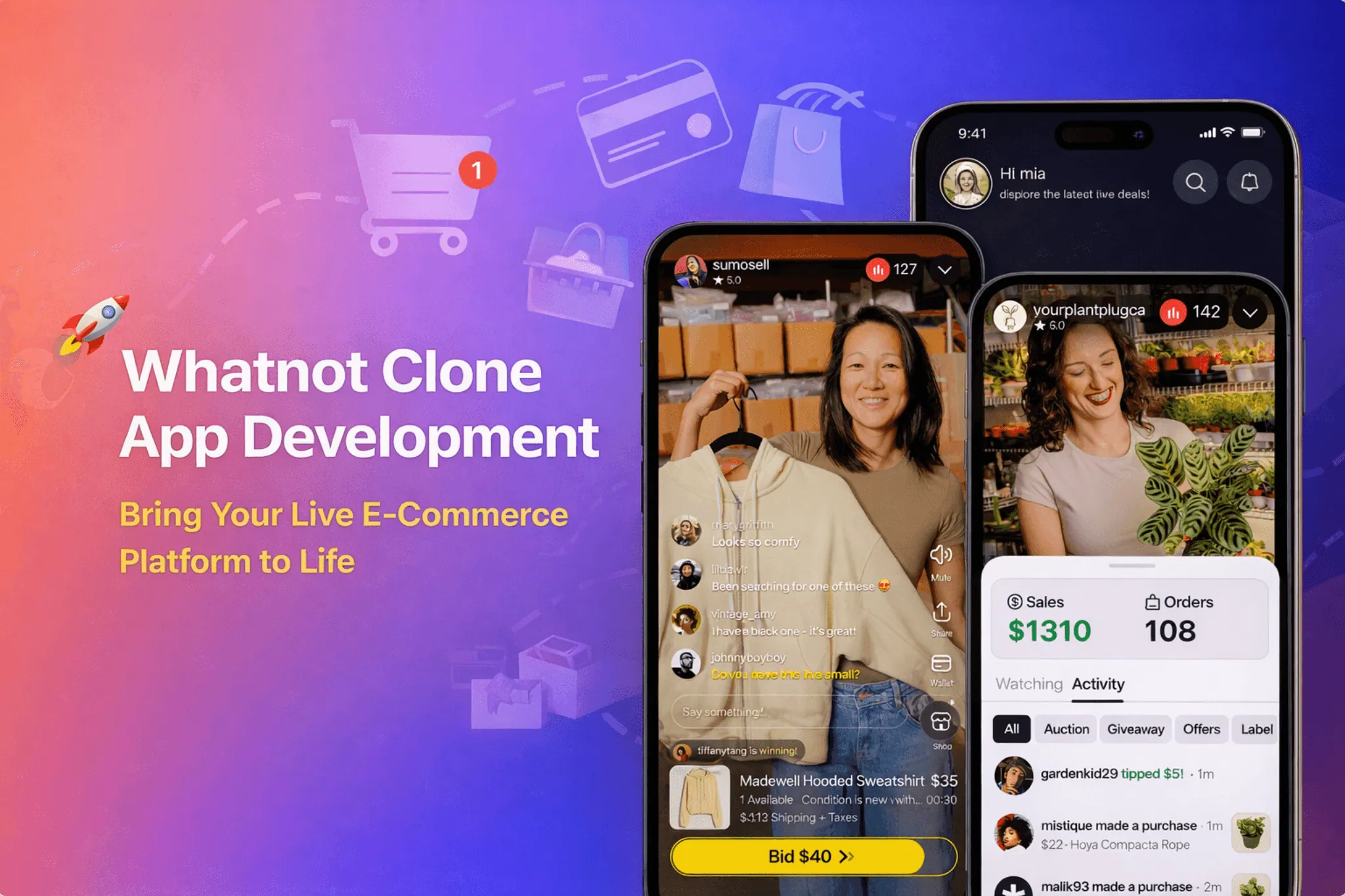
Whatnot is a live-stream shopping marketplace that allows sellers to host real-time auctions while buyers bid instantly during the broadcast. Unlike traditional eCommerce platforms, Whatnot combines live video streaming, social interaction, and instant checkout in one ecosystem.
Sellers showcase products such as collectibles, sneakers, trading cards, fashion items, and niche merchandise through live sessions. Buyers participate by bidding, chatting, reacting, and purchasing instantly.
This interactive model increases urgency, engagement, and impulse buying, which is why live commerce platforms are experiencing massive growth globally.
Why Build a Whatnot-Like App & How Does It Work?
Live shopping blends entertainment with commerce. Instead of static product listings, customers experience dynamic, real-time interaction.
Why Entrepreneurs Are Entering This Market
- Rising demand for live commerce experiences
- Higher engagement compared to traditional marketplaces
- Strong commission-based revenue opportunities
- Community-driven brand building
- Faster product sales cycles
How a Whatnot-Style Platform Operates
- Sellers register and verify accounts.
- They schedule or start a live auction stream.
- Buyers join the stream and place real-time bids.
- Highest bidder wins when the timer ends.
- Secure payment is processed.
- Seller ships the product.
- Platform earns commission per transaction.
The process is simple, scalable, and highly profitable when executed correctly.
Top Reasons to Invest in a Whatnot Clone Solution
Live stream commerce is rapidly reshaping how people buy and sell online. For entrepreneurs looking to enter an interactive marketplace model, investing in a Whatnot clone solution offers strategic, financial, and technological advantages. Here are the key reasons explained concisely.
1. Tap Into a Fast-Growing Live Commerce Market
Live shopping combines entertainment and purchasing in one experience. Buyers prefer real-time interaction, and sellers benefit from instant engagement. A Whatnot clone allows you to enter this expanding market early and capitalize on increasing demand for interactive, community-driven commerce platforms.
2. Create Multiple Revenue Opportunities
A Whatnot clone supports diverse monetization options such as transaction commissions, premium seller subscriptions, featured listings, and sponsored live events. This diversified model strengthens revenue stability and improves long-term profitability, especially in competitive digital commerce environments.
3. Deliver High User Engagement & Retention
Real-time bidding, live chat, and instant reactions create excitement and urgency. These interactive features increase session time, repeat participation, and overall user loyalty. Community-focused platforms naturally encourage stronger buyer-seller relationships compared to traditional static marketplaces.
4. Reduce Development Time and Risk
Building a live auction platform from scratch requires advanced streaming systems and bidding logic. A clone solution provides a proven framework, reducing technical uncertainty, saving development time, and enabling faster market launch without compromising scalability.
5. Target Profitable Niche Communities
Instead of competing with large general marketplaces, a Whatnot clone allows you to focus on specific niches like collectibles, sneakers, or luxury items. Serving dedicated communities builds trust, improves engagement, and strengthens brand authority within targeted markets.
Essential Features of a Whatnot Clone App
A robust Whatnot clone app requires clearly defined feature segmentation to ensure smooth operations for buyers, sellers, and administrators. Below is the structured feature breakdown used in professional live marketplace platforms.
User Panel Features
1. Secure Registration & Profile Management
Users can sign up via email, phone, or social login and manage their profile, payment details, and preferences securely.
2. Browse & Discover Live Auctions
Advanced search, category filters, and personalized recommendations help users discover relevant live streams and upcoming auctions.
3. Real-Time Live Streaming Access
Users can join live auctions with low-latency streaming, ensuring seamless viewing and instant participation.
4. Instant Bidding System
Buyers can place real-time bids with auto-update pricing, countdown timers, and instant winner confirmation.
5. Live Chat & Reactions
Interactive chat and emoji reactions allow buyers to communicate with sellers and other participants during auctions.
6. Secure Payments & Checkout
Integrated payment gateways support multiple payment methods with encrypted transactions and order confirmation.
7. Order Tracking & Notifications
Users receive real-time updates on auction wins, payment status, shipping progress, and delivery tracking.
8. Ratings & Reviews
Buyers can rate sellers and leave feedback, strengthening trust within the marketplace ecosystem.
Seller Panel Features
1. Seller Onboarding & Verification
Structured registration with KYC verification ensures credibility and compliance.
2. Product Listing & Inventory Management
Sellers can upload products, manage stock levels, set base prices, and categorize listings efficiently.
3. Live Auction Scheduling & Hosting
Ability to schedule auctions in advance or start instant live sessions with streaming tools.
4. Real-Time Bid Monitoring
Sellers can track active bids, manage auction timing, and view participant engagement metrics.
5. Revenue Dashboard & Analytics
Detailed insights into sales performance, earnings, commission deductions, and transaction history.
6. Order & Shipment Management
Tools to manage order confirmation, shipping status updates, and buyer communication.
7. Promotional Tools
Options to boost listings, create featured auctions, and access advertising placements.
Admin Panel Features
1. User & Seller Management
Admin can monitor registrations, approve sellers, suspend accounts, and manage platform access.
2. Commission & Revenue Control
Flexible commission settings by category, seller tier, or promotional campaigns.
3. Auction Monitoring & Moderation
Real-time monitoring of live sessions to ensure compliance and prevent misuse.
4. Payment & Transaction Oversight
Full visibility into payments, refunds, escrow handling, and financial reporting.
5. Dispute Resolution System
Admin tools to manage complaints, refund requests, and user disputes effectively.
6. Advanced Analytics & Reports
Comprehensive dashboards showing platform growth, revenue trends, user engagement, and seller performance.
7. Content & Category Management
Control over product categories, banners, CMS pages, and featured sections.
Profitable Monetization Models for a Whatnot Clone
A well-structured Whatnot clone platform should not rely on a single income source. A diversified monetization model ensures stable cash flow, scalability, and long-term profitability. Below are the most effective revenue strategies used in live auction marketplaces.
Commission on Successful Auctions
The primary revenue model is charging a percentage commission on each completed transaction. The platform deducts a predefined fee once an auction concludes successfully. Commission rates can vary by category, seller tier, or promotional campaign, allowing flexible revenue optimization.
Seller Subscription Plans
Offer tier-based subscription packages for sellers. Premium plans may include reduced commission rates, priority listing placement, advanced analytics, or promotional tools. Recurring subscription fees create predictable monthly revenue while incentivizing sellers to upgrade for better visibility.
Featured Listings & Auction Boosts
Sellers can pay to promote their live sessions on the homepage or within specific categories. Boosted visibility increases participation and bidding competition. This model works especially well during peak seasons or high-demand niche events.
Sponsored Live Events
Brands or high-volume sellers can sponsor special auction events. Sponsored streams receive highlighted placement and additional promotional banners. This creates partnership-based revenue opportunities while enhancing platform credibility and engagement.
In-App Advertising
Display targeted advertisements within the platform, such as banner ads or recommended products. Ads can be optimized based on user behavior, bidding interests, or category preferences, generating additional passive income without disrupting user experience.
Transaction & Payment Processing Fees
In addition to commissions, platforms can apply a small convenience or payment processing fee to cover gateway costs and operational overhead. Transparent fee structuring ensures trust while contributing to revenue margins.
Premium Buyer Memberships
Introduce exclusive memberships for buyers offering early auction access, special discounts, loyalty rewards, or VIP-only streams. This enhances user retention while generating recurring subscription income.
Data Insights & Analytics Services
For enterprise sellers, provide advanced analytics reports on bidding behavior, audience engagement, and performance trends. Offering paid access to deeper insights creates additional value-driven monetization.
Our Step-by-Step Whatnot Clone Development Process
Developing a scalable Whatnot clone requires structured planning, technical precision, and performance-focused execution. Below is our systematic development approach that ensures stability, security, and long-term scalability for live auction platforms.
1. Business Analysis & Requirement Gathering
We begin by understanding your target niche, revenue model, commission structure, and user flow. This phase includes competitor analysis, feature mapping, and scalability planning to ensure the platform aligns with your long-term business objectives.
2. Platform Architecture & Tech Stack Finalization
Our team defines the system architecture, including streaming infrastructure, real-time bidding engine, database structure, and cloud hosting environment. Selecting the right tech stack at this stage ensures high performance and smooth scalability under heavy traffic loads.
3. UI/UX Design & Wireframing
We design intuitive interfaces for users, sellers, and admins. Wireframes and prototypes are created to optimize navigation, auction flow, and checkout experience. The goal is to deliver a seamless, interactive, and conversion-focused user journey.
4. Frontend & Backend Development
Our developers build the platform modules, including live streaming integration, real-time bidding logic, chat functionality, payment gateway setup, and dashboard systems. Clean code structure and modular development ensure easier updates and future feature expansion.
5. Payment Integration & Security Implementation
We integrate secure payment gateways with encryption protocols, SSL certification, and escrow-based transaction handling. Role-based access controls and authentication systems strengthen data protection and fraud prevention.
6. Quality Assurance & Performance Testing
The platform undergoes rigorous functional testing, load testing, and real-time streaming stress testing. We verify bid synchronization, payment accuracy, and server response time to ensure smooth performance during live events.
7. Deployment & App Store Launch
After successful testing, we deploy the solution on secure cloud servers and assist with publishing on Android, iOS, and web platforms. Deployment includes server optimization and domain configuration.
8. Post-Launch Support & Scaling
After launch, we provide technical support, performance monitoring, feature enhancements, and scalability upgrades. Continuous maintenance ensures the platform adapts to increasing traffic and evolving market demands.
Our Tech Stack for Develop an App Like Whatnot
Building a live auction platform like Whatnot requires a carefully selected technology stack that ensures real-time performance, scalability, and transaction security. Below is the structured technology framework we use to develop a high-performing live shopping ecosystem.
Frontend Technologies (User Interface Layer)
- React Native / Flutter – Cross-platform mobile app development for Android & iOS with a single codebase
- React.js / Next.js – High-performance, SEO-friendly web applications
- HTML5, CSS3, JavaScript – Core technologies for responsive and interactive interfaces
Backend Technologies (Application Logic Layer)
- Node.js / Laravel / Django – Scalable and secure backend frameworks
- REST APIs / GraphQL – Seamless communication between frontend and server
- WebSockets / Socket.io – Real-time bid synchronization and live updates
- Microservices Architecture – Independent and scalable service modules
- Authentication & Authorization (JWT / OAuth) – Secure role-based access control
Database & Data Management
- MySQL / PostgreSQL – Structured data storage for transactions and accounts
- MongoDB – Flexible handling of dynamic auction and chat data
- Redis – High-speed caching for real-time bid updates
- Cloud Databases – Automated backups and high availability
Live Streaming Technologies
- WebRTC – Real-time communication with minimal delay
- Agora / AWS IVS / Twilio Video – Reliable live streaming SDKs
- Adaptive Bitrate Streaming – Smooth viewing across varying network conditions
Cloud Infrastructure & Hosting
- AWS / Google Cloud / Microsoft Azure
- Auto Scaling & Load Balancing
- CDN Integration – Faster global content delivery
- Docker (Containerization) – Simplified deployment and updates
Payment & Security Technologies
- Stripe / PayPal / Razorpay Integration
- SSL Encryption
- Escrow-Based Payment Systems
- PCI-DSS Compliance Standards
- Fraud Detection & Monitoring Tools
Third-Party Integrations
- Push Notification Services (Firebase / OneSignal)
- SMS & Email Notification APIs
- Analytics & Reporting Tools (Google Analytics / Mixpanel)
- Social Media Login Integration
DevOps, Monitoring & Maintenance
- CI/CD Pipelines
- Automated Testing Tools
- Performance Monitoring (New Relic / Datadog)
- Error Tracking Systems (Sentry)
- Server Log Management
Future-Ready Trends in Live Shopping Platform Development
Live shopping platforms are evolving beyond basic streaming and bidding. To remain competitive, businesses must integrate emerging technologies that enhance engagement, personalization, and scalability. Below are the key trends shaping the future of live commerce platforms.
AI-Powered Personalization
Artificial Intelligence is transforming how users discover auctions and products. Smart recommendation engines analyze bidding behavior, watch history, and purchase patterns to suggest relevant live streams. This increases engagement, improves conversion rates, and boosts overall platform revenue.
Augmented Reality (AR) Previews
AR integration allows buyers to visualize products before bidding. From trying on accessories virtually to viewing collectibles in 3D space, immersive previews reduce hesitation and enhance buyer confidence during live auctions.
Influencer-Led Live Commerce
Influencers are becoming powerful auction hosts. Platforms are integrating creator dashboards, audience analytics, and monetization tools to support influencer-driven streams. This trend expands reach and accelerates user acquisition through trusted personalities.
Blockchain & Transparent Transactions
Blockchain technology is being explored for secure ownership verification, especially for rare collectibles and digital assets. Smart contracts can automate escrow processes, ensuring transparency and minimizing disputes between buyers and sellers.
Multi-Currency & Cross-Border Expansion
Future-ready platforms support global payments, tax configuration, and localized interfaces. Multi-language and multi-currency functionality allows businesses to scale internationally and attract a broader audience base.
Gamification & Loyalty Programs
Gamified elements such as bidding streak rewards, loyalty points, badges, and leaderboard rankings enhance user retention. These engagement mechanisms encourage repeat participation and strengthen community interaction.
Advanced Real-Time Analytics
Live performance dashboards provide insights into viewer count, bid frequency, conversion ratios, and revenue metrics. Data-driven decision-making enables sellers and platform owners to optimize auction strategies effectively.
Low-Latency Streaming Optimization
Continuous improvements in WebRTC and edge computing reduce streaming delays. Ultra-low latency is becoming a competitive advantage, ensuring bid synchronization accuracy and smoother user experiences.
How Much Does It Cost to Build an App Like Whatnot?
The cost of developing a live shopping platform depends on feature depth, streaming infrastructure, customization level, and scalability requirements. Below is a transparent pricing breakdown to help you understand investment levels based on business goals.
Development Tier | Estimated Cost Range | Best For | Key Inclusions | Deployment Timeline |
Basic Live Auction App | $6,000 – $10,000 | Startups & niche marketplaces | Core live streaming, real-time bidding, user & seller panels, admin dashboard, basic payment integration | 7 – 8 Weeks |
Mid-Level Scalable Platform | $10,000 – $20,000 | Growing businesses & regional platforms | Advanced streaming integration, analytics dashboard, multi-category support, enhanced UI/UX, secure escrow payments, notification system | 8 – 10 Weeks |
Advanced Enterprise Solution | $20,000 – $30,000 | Large-scale & global marketplace launch | AI-based recommendations, multi-language & multi-currency support, cloud auto-scaling, advanced admin controls, premium UI customization, enhanced security layers | 10 – 12 Weeks |
Factors That Influence Whatnot Clone App Development Cost
The development cost of a Whatnot clone app typically ranges between $6,000 to $30,000, but the final investment depends on several technical and business variables. Below is a clear breakdown of the key factors that directly impact pricing.
Feature Complexity & Customization Level
The more advanced the feature set, the higher the development effort. Basic live streaming and bidding require less engineering compared to AI recommendations, gamification, or advanced analytics dashboards. Custom UI/UX design and niche-specific modifications also increase overall cost.
Live Streaming Infrastructure
Low-latency streaming is one of the most resource-intensive components. Choosing between WebRTC, AWS IVS, or third-party SDKs impacts both development and hosting costs. High-quality streaming with minimal delay requires stronger server configuration and optimization.
Real-Time Bidding Engine Architecture
Developing a reliable real-time bidding system involves socket integration, concurrency handling, and synchronization accuracy. The more optimized and scalable the bidding engine, the more backend development effort is required.
Platform Coverage (Android, iOS, Web)
Building a single mobile app costs less than developing Android, iOS, and web platforms simultaneously. Cross-platform frameworks reduce cost, while fully native apps require additional development time and budget.
UI/UX Design Depth
Pre-built interface templates are more cost-effective than fully custom-designed layouts. Advanced animations, interactive dashboards, and brand-specific user journeys increase design and frontend development costs.
Payment Gateway & Security Integration
Multiple payment integrations, escrow systems, fraud detection tools, and PCI compliance standards add to development complexity. Strong encryption layers and authentication systems also influence the total cost.
Cloud Infrastructure & Hosting Configuration
Auto-scaling servers, CDN integration, load balancing, and global deployment setups increase infrastructure investment. The more traffic capacity required, the higher the hosting configuration cost.
Third-Party Integrations
Integrations such as push notifications, SMS services, analytics tools, influencer dashboards, or marketing automation platforms add additional development effort and licensing expenses.
Maintenance & Post-Launch Support
Ongoing updates, performance monitoring, security patches, and feature enhancements are separate considerations. Long-term support packages influence the overall project investment.
Why CloneAppz Is the Smart Choice for Whatnot Clone App Development
Choosing the right clone app development partner is as important as choosing the right business model. A live auction platform requires technical precision, scalable infrastructure, and long-term support. CloneAppz delivers a structured, performance-focused Whatnot clone solution built for serious marketplace entrepreneurs.
Proven Expertise in Live Marketplace Development
CloneAppz specializes in building scalable clone and white-label marketplace solutions. Our team understands real-time bidding logic, low-latency streaming integration, and secure transaction workflows — ensuring your platform operates smoothly even during high-traffic auctions.
Transparent Cost Structure
We provide clear development tiers based on feature scope and scalability needs. No hidden charges. No unrealistic promises. You receive a detailed breakdown aligned with your business goals, helping you plan investment with confidence.
Scalable & Future-Ready Architecture
Our solutions are built on modular architecture, allowing seamless expansion into new categories, regions, and revenue models. Whether you start with a niche audience or scale globally, the infrastructure is designed for long-term growth.
Complete White Label Ownership
With CloneAppz, you get full brand control, commission flexibility, and platform ownership. You are not dependent on third-party marketplaces. Your data, revenue, and policies remain under your control.
Advanced Security & Payment Integration
We integrate secure payment gateways, escrow-based transaction handling, SSL encryption, and role-based authentication systems. This ensures financial security and builds trust among buyers and sellers.
Faster Deployment Without Compromising Quality
Our structured development process reduces time-to-market while maintaining enterprise-grade performance standards. You can launch faster while focusing on marketing and seller onboarding.
Dedicated Post-Launch Support & Scaling Assistance
Beyond development, we provide technical support, performance monitoring, and feature upgrades. As your platform grows, we help optimize infrastructure and enhance functionality to meet increasing demand.
Conclusion
Building a live shopping app like Whatnot presents a powerful opportunity in today’s rapidly evolving digital commerce landscape. By combining real-time streaming, interactive bidding systems, secure payment processing, and community-driven engagement, you create a marketplace that delivers value to both sellers and buyers.
As discussed, success depends on structured planning, scalable architecture, diversified monetization strategies, and a clear understanding of development costs ranging between $6,000 to $30,000. From robust user, seller, and admin panels to low-latency streaming and secure escrow integration, every technical component plays a critical role in platform stability and profitability.
With the right niche focus, optimized infrastructure, and continuous feature innovation, such as AI personalization and advanced analytics, your Whatnot-style platform can achieve sustainable growth. The live commerce market is expanding, and businesses that act strategically today can secure a competitive advantage in this high-engagement ecosystem.
Now is the right time to invest in a scalable live auction solution and build a future-ready digital marketplace.
Frequently Asked Questions
01What do clone items mean on Whatnot?
On Whatnot, “clone items” does not refer to duplicate or counterfeit products. In live auction terms, it can sometimes mean similar listings or repeated product drops from the same seller. In the development context, however, a Whatnot clone means a ready-made app solution that replicates the core functionality of the Whatnot platform, such as live streaming, real-time bidding, chat, and secure checkout, but is fully customizable under your own brand.
02How to make an app like Whatnot?
To build an app like Whatnot, you need a structured development process that includes: Market research and niche selection Feature planning (live streaming, bidding engine, payments) UI/UX design for users, sellers, and admins Backend development with real-time socket integration Secure payment gateway and escrow setup Cloud hosting and performance optimization Testing, deployment, and post-launch support
03How to clone in Whatnot?
You cannot directly copy the official Whatnot platform, but you can build a similar live auction app using a white label clone solution with streaming, bidding, secure payments, and full brand customization.
04How long does it take to develop a Whatnot clone app?
Development typically takes 4 to 12 weeks, depending on feature complexity, customization level, and platform coverage (Android, iOS, Web). Advanced enterprise features may extend the timeline slightly.
05What is the average cost to build a Whatnot-style app?
The estimated development cost ranges between $6,000 – $30,000, depending on scalability requirements, streaming infrastructure, custom features, and security integrations.
06Is live streaming difficult to integrate?
Live streaming requires low-latency technologies like WebRTC, AWS IVS, or Agora SDK. With the right infrastructure and cloud configuration, streaming can be integrated efficiently while ensuring smooth real-time bidding performance.
07Can I monetize a Whatnot clone in multiple ways?
Revenue is generated through auction commissions, seller subscriptions, featured listings, sponsored live events, in-app advertising, and premium buyer memberships, creating diversified income streams that support long-term growth and platform scalability.
08Is a Whatnot clone scalable for global markets?
Yes. With multi-language support, multi-currency payments, cloud auto-scaling, and CDN integration, the platform can handle international users and traffic spikes during major live events.