Talabat Clone App Development: Build the Next Food Delivery Giant
Build your own food delivery platform with Talabat clone app development, covering key features, development process, monetization models, and white label options.
By CloneAppz Team14 min read
The food delivery industry has undergone a remarkable transformation over the past decade. Customers no longer rely on traditional takeaway services or phone calls to order meals. Instead, they expect a seamless digital experience where they can browse restaurants, compare menus, customize orders, make secure online payments, and track deliveries in real time. This shift in consumer behaviour has created significant opportunities for entrepreneurs and enterprises looking to enter the on-demand food delivery market.
Among the leading players in this industry, Talabat has built a strong reputation by offering a comprehensive platform that connects customers, restaurants, and delivery partners through a unified ecosystem. Its success is driven by a user-friendly interface, advanced technology, efficient logistics, and scalable business operations. These qualities have encouraged businesses worldwide to explore similar marketplace models.
Investing in talabat clone app development allows startups and enterprises to launch a feature-rich food delivery platform based on a proven business model while customising it according to their own branding, operational workflows, and target audience. Rather than spending years validating an idea and building every functionality from scratch, businesses can focus on expanding their restaurant network, acquiring customers, and increasing revenue.
As customer expectations continue to evolve, launching a modern food delivery platform requires more than simply replicating an existing application. Businesses must integrate intelligent technologies, scalable infrastructure, seamless third-party services, and engaging user experiences that differentiate their platform in an increasingly competitive market.
Understanding the Business Model of Talabat
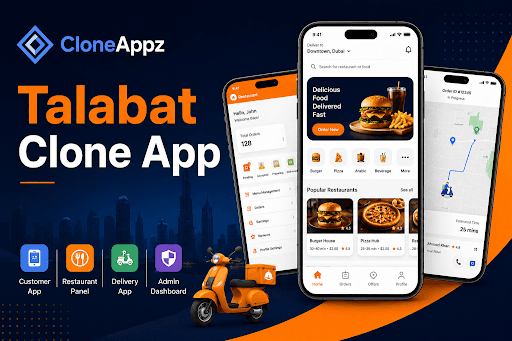
Talabat operates as a multi-vendor food delivery marketplace where customers, restaurants, delivery partners, and administrators interact through connected applications. Every stakeholder has a dedicated interface designed to simplify their daily operations while contributing to the platform's overall efficiency.
Customers can discover nearby restaurants, browse digital menus, place customised food orders, complete secure online payments, and monitor deliveries from preparation to doorstep. Restaurants receive incoming orders, update menus, manage inventory, launch promotional campaigns, and analyse business performance through their dashboard. Delivery partners efficiently manage assigned deliveries using GPS navigation and real-time order updates, while administrators oversee the entire marketplace from a central management panel.
Businesses planning to build an app like Talabat should focus on creating a scalable ecosystem rather than a standalone ordering application. A successful food delivery marketplace depends on smooth coordination between all participants, supported by reliable backend architecture and intelligent automation.
Why Talabat Clone App Development Is Gaining Global Demand
The demand for online food delivery services continues to increase due to changing consumer lifestyles, growing smartphone penetration, digital payment adoption, and the rapid expansion of cloud kitchens. Entrepreneurs are increasingly investing in digital platforms that can efficiently connect customers with restaurants while generating multiple revenue streams.
Choosing talabat clone app development enables businesses to reduce development time, minimise technical risks, and accelerate market entry by leveraging an already validated marketplace model. Instead of investing substantial resources in building every feature from the ground up, organisations can customise an existing framework to align with their operational goals and regional market requirements.
Another major advantage is scalability. Modern clone solutions allow businesses to begin operations within a single city and gradually expand into multiple regions without rebuilding the application architecture. This flexibility makes clone-based platforms attractive for startups, restaurant chains, and enterprises looking to establish a long-term presence in the food delivery industry.
What Is a Talabat Clone App?
A talabat clone app is a customisable food delivery software solution inspired by the core functionality and operational structure of Talabat. It enables entrepreneurs to launch their own branded food delivery marketplace while modifying the design, features, business logic, payment systems, and delivery workflows according to specific market needs.
Unlike a simple application template, a professional clone solution provides a scalable technology foundation capable of supporting thousands of users, multiple restaurant partners, diverse payment methods, and real-time delivery management.
Businesses can also personalise every aspect of the platform, including user experience, commission models, promotional strategies, loyalty programmes, and customer engagement features, allowing them to establish a unique market identity.
Core Components of a Talabat Clone Platform
A successful food delivery ecosystem consists of several interconnected applications that work together to provide a seamless experience for every stakeholder.
Customer Application
The customer application serves as the primary interaction point between users and restaurants. It should provide an intuitive interface that simplifies food discovery, ordering, and payment while encouraging repeat purchases.
Essential customer features include:
- User registration and authentication
- Restaurant discovery
- Smart cuisine filters
- Advanced search functionality
- Digital menu browsing
- Food customisation
- Multiple payment methods
- Live order tracking
- Favourite restaurants
- Order history
- Ratings and reviews
- Push notifications
- In-app customer support
An intuitive customer application directly impacts user satisfaction and plays a critical role in customer retention.
Restaurant Management Panel
Restaurant partners require comprehensive management tools to efficiently handle incoming orders and maintain operational control.
The restaurant dashboard typically includes:
- Restaurant profile management
- Menu creation and editing
- Category management
- Inventory management
- Pricing updates
- Promotional campaigns
- Order acceptance
- Delivery assignment
- Sales reporting
- Customer analytics
A well-designed dashboard enables restaurant owners to manage daily operations efficiently while improving customer service quality.
Delivery Partner Application
Delivery executives represent the final stage of the customer journey, making their application equally important.
Core functionalities include:
- Rider registration
- Identity verification
- Availability management
- Order acceptance
- GPS navigation
- Route optimisation
- Delivery confirmation
- Earnings dashboard
- Wallet management
- Delivery history
- Performance analytics
An efficient delivery application improves operational productivity while reducing average delivery times.
Admin Dashboard
The administration panel acts as the control centre for the entire marketplace.
Administrators can manage:
- Customer accounts
- Restaurant approvals
- Delivery partner verification
- Commission settings
- Coupons and promotions
- Payment management
- Customer support
- Reports and analytics
- Marketing campaigns
- Platform settings
- Content management
- Business intelligence dashboards
A comprehensive admin dashboard provides complete visibility into platform performance while supporting informed business decisions.
Essential Features Every Talabat Clone App Should Include
Launching a successful white label food delivery app requires much more than basic ordering functionality. Modern users expect convenience, speed, personalisation, and security throughout their entire ordering experience. Incorporating advanced features helps businesses improve customer satisfaction while increasing operational efficiency.
Intelligent Restaurant Discovery
Finding the right restaurant should be quick and effortless. Customers should be able to browse restaurants based on cuisine, location, ratings, estimated delivery time, pricing, dietary preferences, and ongoing offers.
Advanced search algorithms significantly improve user experience by reducing the time required to discover suitable dining options.
Personalised Food Recommendations
Modern white label food delivery platforms utilise ai integration to analyse customer preferences, browsing behaviour, previous purchases, favourite cuisines, and ordering frequency. Based on this data, the system recommends restaurants and dishes that match individual customer interests.
Personalised recommendations improve customer engagement, increase average order value, and encourage repeat purchases by presenting highly relevant options rather than generic listings.
Real-Time Order Tracking
Transparency has become one of the most important aspects of online food delivery. Customers expect continuous visibility throughout the delivery journey, from restaurant confirmation to rider arrival.
Real-time GPS tracking allows users to monitor food preparation, rider location, estimated arrival time, and delivery progress without repeatedly contacting customer support.
Multiple Secure Payment Options
Customers prefer flexibility when making online transactions. Supporting various payment methods improves conversion rates and accommodates diverse customer preferences.
Common payment options include:
- Credit cards
- Debit cards
- Digital wallets
- UPI
- Net banking
- Cash on delivery
- Buy Now Pay Later services
Secure payment gateways combined with encrypted transactions ensure safe and reliable digital payments.
Smart Push Notifications
Timely notifications keep customers informed while improving overall platform engagement.
Examples include:
- Order confirmation
- Restaurant acceptance
- Food preparation updates
- Delivery partner assignment
- Estimated arrival notifications
- Promotional campaigns
- Discount offers
- Loyalty rewards
Automated communication reduces uncertainty while maintaining customer engagement throughout the ordering process.
Ratings and Review System
Customer feedback plays an important role in building trust across the platform. Reviews help future customers make informed decisions while encouraging restaurants to maintain high service standards.
Administrators can also monitor ratings to identify underperforming restaurants and improve overall marketplace quality.
Loyalty and Rewards Programme
Customer acquisition is expensive, making retention strategies essential for long-term profitability.
Loyalty programmes reward repeat customers through:
- Cashback offers
- Reward points
- Referral bonuses
- Exclusive discounts
- Birthday rewards
- Membership benefits
These incentives increase repeat purchases while strengthening customer loyalty.
Advanced Technologies Used in Talabat Clone App Development
Building a modern food delivery platform requires advanced technologies capable of supporting scalability, automation, security, and operational efficiency. Businesses that invest in intelligent technology stacks are better positioned to compete in rapidly evolving digital markets.
Artificial Intelligence for Smarter Operations
Artificial intelligence has transformed the food delivery industry by automating decision-making and enhancing customer experiences.
Modern platforms use AI for:
- Restaurant recommendations
- Customer behaviour analysis
- Predictive ordering
- Dynamic pricing
- Fraud detection
- Chatbots
- Customer segmentation
- Marketing automation
- Demand forecasting
Businesses looking to create an app like Talabat should consider AI capabilities from the early stages of development to remain competitive in future markets.
Cloud Computing Infrastructure
Cloud infrastructure enables food delivery platforms to scale rapidly while maintaining high application availability.
Benefits include:
- Automatic scaling
- High uptime
- Disaster recovery
- Data redundancy
- Faster deployment
- Global accessibility
Cloud-native architecture ensures the platform remains responsive during peak ordering hours.
Machine Learning
Machine learning continuously improves operational performance by analysing customer behaviour, purchasing trends, and delivery patterns.
It supports:
- Personalised recommendations
- Customer retention
- Demand prediction
- Delivery optimisation
- Restaurant performance analysis
Business Analytics
Comprehensive analytics dashboards provide actionable insights into platform performance.
Businesses can monitor:
- Customer acquisition
- Revenue growth
- Delivery efficiency
- Restaurant performance
- Marketing ROI
- Order completion rates
- Peak ordering hours
These insights support data-driven decision-making and long-term business planning.
Technology Stack for Talabat Clone App Development
Selecting the right technology stack directly influences application performance, scalability, security, and future expansion.
Mobile Application Development
- Flutter
- React Native
- Swift
- Kotlin
Backend Development
- Node.js
- Laravel
- Django
- NestJS
Database Management
- PostgreSQL
- MongoDB
- MySQL
- Redis
Cloud Platforms
- Amazon Web Services (AWS)
- Microsoft Azure
- Google Cloud Platform
Maps and Navigation
- Google Maps
- Mapbox
Revenue Models of a Talabat Clone Platform
A successful food delivery platform should generate revenue through multiple channels rather than relying solely on delivery charges. Diversifying income sources improves business sustainability while creating opportunities for long-term profitability.
Commission on Restaurant Orders
The most common revenue model is commission-based earnings. Restaurants pay a fixed percentage or commission on every successful order processed through the platform. The commission rate may vary depending on restaurant categories, order volume, or partnership agreements.
This model creates a recurring source of revenue while allowing restaurants to access a larger customer base without investing heavily in their own technology infrastructure.
Delivery Charges
Customers are charged delivery fees based on several factors such as distance, order value, delivery location, peak hours, and weather conditions. Businesses can also implement dynamic pricing models that automatically adjust delivery fees according to demand.
Featured Restaurant Listings
Restaurants often seek greater visibility within food delivery applications. Businesses can offer premium listing packages that place restaurants at the top of search results, category pages, or promotional sections.
Sponsored placements help restaurants attract more customers while generating additional advertising revenue for the platform.
Subscription Memberships
Subscription plans provide customers with exclusive benefits such as unlimited free deliveries, priority customer support, cashback offers, and member-only discounts.
Recurring subscription income creates predictable monthly revenue while improving customer retention.
In-App Advertising
Food delivery platforms attract large numbers of active users, making them valuable advertising channels. Restaurants and food brands can promote their products through banners, sponsored campaigns, and promotional notifications within the application.
Surge Pricing During Peak Hours
During lunch, dinner, weekends, festivals, and special events, delivery demand increases significantly. Dynamic pricing allows businesses to temporarily increase delivery fees based on demand, ensuring better delivery availability while improving overall profitability.
Step-by-Step Talabat Clone App Development Process
Developing a scalable food delivery marketplace requires a structured approach that combines technical expertise with strategic business planning. Every development phase contributes to building a reliable, secure, and high-performing platform.
Market Research and Business Analysis
The development journey begins with understanding customer expectations, regional food delivery trends, competitor strategies, and market opportunities. Businesses should identify their target audience, preferred delivery model, pricing strategy, and monetisation approach before starting development.
A detailed market analysis also helps define unique selling propositions that differentiate the platform from existing competitors.
Requirement Gathering
Once business objectives are clearly defined, developers prepare detailed project documentation outlining platform features, user workflows, technical architecture, integrations, security requirements, and scalability goals.
This phase reduces development uncertainties and establishes a clear roadmap for execution.
UI and UX Design
User experience plays a critical role in the success of any food delivery application.
Designers create intuitive interfaces that simplify navigation for customers while providing efficient management dashboards for restaurants, delivery partners, and administrators.
A modern interface focuses on:
- Easy navigation
- Minimal checkout steps
- Fast restaurant discovery
- Clear order tracking
- Responsive mobile experience
- Accessible design
A well-designed interface improves customer engagement while reducing user abandonment.
Application Development
Once the design is approved, developers begin building the frontend and backend components of the platform.
This stage includes:
- Customer application development
- Restaurant dashboard development
- Delivery application development
- Admin panel development
- Database configuration
- Cloud infrastructure setup
- Business logic implementation
Businesses planning to develop an app like Talabat should ensure that the application architecture supports future scalability without requiring major redevelopment.
Third-Party Integration
Modern food delivery applications depend on numerous external services to deliver a seamless customer experience.
Development teams implement reliable api integration with:
- Payment gateways
- Google Maps
- SMS gateways
- Push notification services
- Email platforms
- CRM software
- Analytics tools
- Marketing automation platforms
- Customer support systems
Well-planned integrations improve operational efficiency while reducing manual intervention across business operations.
Quality Assurance and Testing
Before deployment, the platform undergoes comprehensive testing to ensure stability, security, and performance.
Testing includes:
- Functional testing
- Performance testing
- Security testing
- Compatibility testing
- Load testing
- User acceptance testing
Thorough testing helps eliminate bugs while ensuring a smooth user experience after launch.
Deployment and Post-Launch Support
After successful testing, the application is deployed on Android, iOS, and web platforms.
Post-launch services generally include:
- Performance monitoring
- Security updates
- Feature enhancements
- Bug fixing
- Cloud optimisation
- Technical maintenance
Continuous improvements help businesses remain competitive while adapting to changing customer expectations.
Estimated Cost of Talabat Clone App Development
The overall cost of talabat clone app development depends on various factors, including project complexity, feature requirements, technology stack, application platforms, third-party integrations, security standards, and future scalability requirements.
A simple MVP with essential ordering functionality generally requires a lower investment, whereas enterprise-grade platforms with intelligent automation, multilingual support, advanced analytics, and cloud-native architecture involve higher development costs.
Development Stage | Estimated Cost |
Basic MVP Solution | $6,000 – $12,000 |
Mid-Level Marketplace | $12,000 – $20,000 |
Enterprise Food Delivery Platform | $20,000 – $35,000+ |
Businesses should consider long-term scalability rather than focusing only on initial development costs. Investing in a scalable platform reduces future redevelopment expenses while supporting sustainable business growth.
Why Choose CloneAppz for Talabat Clone App Development
Selecting the right development partner is essential for building a scalable and reliable food delivery platform. An experienced team can help you reduce development risks, accelerate deployment, and ensure your application performs efficiently as your business grows.
CloneAppz is a trusted clone app development company that delivers customised food delivery solutions for startups, restaurant businesses, and enterprises. From UI/UX design and backend development to deployment and ongoing maintenance, the company provides end-to-end services tailored to your business requirements.
Whether you need a feature-rich marketplace, advanced integrations, or a reliable talabat clone script, CloneAppz focuses on developing secure, scalable, and future-ready solutions that help businesses launch quickly and compete effectively in the food delivery market.
Conclusion
The online food delivery industry continues to create new opportunities for businesses looking to establish a strong digital presence. Investing in talabat clone app development allows entrepreneurs to launch a scalable platform with modern features, streamlined operations, and multiple revenue opportunities.
If you want to develop an app like Talabat, choosing an experienced technology partner like CloneAppz ensures your platform is built with the right technology, security, and scalability to support long-term business growth.
Build it with CloneAppz
Food Delivery App
Restaurant ordering and delivery platform
Frequently Asked Questions
01How much does it cost to build an app like Talabat?
The cost typically ranges from $6,000 to $35,000+, depending on the number of features, supported platforms, third-party integrations, UI/UX complexity, and scalability requirements.
02How long does talabat clone app development take?
A standard food delivery platform usually takes 3 to 8 months to develop. The timeline depends on the project scope, custom features, and testing requirements.
03What features should a Talabat clone app include?
A modern platform should include customer, restaurant, delivery partner, and admin panels along with real-time order tracking, secure payments, restaurant management, ratings and reviews, push notifications, and analytics.
04Can I customise the Talabat clone script?
Yes. A professional talabat clone script can be customised with your branding, business model, payment gateways, delivery workflow, commission structure, languages, and additional features to meet your business goals.
05Is it better to build an app like Talabat from scratch or use a clone solution?
If you want faster market entry and lower development costs, a clone solution is a practical option. Businesses requiring unique workflows and advanced features can further customise the platform according to their requirements.
06Which technologies are used to develop an app like Talabat?
Popular technologies include Flutter or React Native for mobile apps, Node.js or Laravel for the backend, PostgreSQL or MongoDB for databases, and AWS or Google Cloud for cloud infrastructure.