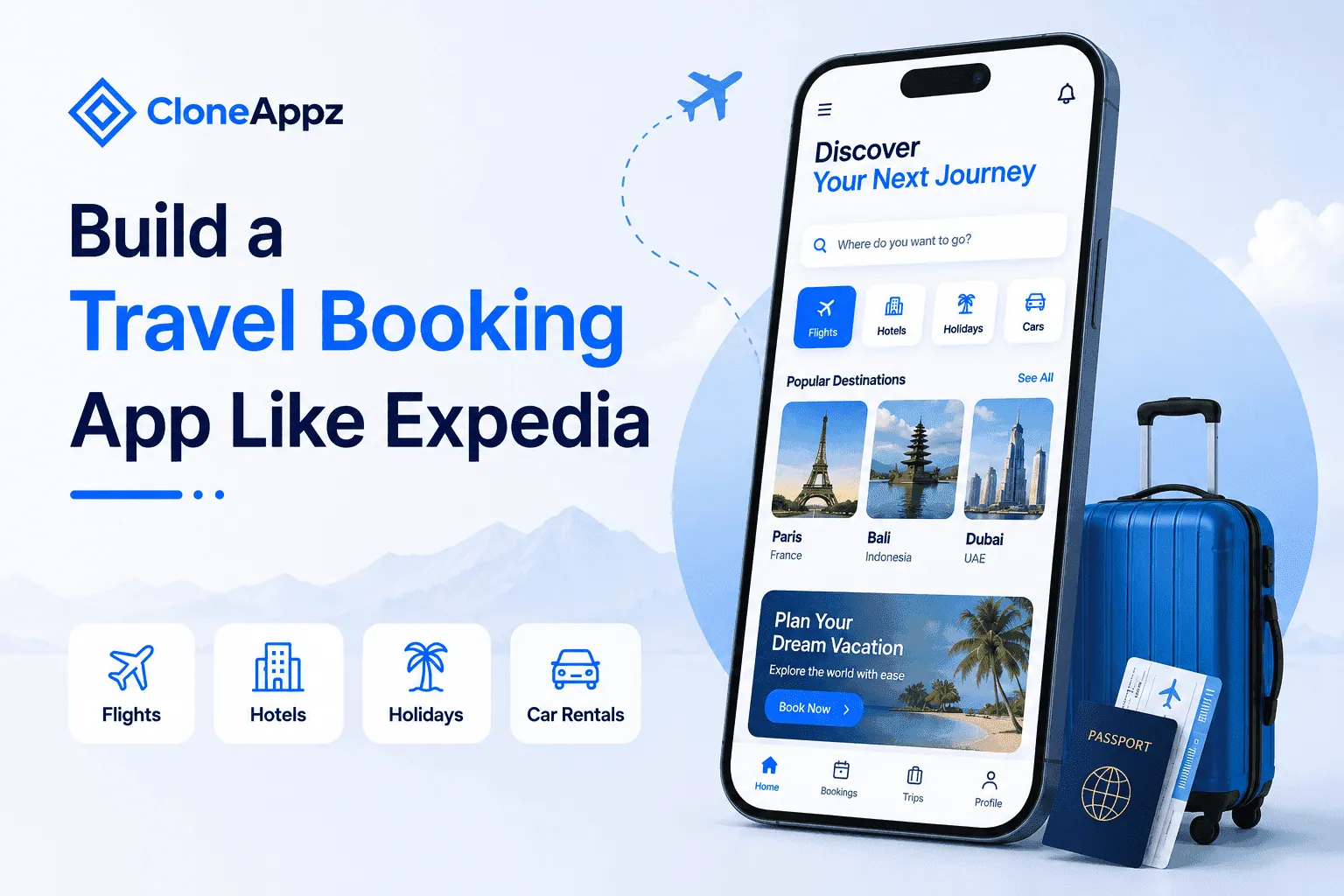
Expedia Clone: Build a Travel Booking App Like Expedia
Looking to create an app like Expedia? CloneAppz offers Expedia clone scripts, MVP development, and seamless API integration for fast, scalable launches.
By CloneAppz Team16 min read
Picture a regional travel agency that has spent a decade building relationships with hotels, local operators, and airlines. Every booking still runs through phone calls, spreadsheets, and a patchwork of supplier portals, while Expedia or Booking.com quietly absorb customers who now expect to search, compare, and book in a single app.
The travel agency’s founder isn't short on domain knowledge or supplier trust; what's missing is the platform.
This is the situation more travel businesses find themselves in every year, and it's why "Expedia clone" has become such a common search term among founders, hoteliers, and travel-tech entrepreneurs.
But a clone, done properly, isn't about copying Expedia pixel-for-pixel. It's about borrowing a proven architecture, the search-compare-book-manage flow that Expedia spent two decades refining, and rebuilding it around a business's own brand, supply chain, and market.
This guide covers what an Expedia clone actually is, why the market still has room for new entrants, the features and technology that matter, how to approach development the right way, what it costs, and the mistakes worth avoiding along the way.
What is an Expedia Clone, Really?
The Difference Between a Literal Clone and a Clone Script (Framework)
The word "clone" causes some confusion. A literal clone would mean copying Expedia's code, brand, and data, which is neither legal nor useful to anyone building an independent business.
What the term actually refers to in software development is a clone script or framework: a pre-structured application that replicates Expedia's core functionality (search, price comparison, booking, itinerary management) without any of its branding, content, or proprietary code.
Think of it the way a house builder thinks of a floor plan. The layout is proven and familiar, but the materials, finishes, and address are entirely the client's own.
An Expedia clone script gives a business that floor plan for a travel booking platform, saving months of foundational engineering while leaving every business-specific decision, from supplier integrations to pricing logic, in the founder's hands.
What CloneAppz Means by "Expedia Clone App Development"
At CloneAppz, Expedia clone app development refers to building a customizable online travel booking platform using this proven framework as the starting point, then adapting it to the client's niche, supply network, and growth plan.
That might mean a full-featured OTA (online travel agency) app for a startup, a booking layer fitted onto an existing hospitality brand, or a lean MVP built to validate demand in a specific region before any major investment happens.
This framework is a head start, not a finished product, and the real work lies in its configuration, integration, and scaling.
Why the OTA Market Still Has Room for a New Player
Online travel booking has moved well past its early-adopter phase. Global travel app usage has climbed steadily since the pandemic recovery, and the online travel agency segment continues to grow at a healthy pace year over year as travellers shift away from offline booking channels.
Mobile-first booking behaviour has become the default rather than the exception, especially among travellers under 40.
This growth isn't concentrated only in giants like Expedia and Booking.com. It's spread across thousands of smaller, regional, and niche platforms that serve travellers those giants don't serve well.
Where Big Players Like Expedia Fall Short for Niche and Regional Audiences
Expedia's scale is also its limitation. A platform built to serve hundreds of millions of users globally cannot easily prioritize the needs of a specific region, language, currency, or travel style. This creates real openings:
- Regional and domestic travel markets where local currency, local payment methods, and local supplier relationships matter more than global inventory breadth.
- Corporate and business travel management, where companies want approval workflows, expense integration, and dedicated account management that consumer-facing giants don't offer.
- Niche and experiential travel, such as adventure tourism, wellness retreats, religious travel, or luxury bespoke itineraries, where generic search results feel impersonal.
- Markets with lower card penetration, where cash-on-arrival, local wallets, or installment payment options increase conversion far more than Expedia's standard checkout flow.
None of these gaps require out-innovating Expedia globally. They require serving a specific audience better than a generalist platform ever could.
Who Should Actually Consider Building One
An Expedia-style platform makes sense for-
- Travel agencies moving from offline to digital
- Hospitality groups that want to control their own booking channel instead of paying commission to aggregators
- Regional OTA startups entering underserved markets
- B2B travel management companies serving corporate clients can benefit most from choosing to create an app like Expedia.
It generally does not make sense for a business with no existing supplier relationships or travel industry context, since the platform is only as strong as the inventory and partnerships behind it.
Core Features an Expedia-Like Platform Needs
The features of any digital app solution either make it or break it. Here are some of the needed features that we include during Expedia clone development to ensure that it never breaks.
Traveller-Facing Features
Search, filters, and price comparison
This feature forms the heart of the experience. Travellers expect to filter by date, price, location, amenities, and traveller ratings, then compare pricing across multiple suppliers in a single view, exactly as they would on Expedia itself.
Booking and itinerary management
This covers real-time availability checks, instant booking confirmation, and a dashboard where travellers can view, modify, or cancel upcoming trips without contacting support.
Reviews, wishlists, and loyalty mechanics
These features build the retention layer. Verified reviews build trust, wishlists reduce booking abandonment by letting users save options for later, and a simple loyalty or rewards structure gives repeat travellers a reason to book directly rather than shopping around again next time.
Supply-Side and Partner Features
Property, airline and vendor onboarding
It determines how easily new supply joins the platform. A self-service or semi-managed onboarding flow, where hotels, tour operators or transport providers can list inventory and manage their own listings, reduces the operational burden on the platform owner considerably.
Inventory and rate management
These tools let suppliers control pricing, availability calendars, and special offers in real time, which is essential for avoiding overbooking and rate mismatches, two of the most common complaints in early-stage OTA platforms.
Admin and Backend Capabilities
The admin panel is where the business actually runs.
- Commission management handles how the platform earns revenue from each booking.
- Reporting tools give visibility into booking trends, supplier performance, and revenue.
- A structured dispute resolution workflow protects both travellers and suppliers when bookings go wrong.
The Technology That Powers a Platform Like Expedia
To start with, let’s understand why API integration is the real backbone of an Expedia clone.
If there's one area that separates a genuinely functional Expedia clone from a demo shell, it's API integration. Expedia's search results feel comprehensive because the platform pulls live inventory from dozens of sources simultaneously.
Replicating that requires connecting to Global Distribution Systems (GDS) such as Amadeus, Sabre, and Travelport for flight and hotel inventory, along with OTA and channel manager APIs for hotel rates and availability, and payment gateway APIs that support multiple currencies and local payment methods.
Each of these integrations comes with its own authentication requirements, rate limits, and data licensing terms, and getting them wrong is one of the most common reasons early-stage travel platforms stall after launch.
A development partner's experience with these specific integrations matters far more than how quickly they can spin up a front-end interface.
Choosing Between a Pre-Built Script and Custom Development
Approach | What It Covers | Timeline & Cost | Best For |
Pre-built clone script | Front-end and core booking logic ready out of the box | Fastest, lowest cost | Founders who want proven application structure without rebuilding the basics |
Custom API integration | GDS, payment, and supplier connections tailored to the business | Moderate addition to timeline and cost | Matching the platform to a specific supplier mix and target market |
Hybrid approach (recommended) | Clone script framework + custom integration work | Balanced timeline and cost | Most founders — combines speed with the flexibility to fit real business needs |
Fully custom development | Entire platform built from scratch | Longest timeline, highest cost | Rarely necessary; only for highly unusual requirements the framework can't support |
Security, Payments and Compliance Considerations
Travel platforms handle sensitive payment data and personal travel details, which makes security non-negotiable.
PCI-DSS compliance is essential for any platform processing card payments, data encryption protects traveller information both in transit and at rest, and multi-currency payment gateway support is what actually determines whether international travellers complete a booking or abandon it at checkout.
How to Build an App Like Expedia, Step by Step
How you can build an app like Expedia and ensure that you stand apart from your competitors.
Step 1: Define Your Niche and Business Model
Before any development begins, the business model needs to be clear.
Will the platform earn through commission on bookings, subscription fees for suppliers, advertising, or a combination? Is the target audience leisure travellers, business travellers, or a specific niche?
These decisions shape every feature and integration choice that follows, and skipping this step is why many travel platforms end up building features nobody asked for.
Step 2: Start with an MVP, Not a Full Platform
This is where most first-time OTA founders go wrong.
An MVP (minimum viable product) for a travel booking app typically includes-
- Core search and booking functionality for one or two supplier categories
- A basic admin panel
- Payment processing
It deliberately leaves out advanced features like loyalty programmes, multi-trip planners, or group booking tools until real user demand justifies building them.
The logic is straightforward: a full-featured platform costs significantly more and takes considerably longer to build, and there's no way to know in advance which features travellers will actually use.
An MVP validates demand, supplier interest, and booking behaviour with real users, and that data then guides which features deserve investment in version two. Businesses that skip the MVP stage often end up rebuilding major parts of their platform within the first year, once real usage patterns contradict their original assumptions.
Step 3: Integrate Core Travel APIs
With the MVP scope defined, the next phase is connecting to the GDS, OTA, or supplier APIs that will actually populate the platform with bookable inventory.
This is typically the most technically demanding phase of the build and the one most likely to affect the launch timeline, so scope it and start it early rather than treating it as an afterthought once the interface is finished.
Step 4: Build, Test and Launch
Development proceeds through the core booking flow, admin panel, and supplier dashboard, followed by a thorough testing cycle covering booking accuracy, payment processing, load handling, and security.
Businesses that launch an app like Expedia should treat go-live as the start of a feedback loop rather than a finish line.
Step 5: Scale with Data and Partnerships
Once live, the platform's own booking and search data becomes the best guide for what to build next.
- Which searches return no results?
- Where do users abandon the booking flow?
- Which supplier categories get the most engagement?
Answering these questions with real data, and expanding supplier partnerships accordingly, is how a lean MVP grows into a platform genuinely competitive with the giants.
What Does Expedia Clone App Development Actually Cost?
We at CloneAppz build an app like Expedia for you in the range of $5,000 – $35,000. The exact cost figure highly depends upon the level of customizations you need in an app and other factors such as-
Key Cost Drivers
Cost varies more than most pricing pages let on, and it depends heavily on a handful of factors:
- The number and complexity of API integrations required
- Whether the platform needs iOS, Android, and web versions or just one
- The depth of customization versus a framework's default structure, and the level of post-launch support included.
A platform integrating with three GDS providers and a multi-currency payment gateway will always cost more than one built for a single region with a handful of local suppliers, regardless of how similar the two look on the surface.
MVP vs Full-Scale Platform: Ballpark Ranges
An MVP-scoped travel booking app, covering core search, booking, and a basic admin panel for one or two supplier categories, generally sits at the lower end of custom development budgets.
A full-scale platform with multiple API integrations, advanced supplier tools, loyalty features, and multi-platform support represents a considerably larger investment, often several times that of an MVP.
Rather than quoting a single fixed number the way some clone script vendors do, it's worth understanding that the real driver of cost is scope, not the framework itself. A clear MVP-first scope keeps the initial investment manageable while leaving room to expand as the business validates demand.
How to Choose the Right Clone App Development Company
The efficiency and effectiveness of your digital solutions largely depend upon the clone app development company you choose. So be wise and read ahead to understand how to choose the right one.
Questions to Ask Before You Sign a Contract
A few questions separate a genuinely capable development partner from one that's simply reselling a template.
- Ask which specific GDS or OTA APIs they've integrated before, not just whether they "can integrate APIs."
- Ask what happens to the source code after launch, whether it's fully owned by the business or licensed from the vendor.
- Ask what post-launch support includes and for how long.
- Ask to see a live, working platform they've built, not just a feature list or demo video.
Red Flags in "Ready in a Week" Promises
Timelines that sound too fast usually are. A functioning demo shell can be assembled quickly, but a platform with real API integrations, tested payment flows, and a working supplier onboarding process takes meaningfully longer to build properly.
Any vendor promising a fully live, integration-ready OTA platform within days is either overselling the timeline or underdelivering on what "live" actually means.
It's worth asking directly what "live within a week" includes and, more importantly, what it doesn't.
Why Ownership, Source Code and Post-Launch Support Matter Most
The single biggest long-term risk in clone app development isn't the initial build; it's what happens afterwards. A business that doesn't own its source code outright is locked into its vendor for every future change, however small.
Full source code ownership, transparent licensing for any third-party components, and a clearly defined support period after launch matter far more to a platform's long-term health than how quickly the first version goes live.
Common Mistakes Businesses Make When Building a Travel Booking App
Over-building before validating demand is the most expensive mistake in this category. Founders often want every feature Expedia has on day one, without confirming that their own audience wants or needs it.
Ignoring API rate limits and data licensing terms causes real operational problems later. Some GDS and supplier APIs cap requests per minute or require specific data usage agreements, and platforms that don't plan around these limits can hit unexpected bottlenecks as booking volume grows.
Underestimating post-launch supportleaves platforms vulnerable right when they need stability most. Travel bookings involve live payments and time-sensitive inventory, so bugs or downtime in the weeks after launch directly cost the business money and traveller trust. A support plan covering only the first month rarely matches how long a new platform needs hands-on attention.
Why Businesses Choose CloneAppz for Expedia Clone App Development
Various other agencies can develop an app like Expedia. So what makes CloneAppz different from others? Read along to find out!
Our Approach to MVP-First Travel Platform Builds
CloneAppz builds Expedia-style platforms around a deliberately MVP-first philosophy.
Rather than pushing every business towards a maximalist feature set from day one, our process starts by defining the smallest version of the platform that can validate real demand, then expands based on actual booking and search data once the business is live.
API Integration Expertise Across GDS and OTA Systems
Because API integration is where most travel platform builds succeed or stall, it's the area we invest the most technical attention in. Our team works directly with GDS providers, OTA supplier APIs, and multi-currency payment gateways, so the platform launches with inventory and payment flows that actually work in production.
What Ownership and Support Look Like with CloneAppz
Every business we work with retains full ownership of its source code, with clear licensing on any third-party components used. Post-launch, our support extends well beyond the first few weeks, covering the bug fixes and adjustments that come up once real travellers start using the platform.
Conclusion: Is Building an App Like Expedia Worth It in 2026?
For the right business, yes, but only with the right strategy behind it.
The travel booking market still has real room for platforms that serve a specific region, niche, or traveller type better than a generalist giant ever could, and a proven clone framework removes much of the foundational engineering work that would otherwise eat up months of development time.
What actually determines success isn't how quickly the first version launches, but whether the MVP fulfills genuine demand, whether the API integrations are built to hold up under real booking volume, and whether the development partner treats source code ownership and post-launch support as seriously as the initial build.
Get those fundamentals right, and an Expedia clone becomes less of a gamble and more of a genuinely viable way to enter the online travel market.
Frequently Asked Questions
01How much does it cost to develop an app like Expedia?
Cost depends primarily on the number of API integrations, the platforms supported (iOS, Android, web), and the depth of customisation. An MVP-scoped build costs considerably less than a full-scale platform with multiple integrations and advanced features.
02What is an Expedia clone script?
An Expedia clone script is a pre-built software framework that replicates the core search, comparison, and booking functionality of Expedia, without any of Expedia's branding or proprietary code. It serves as a customizable starting point for building an independent travel booking platform.
03How long does it take to build a travel booking app like Expedia?
Timelines vary based on scope, but an MVP with core booking functionality and one or two API integrations typically takes several weeks to a few months. Full-scale platforms with multiple GDS integrations and advanced features take considerably longer.
04Can I integrate real flight and hotel data into my Expedia clone?
Yes. This is done through GDS providers such as Amadeus, Sabre, and Travelport for flights, and OTA or channel manager APIs for hotel inventory and rates. This integration work is typically the most technically involved part of the build.
05Is it legal to build an app similar to Expedia?
Yes, building a travel booking platform with similar functionality to Expedia is legal, provided the platform doesn't copy Expedia's branding, trademarks, or proprietary code. Clone scripts replicate functionality and workflow, not intellectual property.
06What is the difference between a clone app and a custom-built travel platform?
A clone app uses a pre-built framework as its foundation, which speeds up development of core functionality, while a fully custom platform is built from scratch. Most practical builds use a hybrid approach: a proven framework for the application structure, with custom development for API integrations and business-specific features.
07Do I need a large budget to launch an MVP travel booking app?
No. An MVP is specifically designed to validate demand with a minimal, functional feature set, which keeps the initial investment considerably lower than a full-scale platform. Additional features and integrations can be added once real usage data supports the investment.
08Which APIs are used in Expedia-like travel platforms?
Common integrations include GDS APIs (Amadeus, Sabre, Travelport) for flight and hotel inventory, OTA and channel manager APIs for hotel rates and availability, and multi-currency payment gateway APIs for processing bookings across different regions.