Contact Us
Blogs

Character AI Clone Development: Build a Scalable AI Character Platform
Build a scalable AI character platform with CloneAppz. Explore character AI clone development, features, tech stack, voice AI, and enterprise-ready solutions.
Mobile App

Artificial intelligence has transformed the way people communicate, learn, entertain themselves, and engage with digital platforms. Among the fastest-growing AI products, character-based conversational platforms have created an entirely new category of interactive experiences where users can chat with AI personalities that mimic celebrities, fictional characters, historical figures, educators, business assistants, or completely custom virtual personas. These applications are powered by advanced large language models, memory systems, contextual reasoning, voice synthesis, and personalization engines that make conversations feel more natural than traditional chatbots.
As user expectations continue to evolve, businesses are actively investing in character ai clone development to launch their own intelligent conversational platforms with unique branding, premium AI features, and scalable infrastructure. From entertainment startups to EdTech companies and enterprise AI providers, organizations are exploring AI character platforms to improve customer engagement, create subscription-based products, and unlock new monetization opportunities.
Whether you plan to launch an AI companion platform, an educational assistant, a customer engagement solution, or a niche conversational application, building a scalable architecture is essential for long-term growth. Modern AI applications must handle millions of conversations simultaneously while maintaining low response times, contextual memory, multilingual support, and enterprise-grade security.
CloneAppz specializes in developing next-generation AI applications tailored to different business requirements. As an experienced clone app development company, our team builds highly scalable AI solutions equipped with advanced language models, voice intelligence, cloud-native infrastructure, and customizable user experiences that help businesses launch faster while maintaining complete ownership of their platform.
Understanding Character AI Clone Development and Its Growing Business Potential
Character AI clone development refers to building an intelligent conversational platform where users interact with AI-generated personalities capable of responding naturally across multiple topics. Unlike conventional chatbots that follow predefined scripts, AI characters continuously generate context-aware responses using advanced language models trained on billions of parameters.
Modern AI character platforms combine multiple technologies, including Natural Language Processing (NLP), transformer-based language models, Retrieval-Augmented Generation (RAG), semantic search, vector databases, reinforcement learning, and personalized memory systems. These technologies work together to create conversations that feel dynamic, engaging, and increasingly human-like.
Businesses are investing in these platforms because conversational AI has expanded far beyond customer support. Today, AI characters serve as tutors, virtual influencers, gaming companions, healthcare assistants, productivity coaches, relationship advisors, language teachers, and entertainment personalities.
A scalable AI character platform also enables organizations to introduce industry-specific AI personas that understand domain knowledge while maintaining consistent communication styles. This flexibility makes AI character applications suitable for multiple business models across healthcare, finance, education, media, gaming, eCommerce, and enterprise collaboration.
Why Businesses Are Investing in AI Character Platforms
The global demand for personalized AI interactions has increased significantly due to improvements in generative AI technologies. Consumers no longer expect robotic chatbot responses. Instead, they prefer conversational experiences that remember previous interactions, understand emotions, adapt personalities, and communicate naturally.
Organizations benefit from AI character platforms because they:
Deliver Highly Personalized User Experiences
Modern AI characters remember user preferences, previous conversations, favorite topics, learning progress, and behavioral patterns to generate increasingly personalized responses over time.
Increase User Retention
Unlike static chatbot applications, AI character platforms encourage repeated engagement by creating emotional connections, interactive storytelling, personalized recommendations, and evolving conversations.
Create New Revenue Opportunities
Businesses can monetize AI character platforms through premium subscriptions, enterprise licensing, AI marketplace commissions, virtual gifting, token purchases, voice upgrades, and custom character creation services.
Reduce Operational Costs
AI-powered conversational assistants automate thousands of repetitive interactions, reducing customer support costs while maintaining high service availability.
Scale Globally
Cloud-native AI infrastructures allow businesses to support millions of users across multiple countries while offering multilingual conversations, localized content, and region-specific AI behaviors.
Core Components Required to Build a Scalable AI Character Platform

Developing an enterprise-grade AI platform requires much more than integrating a language model into a chat interface. Every system component must work together to deliver fast, intelligent, and context-aware conversations.
AI Language Model Layer
The language model serves as the foundation of the entire platform. It understands user intent, predicts responses, maintains conversational flow, and generates meaningful content in real time.
Popular deployment options include:
Open-source LLMs
Proprietary language models
Fine-tuned enterprise models
Industry-specific AI models
Hybrid multi-model architecture
Many businesses planning to develop an app like character ai choose hybrid architectures that intelligently switch between different models depending on query complexity, reducing infrastructure costs while improving response quality.
Conversation Management Engine
Conversation management is responsible for maintaining contextual continuity across user interactions.
Major responsibilities include:
Session management
Context preservation
Intent recognition
Dynamic prompt generation
Response optimization
Multi-turn dialogue management
Personality consistency
Without an advanced conversation engine, AI responses quickly become repetitive and inconsistent.
Long-Term Memory System
One of the biggest differentiators between basic chatbots and premium AI character platforms is persistent memory.
Memory architecture typically stores:
User preferences
Relationship history
Favorite conversation topics
Custom personality settings
Learning progress
Frequently discussed subjects
Emotional interaction history
Instead of restarting every conversation from scratch, the AI continuously improves future responses based on stored contextual information.
Character Personality Engine
Each AI personality requires unique behavioral characteristics that remain consistent throughout conversations.
Personality configuration generally includes:
Communication tone
Vocabulary style
Humor level
Emotional intelligence
Domain expertise
Conversation boundaries
Creativity settings
Role-playing behavior
The personality engine ensures every AI character maintains its unique identity across thousands of conversations.
Essential Features Every Character AI Clone Should Include
A competitive AI platform requires significantly more functionality than a traditional messaging application. Businesses should focus on building intelligent features that improve engagement, personalization, and scalability.
AI Character Marketplace
Users should be able to browse thousands of AI personalities across different categories.
Examples include:
Historical personalities
Fictional characters
Business mentors
Language tutors
Fitness coaches
Mental wellness companions
Entertainment personalities
Gaming assistants
A searchable marketplace improves discovery while encouraging user exploration.
Custom Character Builder
One of the most valuable features allows users to create their own AI personalities.
The builder typically supports:
Character name
Avatar customization
Personality configuration
Writing style
Knowledge domain
Emotional behavior
Conversation examples
Privacy settings
This functionality significantly increases platform engagement because users become creators instead of only consumers.
Smart Prompt Optimization
Prompt engineering directly affects AI response quality.
An intelligent prompt optimization engine automatically enriches user prompts by adding contextual instructions before they reach the language model. This improves accuracy while maintaining consistent personality traits.
Dynamic Context Switching
Enterprise AI platforms should intelligently recognize topic transitions during conversations.
For example, if a user moves from discussing travel to programming, the AI adjusts its reasoning strategy without losing previous conversational context.
This creates significantly smoother conversations.
Ready to Launch Your Character AI Clone Platform?
Build a scalable AI character platform with CloneAppz. From intelligent conversations and voice AI to custom character creation and enterprise-grade infrastructure, our experts deliver secure, feature-rich solutions tailored to your business goals.
AI Workflow Behind Every Intelligent Character Conversation
Although conversations appear instantaneous, several AI systems operate simultaneously behind the scenes.
A typical workflow includes:
User Query Processing
The platform receives user input and performs language detection, profanity filtering, spelling correction, and intent recognition before forwarding the request to downstream AI services.
Semantic Understanding
Embedding models convert the query into numerical vectors that capture semantic meaning rather than simply matching keywords.
These embeddings help retrieve relevant contextual information from vector databases.
Memory Retrieval
Before generating a response, the AI retrieves previous conversations, saved memories, user preferences, and historical context.
This ensures continuity throughout long-term interactions.
Knowledge Retrieval
Modern AI systems frequently integrate Retrieval-Augmented Generation to fetch updated information from external databases, documents, APIs, or enterprise knowledge bases.
This approach improves factual accuracy while reducing hallucinations.
Response Generation
The language model combines user input, retrieved memories, contextual prompts, personality instructions, and external knowledge to generate a coherent response.
Safety Moderation
Generated responses pass through moderation layers that detect harmful content, misinformation, policy violations, or sensitive outputs before being delivered to users.
Building an AI Platform That Supports Millions of Conversations Simultaneously
Scalability should be considered from the earliest stages of development rather than after user growth begins.
A production-ready AI platform generally follows a distributed cloud architecture consisting of independent microservices responsible for authentication, AI inference, memory management, notifications, billing, analytics, recommendation engines, moderation, and content storage.
Instead of relying on a single server, requests are distributed across multiple cloud instances using intelligent load balancing mechanisms. This architecture ensures uninterrupted service even during sudden traffic spikes.
Containerized deployments using Kubernetes enable automatic horizontal scaling based on CPU utilization, GPU workload, memory consumption, or concurrent user sessions.
Distributed caching systems reduce repeated database queries, while Content Delivery Networks accelerate media delivery worldwide.
These infrastructure decisions become increasingly important for businesses planning to build an ai chat apps like character ai capable of supporting enterprise-scale user bases without sacrificing performance.
User Roles Within a Character AI Platform
A scalable AI application typically includes multiple user roles with different permissions and management capabilities.
End Users
Users interact with AI characters, create conversations, purchase subscriptions, customize personalities, and manage personal settings.
Character Creators
Creators design AI personalities, publish them within the marketplace, update prompts, monitor analytics, and generate recurring revenue.
Moderators
Moderators review reported conversations, manage inappropriate content, enforce community policies, and oversee platform safety.
Administrators
Platform administrators manage users, AI models, billing systems, moderation tools, analytics dashboards, subscription plans, infrastructure monitoring, and security configurations from a centralized admin panel.
Future-Proofing Your AI Character Platform
Generative AI technologies continue evolving rapidly. Businesses should build modular architectures capable of integrating new AI models without rebuilding the entire application.
Future-ready platforms support plug-and-play AI services, interchangeable language models, multi-cloud deployments, advanced personalization engines, and continuous model fine-tuning. This flexibility allows organizations to remain competitive as new AI innovations emerge.
Technology Stack Required for Character AI Clone Development
Selecting the right technology stack directly impacts the scalability, performance, and maintainability of an AI-powered conversational platform. Since an AI character application processes thousands of concurrent conversations, retrieves contextual memories, performs AI inference, and manages multimedia interactions simultaneously, every layer of the architecture should be optimized for speed and reliability.
CloneAppz follows a modular microservices architecture that allows every component to scale independently without affecting the overall platform performance.
A modern technology stack generally includes:
Frontend Technologies
The frontend is responsible for delivering a responsive and engaging user experience across web and mobile platforms.
Common frontend technologies include:
React.js
Next.js
React Native
Flutter
Swift
Kotlin
These frameworks provide fast rendering, cross-platform compatibility, offline support, and seamless real-time messaging experiences.
Backend Technologies
The backend manages authentication, business logic, AI orchestration, subscriptions, user management, moderation, analytics, and API communication.
Popular backend frameworks include:
Node.js
NestJS
Python FastAPI
Django
GoLang
A scalable backend architecture should support asynchronous processing, API rate limiting, distributed caching, and high concurrency.
Database Infrastructure
Different databases serve different purposes within an AI application.
Relational Databases
PostgreSQL
MySQL
NoSQL Databases
MongoDB
Cassandra
Caching
Redis
Vector Databases
Pinecone
Milvus
Weaviate
ChromaDB
Object Storage
AWS S3
Google Cloud Storage
Using multiple specialized databases ensures optimal performance for structured data, AI embeddings, media storage, and session management.
Cloud Infrastructure
Cloud-native deployment allows the platform to automatically scale based on user demand.
Preferred cloud platforms include:
AWS
Microsoft Azure
Google Cloud Platform
Cloud services typically manage:
GPU instances
Auto scaling
Object storage
Monitoring
Container orchestration
Global CDN
Disaster recovery
Backup automation
Develop an Enterprise-Ready Character AI Voice Clone
Launch a secure, scalable, and feature-rich AI character platform with custom personas, intelligent conversations, voice capabilities, and cloud-native architecture built to support long-term business growth.
AI Models That Power Modern Character Platforms
The language model serves as the intelligence layer of the application. Selecting the right model depends on business objectives, expected traffic, inference costs, and customization requirements.
Organizations developing enterprise-grade conversational applications often combine multiple AI models instead of relying on a single language model.
Common options include:
Open Source Models
Open-source models provide flexibility for businesses that want complete ownership of their AI infrastructure.
Advantages include:
Complete customization
Lower long-term licensing costs
Private deployment
Fine-tuning capabilities
Enterprise control
Proprietary AI Models
Hosted AI models offer excellent language understanding with minimal infrastructure management.
Benefits include:
Faster deployment
High-quality responses
Regular model improvements
Managed infrastructure
Hybrid AI Architecture
Many successful AI applications intelligently route requests between multiple language models depending on query complexity.
For example:
Simple conversations use lightweight models.
Technical questions use advanced reasoning models.
Creative storytelling uses specialized creative models.
This significantly reduces operational costs while maintaining premium user experiences.
Implementing Character AI Voice Clone Capabilities

Voice interaction has become one of the most valuable differentiators for AI character platforms. Instead of relying only on text conversations, businesses are integrating realistic speech synthesis and speech recognition to create immersive experiences.
A well-designed character ai voice clone feature combines several AI technologies working together in real time.
Speech-to-Text Processing
The conversation begins when a user speaks into the application.
Speech recognition services convert spoken language into structured text while filtering background noise, identifying punctuation, and detecting multiple languages.
Language Model Processing
After transcription, the text is sent to the AI engine, where contextual reasoning generates an intelligent response.
The model also considers previous conversations, personality traits, user preferences, and memory before producing the output.
Text-to-Speech Generation
The generated response is converted back into natural speech.
Modern speech synthesis engines can produce:
Human-like emotions
Different accents
Age variations
Gender options
Speaking styles
Dynamic tone adjustment
Voice Personalization
Users increasingly expect AI characters to have unique voices.
Businesses can allow users to configure:
Speaking speed
Voice pitch
Emotional tone
Regional accents
Character-specific voices
These capabilities significantly improve immersion and user engagement.
Designing a Personalized Memory Architecture
Memory is one of the defining characteristics of intelligent conversational systems. Users expect AI characters to remember previous interactions naturally rather than treating every conversation as a new session.
Memory systems generally operate at multiple levels.
Short-Term Memory
Short-term memory stores the active conversation context.
It helps the AI understand:
Previous questions
Follow-up requests
Conversation flow
Temporary instructions
Long-Term Memory
Long-term memory stores information across multiple sessions.
Examples include:
User interests
Favorite topics
Personal preferences
Conversation history
Learning progress
Relationship context
Semantic Memory
Semantic memory stores generalized knowledge rather than conversation history.
It allows AI characters to recall facts learned from documents, knowledge bases, or enterprise datasets.
Retrieval-Augmented Generation for Better AI Responses
One limitation of traditional language models is that they rely primarily on training data. Retrieval-Augmented Generation (RAG) solves this problem by retrieving external information before generating responses.
A RAG pipeline generally follows these steps:
User submits a query.
The query is converted into vector embeddings.
Similar documents are retrieved.
Retrieved information is merged into the prompt.
The language model generates a context-aware response.
Benefits include:
Improved factual accuracy
Reduced hallucinations
Access to updated information
Better enterprise knowledge integration
Higher response relevance
This architecture is particularly useful for organizations that build an apps like character ai focused on education, healthcare, finance, or customer support.
API Integrations That Enhance AI Character Platforms
Modern AI applications rarely operate in isolation. APIs extend platform capabilities while reducing development time.
Popular integrations include:
Authentication APIs
Google Login
Apple Login
Microsoft Login
OAuth
Payment Gateways
Stripe
PayPal
Razorpay
AI APIs
Language models
Image generation
Speech synthesis
Speech recognition
Content moderation
Communication APIs
Email notifications
SMS alerts
Push notifications
WebSockets
Analytics APIs
User behavior tracking
Performance monitoring
Revenue reporting
Crash analytics
Security Architecture for Enterprise AI Applications
Security should never be treated as an optional feature. AI platforms process sensitive conversations, user preferences, subscription information, and generated content that require enterprise-grade protection.
A secure architecture typically includes:
Authentication and Authorization
Role-based authentication ensures users access only the resources permitted by their account.
Recommended features include:
Multi-factor authentication
OAuth
JWT authentication
Session management
Device verification
Data Encryption
Sensitive information should be encrypted during transmission and while stored.
Security standards generally include:
TLS encryption
AES-256 encryption
Secure key management
Encrypted backups
AI Content Moderation
Generated AI responses should pass through automated moderation systems capable of detecting:
Hate speech
Violence
Adult content
Harassment
Misinformation
Personally identifiable information
This helps maintain a safe user environment.
Development Process for a Scalable Character AI Platform
Building an enterprise-grade conversational AI application requires a structured development approach.
Discovery and Requirement Analysis
The project begins with identifying business objectives, target audience, monetization strategy, platform requirements, AI capabilities, and scalability goals.
UI/UX Design
Designers create intuitive user journeys, conversation screens, dashboards, onboarding flows, subscription interfaces, and admin panels.
Backend Architecture
Engineers build scalable APIs, authentication systems, AI orchestration services, memory layers, analytics engines, and payment infrastructure.
AI Integration
Language models, embedding services, moderation APIs, speech recognition, and voice generation engines are integrated into the backend.
Testing
Quality assurance teams evaluate:
Functional testing
AI response quality
Security testing
Load testing
Performance testing
API validation
Cross-platform compatibility
Deployment
Applications are deployed using containerized cloud infrastructure with automated CI/CD pipelines for continuous delivery.
Organizations looking to build an ai chat apps like character ai should prioritize continuous monitoring after deployment to optimize latency, AI accuracy, and infrastructure costs as the user base grows.
AI Analytics and Performance Monitoring
Continuous optimization is essential for maintaining high-quality conversations.
Important metrics include:
Average response latency
AI token consumption
User retention
Daily active users
Character popularity
Conversation duration
Subscription conversion
AI accuracy
Error rate
Infrastructure utilization
Advanced analytics help businesses identify user behavior patterns and improve AI performance through iterative model updates.
Monetization Models for a Character AI Clone Platform
Launching an AI character platform is only the first step. A sustainable revenue strategy ensures long-term profitability while supporting continuous AI model improvements, infrastructure upgrades, and feature expansion. Successful AI platforms often combine multiple monetization models rather than relying on a single revenue source.
Subscription Plans
Subscription-based pricing remains one of the most effective monetization strategies for AI applications. Users can access premium features through monthly or annual plans.
Premium subscriptions may include:
Unlimited conversations
Faster AI response generation
Access to premium AI characters
Higher memory limits
Voice conversations
Advanced personalization
Early access to new features
Priority customer support
Recurring subscriptions create predictable revenue while encouraging long-term customer retention.
AI Character Marketplace
A marketplace enables creators to publish custom AI personalities for public use. Businesses can earn commissions whenever premium characters are purchased or subscribed to by users.
Marketplace monetization may include:
Character purchases
Revenue sharing
Featured listings
Premium creator accounts
Commission on paid conversations
This model transforms the platform into a creator economy where developers, educators, influencers, and businesses contribute valuable AI characters.
In-App Purchases
Users can purchase additional features without upgrading to a premium subscription.
Popular purchases include:
Conversation credits
AI image generation
Voice packs
Premium avatars
Custom personality templates
Memory expansion
Exclusive character collections
Enterprise Licensing
Organizations often require private AI deployments for internal use. Enterprise licensing provides customized solutions with enhanced security, dedicated infrastructure, and advanced integrations.
Enterprise packages may include:
Private cloud deployment
Dedicated AI models
Custom integrations
White-label branding
Advanced analytics
SLA-based support
API access
Advertisement-Free Experience
Rather than displaying advertisements, businesses can offer an ad-free premium experience, improving user satisfaction while generating subscription revenue.
Infrastructure Scaling Strategies for Long-Term Growth
As user adoption increases, infrastructure must scale without affecting application performance. AI workloads are computationally intensive, making efficient resource management essential.
Horizontal Scaling
Instead of upgrading a single server, additional instances are deployed to distribute incoming traffic across multiple machines. This approach improves availability and fault tolerance.
GPU Resource Optimization
AI inference consumes significant GPU resources. Intelligent workload scheduling ensures GPU instances are utilized efficiently, reducing operational costs.
Strategies include:
Dynamic GPU allocation
Request batching
Model caching
Auto-scaling GPU clusters
Asynchronous inference
Content Delivery Networks
Global users expect low latency regardless of location. Content Delivery Networks (CDNs) cache static assets such as images, avatars, and media files closer to end users, reducing load times.
Distributed Caching
Caching frequently accessed information minimizes database requests and improves response times.
Common caching layers include:
Session cache
User profile cache
AI prompt cache
Character configuration cache
Frequently accessed metadata
Database Sharding
As conversation history grows, distributing data across multiple database shards prevents bottlenecks and improves query performance.
Challenges in Character AI Clone Development and How to Overcome Them
Building an AI character platform involves technical complexities that require careful planning and engineering expertise.
Maintaining Personality Consistency
One of the biggest challenges is ensuring AI characters remain consistent in tone, behavior, and communication style throughout long conversations.
This can be achieved through:
Structured system prompts
Personality embeddings
Memory retrieval
Prompt optimization
Fine-tuned language models
Reducing AI Hallucinations
Language models occasionally generate inaccurate information. Integrating Retrieval-Augmented Generation (RAG), trusted knowledge bases, and response validation significantly improves factual accuracy.
Managing Infrastructure Costs
AI inference is resource-intensive, especially when serving thousands of concurrent users.
Cost optimization techniques include:
Model routing
Prompt optimization
Token management
GPU scheduling
Intelligent caching
Efficient API utilization
Ensuring User Safety
AI platforms must protect users from harmful or inappropriate content.
Essential safety measures include:
Automated moderation
Community reporting
Content filtering
Age verification
Privacy controls
Human review workflows
Factors Affecting Character AI Clone Development Cost
The overall development cost depends on several technical and business requirements. Every project has unique objectives, making accurate estimation dependent on the desired feature set and infrastructure complexity.
Key cost factors include:
AI Model Selection
Using proprietary APIs, deploying open-source models, or training custom language models significantly influences infrastructure and licensing costs.
Platform Complexity
Basic conversational applications require fewer resources than enterprise platforms featuring memory systems, voice interactions, creator marketplaces, analytics, and moderation tools.
Mobile and Web Applications
Developing Android, iOS, and web platforms simultaneously increases development effort but ensures broader market reach.
Third-Party Integrations
Payment gateways, authentication providers, cloud services, speech APIs, and analytics platforms contribute to implementation costs.
Security Requirements
Advanced security features such as end-to-end encryption, role-based access control, compliance support, and audit logging require additional engineering effort.
AI Infrastructure
GPU servers, vector databases, storage systems, monitoring tools, and cloud orchestration impact long-term operational expenses.
Businesses planning to develop an app like character ai should focus on scalable architecture from the beginning rather than minimizing initial development costs. Investing in a robust foundation reduces future redevelopment expenses and supports sustainable growth.
Future Trends Shaping AI Character Platforms
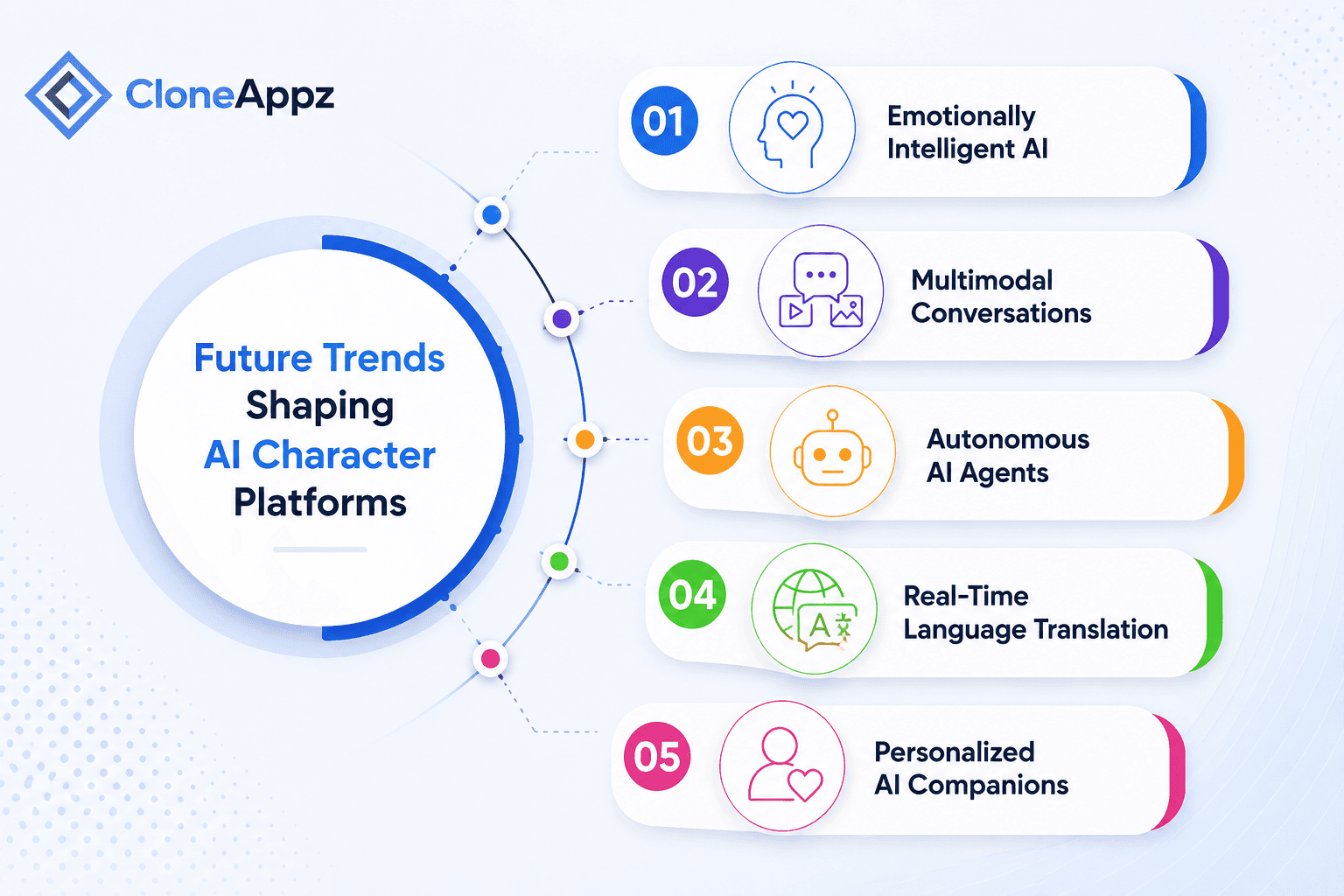
The AI industry continues to evolve rapidly, introducing new technologies that will redefine conversational experiences over the coming years.
Key trends include:
Emotionally Intelligent AI
Future AI systems will better understand emotional context, allowing characters to respond with greater empathy and emotional awareness.
Multimodal Conversations
AI platforms will combine text, voice, images, videos, and interactive media into a unified conversational experience.
Autonomous AI Agents
AI characters will perform real-world tasks such as scheduling meetings, managing workflows, conducting research, and automating repetitive business processes.
Real-Time Language Translation
Instant multilingual conversations will allow users from different regions to communicate naturally with AI characters.
Personalized AI Companions
Advanced personalization engines will continuously adapt AI personalities based on user behavior, preferences, and long-term interactions.
These innovations will further expand opportunities for businesses investing in conversational AI solutions.
Why Choose Us for Character AI Clone Development
Choosing the right technology partner is one of the most important decisions when building an AI-powered conversational platform. A successful product requires more than application development—it demands expertise in artificial intelligence, cloud infrastructure, scalable architecture, security, and user experience.
CloneAppz delivers end-to-end character ai clone development services tailored to startups, enterprises, and growing businesses looking to launch next-generation AI platforms.
Our team combines modern AI technologies with scalable engineering practices to develop applications capable of handling high user volumes while maintaining exceptional performance.
When you partner with CloneAppz, you benefit from:
AI-First Development Approach
We build intelligent platforms powered by advanced language models, contextual memory systems, vector databases, and Retrieval-Augmented Generation to deliver highly engaging conversations.
Scalable Cloud Architecture
Our applications are designed using cloud-native microservices that support automatic scaling, high availability, and optimized infrastructure costs.
Fully Customizable Solutions
Every business has unique requirements. We develop customized AI platforms with flexible branding, feature configurations, monetization options, and administrative controls.
Enterprise-Grade Security
Security is integrated into every stage of development through encrypted communications, secure authentication, role-based access control, and continuous monitoring.
Faster Time to Market
Our proven development process enables businesses to launch production-ready AI applications quickly without compromising quality or scalability.
Dedicated Post-Launch Support
CloneAppz provides ongoing maintenance, AI optimization, feature enhancements, infrastructure monitoring, and technical support to ensure long-term platform success.
Whether you're planning a conversational assistant for customer engagement, an educational AI tutor, or a niche entertainment platform, our experienced team can transform your vision into a scalable product. Businesses exploring a white label ai chat App or a white label ai girlfriend app can also leverage our customizable solutions to accelerate product launches with complete brand ownership.
Conclusion
AI character platforms are transforming the way users interact with digital products by delivering intelligent, personalized, and engaging conversational experiences. From contextual memory and advanced language models to voice interactions and scalable cloud infrastructure, every component plays a critical role in creating a successful AI application.
Businesses investing in this space need more than a functional chatbot, they require a future-ready platform capable of supporting millions of users, integrating evolving AI technologies, and adapting to changing market demands.
With extensive experience in AI-powered application development, CloneAppz helps businesses build secure, scalable, and feature-rich conversational platforms that drive user engagement and long-term growth. By combining modern engineering practices with cutting-edge AI capabilities, we empower organizations to launch innovative products that stand out in an increasingly competitive market.
Launch Your Own AI Character Platform with Confidence
Create an engaging AI platform with personalized characters, contextual memory, voice interaction, and advanced analytics. Our experts build scalable solutions tailored to your business requirements.