Launch Your Crypto Wallet Business with a Trust Wallet Clone
Launch a secure crypto wallet with a Trust Wallet clone. Explore features, development process, cost, benefits, and expert solutions from CloneAppz.
By CloneAppz Team17 min read
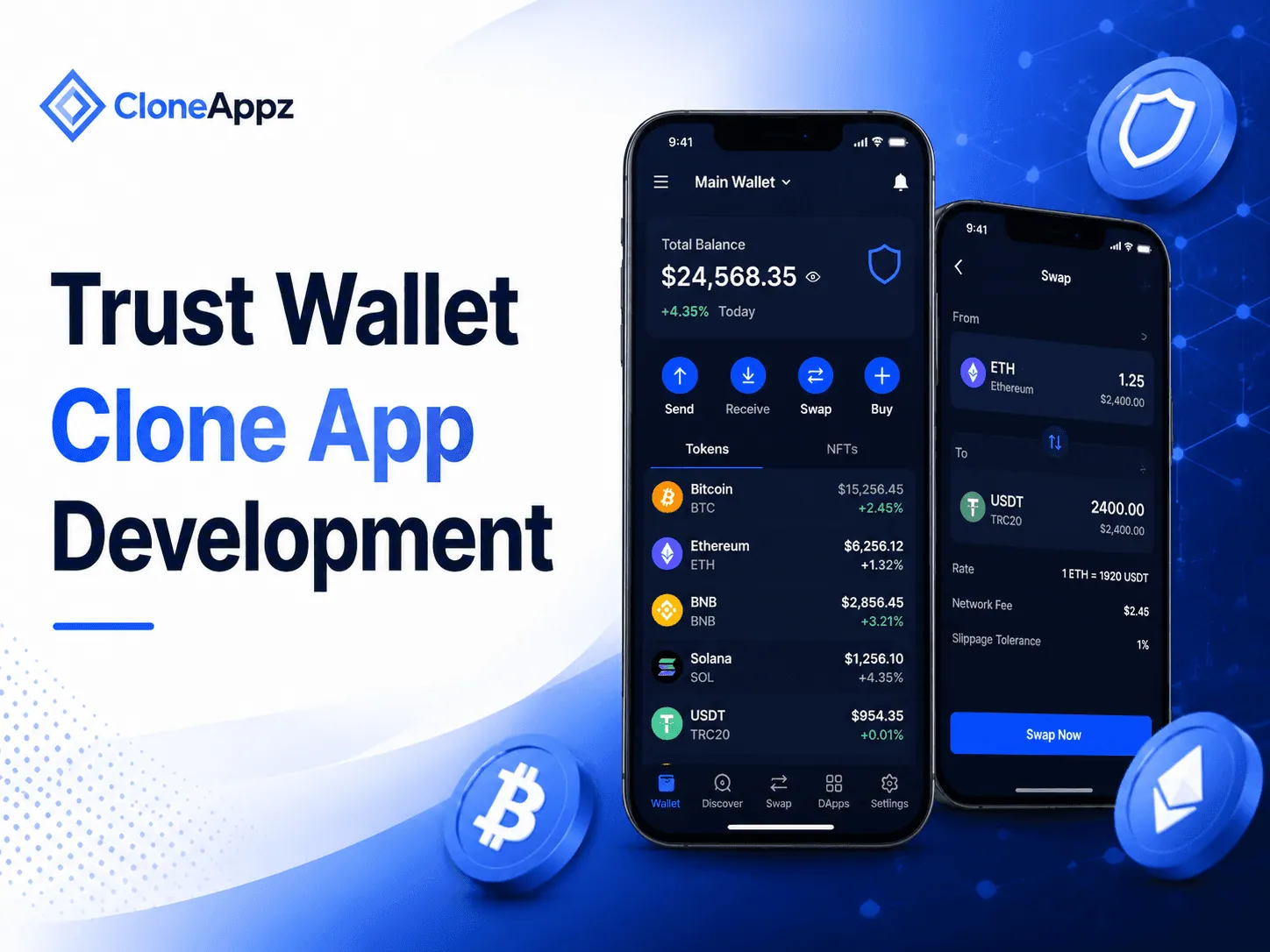
The cryptocurrency industry has transformed how people store, transfer, and manage digital assets. As blockchain adoption continues to grow across industries, crypto wallets have become an essential gateway for users interacting with decentralized ecosystems. Millions of investors now rely on secure mobile wallets to manage cryptocurrencies, NFTs, staking portfolios, and decentralized applications from a single interface.
This rapid adoption presents a lucrative opportunity for startups, crypto exchanges, fintech companies, and blockchain entrepreneurs looking to enter the market with a proven business model. Instead of developing a wallet entirely from scratch, businesses are increasingly choosing a trust wallet clone because it significantly reduces development time, lowers costs, and accelerates market entry while offering enterprise-grade security and scalability.
A modern crypto wallet is no longer limited to storing Bitcoin or Ethereum. Users expect multi-chain compatibility, seamless token swaps, NFT management, staking, DeFi integrations, and bank-level security. Delivering these features requires extensive blockchain expertise and continuous technological innovation.
This is where CloneAppz helps businesses launch secure, scalable, and feature-rich crypto wallet solutions tailored to their business objectives. Whether you are building a startup MVP or a global crypto platform, our experts create customized wallet solutions that are designed for long-term growth.
Understanding the Trust Wallet Clone and Its Business Potential
A trust wallet clone is a ready-to-customize cryptocurrency wallet solution inspired by the functionality and user experience of Trust Wallet. Rather than copying an application, it serves as a fully customizable framework that enables businesses to launch their own branded crypto wallet with advanced blockchain capabilities.
The solution can be modified according to your business requirements, supported blockchain networks, monetization strategy, security policies, and regulatory requirements.
Businesses can personalize almost every aspect of the application, including:
- Wallet branding
- Supported cryptocurrencies
- Blockchain integrations
- User interface
- NFT marketplace connectivity
- DeFi functionality
- Staking services
- Token swap modules
- Security configurations
- Administrative controls
Instead of spending years building blockchain infrastructure from the ground up, organizations can focus on customer acquisition, marketing, partnerships, and ecosystem expansion.
Why Businesses Are Investing in Crypto Wallet Solutions
The global blockchain ecosystem continues to expand beyond cryptocurrency trading. Digital wallets are becoming central to Web3 adoption by enabling users to interact with decentralized finance, NFTs, GameFi, tokenized assets, and blockchain-based identity systems.
Several market trends are accelerating demand for crypto wallets:
Growing Cryptocurrency Ownership
Millions of new users enter the crypto market every year, creating demand for secure wallets that support multiple digital assets without relying solely on centralized exchanges.
Rising Adoption of Decentralized Finance
Users increasingly participate in staking, lending, borrowing, yield farming, and liquidity pools. These activities require wallets capable of interacting directly with decentralized protocols.
Expansion of Multi-Chain Ecosystems
Blockchain networks such as Ethereum, BNB Chain, Solana, Polygon, Avalanche, Tron, and Arbitrum continue to grow. Modern wallets must support cross-chain asset management without compromising user experience.
Increasing NFT Utility
NFTs are no longer limited to digital art. They now represent gaming assets, memberships, intellectual property, event tickets, and real-world ownership, increasing the importance of integrated NFT wallet support.
Demand for Self-Custody
Following several high-profile exchange failures, users increasingly prefer self-custodial wallets that give them complete ownership of their private keys and digital assets.
Why a Trust Wallet Clone Is Better Than Building Everything from Scratch
Developing a blockchain wallet entirely from scratch requires extensive planning, security engineering, blockchain expertise, compliance implementation, testing, and continuous maintenance.
A pre-built foundation significantly simplifies this process while maintaining flexibility for customization.
From Scratch | Trust Wallet Clone |
Longer development cycle | Faster market launch |
Higher development cost | Cost-efficient implementation |
Complex blockchain integrations | Ready blockchain architecture |
Extensive testing required | Pre-tested modules |
Higher technical risks | Proven framework |
Delayed ROI | Faster business growth |
Businesses can launch products months earlier while investing more resources into user acquisition and ecosystem expansion.
Core Components of a Modern Trust Wallet Clone App
A professional crypto wallet combines blockchain technology, cybersecurity, cloud infrastructure, and intuitive user experience.
Secure Wallet Creation
Users should be able to generate new wallets within seconds using secure cryptographic algorithms.
The application automatically generates:
- Public address
- Private key
- Recovery phrase
- Wallet backup options
Private information should remain encrypted on the user's device to maintain complete ownership.
Multi Cryptocurrency Support
A successful wallet supports thousands of cryptocurrencies across multiple blockchain networks.
Common blockchain integrations include:
- Bitcoin
- Ethereum
- Binance Smart Chain
- Polygon
- Solana
- Avalanche
- Tron
- Arbitrum
- Optimism
- Base
This flexibility allows users to manage diversified digital portfolios from a single application.
Real-Time Portfolio Tracking
Users expect live portfolio monitoring that displays:
- Current balance
- Token allocation
- Historical performance
- Market trends
- Profit and loss
- Price movements
Real-time synchronization enhances user engagement and investment decisions.
QR Code Transactions
Crypto transfers become significantly easier through QR code functionality.
Users can:
- Scan wallet addresses
- Generate payment requests
- Receive crypto instantly
- Reduce manual entry errors
This improves transaction speed while minimizing mistakes.
Biometric Authentication
Security remains one of the most critical aspects of crypto wallets.
Modern authentication includes:
- Face recognition
- Fingerprint login
- PIN authentication
- Device authentication
- Multi-factor verification
These security layers reduce unauthorized wallet access.
NFT Storage
NFT adoption continues to expand across industries.
An enterprise wallet should allow users to:
- Store NFTs
- View collections
- Send NFTs
- Receive NFTs
- Organize digital collectibles
- Connect NFT marketplaces
Advanced Features That Differentiate Enterprise Wallet Applications
Modern users expect much more than basic cryptocurrency storage.
Built-In Token Swap
Integrated decentralized exchanges allow users to exchange cryptocurrencies without leaving the application.
Benefits include:
- Better user retention
- Additional revenue streams
- Faster transactions
- Improved user convenience
Staking Integration
Staking enables users to earn passive income directly within the wallet.
Supported staking assets may include:
- Ethereum
- Solana
- Polygon
- Cosmos
- Cardano
- Avalanche
Businesses can generate revenue through staking commissions while increasing customer engagement.
DApp Browser
A decentralized application browser allows users to interact with Web3 applications directly from the wallet.
Supported categories include:
- DeFi
- NFT marketplaces
- Blockchain games
- DAO governance
- Launchpads
- Web3 social platforms
This feature transforms a wallet into a complete blockchain ecosystem.
Push Notifications
Real-time alerts improve transparency and user engagement.
Notifications may include:
- Transaction confirmations
- Price alerts
- Security warnings
- NFT purchases
- Token listings
- Staking rewards
Multi-Language Support
Global crypto businesses require localized experiences.
Supporting multiple languages increases international adoption while improving accessibility.
Cross-Chain Asset Management
Rather than maintaining separate wallets for different blockchain networks, users prefer unified asset management.
Cross-chain functionality enables seamless interaction across various blockchain ecosystems while improving overall user convenience.
Security Features Every Trust Wallet Clone App Development Project Must Include
Security defines the credibility of every cryptocurrency wallet. A single vulnerability can lead to financial losses, damaged reputation, and reduced customer trust. Businesses investing in trust wallet clone app development should prioritize security from the earliest stages of architecture planning instead of treating it as an additional feature.
End-to-End Encryption
Sensitive information including private keys, wallet credentials, and transaction data should remain encrypted throughout storage and transmission.
Strong encryption ensures that user information cannot be accessed by unauthorized parties.
Private Key Ownership
The wallet should remain completely non-custodial.
Users maintain full ownership of:
- Private keys
- Recovery phrases
- Digital assets
No third party should have access to customer funds.
Secure Recovery Phrase Management
Recovery phrases must be generated securely and stored only on the user's device.
Additional security recommendations include:
- Offline backup guidance
- Encrypted storage
- User verification before export
- Recovery validation
Anti-Phishing Protection
Crypto scams continue to increase every year.
An enterprise wallet should actively protect users by:
- Detecting suspicious websites
- Blocking malicious links
- Warning against fake smart contracts
- Identifying fraudulent token interactions
Multi-Factor Authentication
High-value crypto transactions should require additional verification before execution.
Authentication methods include:
- OTP verification
- Biometric approval
- PIN confirmation
- Device verification
- Email authentication
Secure API Architecture
Wallet applications rely on blockchain nodes, market data providers, staking platforms, and third-party integrations.
Secure APIs should implement:
- Access token validation
- Request encryption
- Rate limiting
- Activity monitoring
- Threat detection
Technology Stack Required to Build a Crypto Wallet App Like Trust Wallet
Selecting the right technology stack directly influences application performance, scalability, and long-term maintainability. Businesses planning to build a crypto wallet app like trust wallet should adopt technologies capable of supporting millions of secure blockchain transactions without compromising speed or user experience.
Frontend Technologies
Common frontend frameworks include:
- Flutter
- React Native
- Swift
- Kotlin
These technologies help create responsive applications for both Android and iOS platforms while reducing development complexity.
Backend Development
A scalable backend manages authentication, blockchain communication, notifications, analytics, and administrative operations.
Popular backend technologies include:
- Node.js
- Golang
- Python
- Java
- NestJS
Microservices architecture is often preferred for handling high transaction volumes efficiently.
Blockchain Integrations
Modern wallets should support multiple blockchain protocols through reliable node integrations.
Popular blockchain networks include:
- Ethereum
- Bitcoin
- BNB Chain
- Polygon
- Solana
- Avalanche
- Tron
- Arbitrum
- Base
Each blockchain requires optimized integration to ensure secure transaction processing and network compatibility.
Database Technologies
Although non-custodial wallets minimize centralized storage, backend services still require databases for user preferences, analytics, notifications, and application settings.
Common database options include:
- PostgreSQL
- MongoDB
- Redis
- Firebase
These technologies provide scalability while maintaining high application performance.
Cloud Infrastructure
Reliable cloud deployment ensures high availability and seamless scaling as user traffic grows.
Leading cloud platforms include:
- AWS
- Microsoft Azure
- Google Cloud Platform
Cloud-native deployment enables businesses to support global users with minimal downtime.
Business Benefits of Launching a Trust Wallet Clone App
Launching a crypto wallet offers more than secure digital asset storage. It creates new business opportunities by helping companies build their own blockchain ecosystem while generating recurring revenue. A professionally developed trust wallet clone app enables faster market entry, reduces development complexity, and provides a secure self-custody experience for users.
Businesses looking to expand their blockchain offerings often partner with a White label crypto wallet development company to simplify development while maintaining complete control over branding and future enhancements.
Faster Time to Market
A trust wallet clone provides a ready-to-customize foundation, allowing businesses to launch their crypto wallet much faster than developing it from scratch. This helps reduce development time and gain a competitive advantage.
Cost-Effective Development
Using a pre-built architecture lowers development costs by eliminating the need to build core wallet functionalities from the ground up, making it a practical choice for startups and enterprises.
Scalable and Customizable Solution
The wallet can be customized to support multiple blockchains, cryptocurrencies, NFTs, staking, and DeFi features. Its scalable architecture also allows businesses to add new functionalities as their platform grows.
Multiple Revenue Streams
Businesses can monetize the wallet through transaction fees, token swaps, staking commissions, premium features, and NFT marketplace integrations, creating sustainable long-term revenue opportunities.
Stronger Brand Presence
Launching a branded crypto wallet helps businesses establish credibility in the Web3 market while giving them complete control over the user experience, security standards, and future product development.
Revenue Models for a Trust Wallet Clone Business
Launching a crypto wallet is not just about offering secure digital asset storage. A well-designed wallet can become a sustainable revenue-generating platform through multiple monetization channels. Businesses that develop crypto wallet apps like trust wallet can diversify their income while continuously expanding their blockchain ecosystem.
Transaction Fees
Businesses can charge a small fee on cryptocurrency transfers, token swaps, and blockchain transactions. Even a minimal transaction fee can generate significant recurring revenue as the user base grows.
Token Swap Commission
Integrated decentralized exchanges enable users to swap cryptocurrencies without leaving the application.
Revenue can be generated through:
- Swap commissions
- Liquidity provider partnerships
- Exchange integrations
- Premium routing services
Staking Rewards
Staking has become one of the most attractive features for crypto investors.
Businesses can earn commissions by allowing users to stake supported cryptocurrencies directly from the wallet while simplifying the staking experience.
NFT Marketplace Integration
NFT trading continues to expand across gaming, entertainment, digital collectibles, and tokenized assets.
Revenue opportunities include:
- NFT listing fees
- Marketplace commissions
- Creator verification
- Featured collections
- Promotional placements
Premium Subscription Plans
Businesses can introduce advanced membership plans that provide additional features such as:
- Advanced portfolio analytics
- Enhanced security controls
- Priority customer support
- Multi-device synchronization
- Institutional wallet management
Token Launchpad Partnerships
Many blockchain startups require wallet integrations before launching their tokens.
Partnering with launchpads creates additional business opportunities through promotional campaigns, token sales, and ecosystem collaborations.
Step-by-Step Trust Wallet Clone App Development Process
Building a secure crypto wallet requires a structured development methodology that combines blockchain engineering, cybersecurity, UI/UX design, testing, and deployment. Every stage plays a vital role in delivering a reliable application that users can trust.
Business Requirement Analysis
The first stage focuses on understanding business objectives, target audience, supported cryptocurrencies, blockchain networks, compliance requirements, and revenue strategy.
During this phase, the development team defines:
- Business goals
- User personas
- Wallet architecture
- Security requirements
- Feature roadmap
- Technical feasibility
This planning stage helps reduce development risks and creates a clear implementation strategy.
UI and UX Design
An intuitive interface is one of the biggest success factors for any crypto wallet.
Design specialists create:
- User journeys
- Interactive prototypes
- Wallet dashboards
- Transaction screens
- Portfolio management interfaces
- NFT galleries
- Staking modules
The goal is to simplify blockchain interactions while maintaining a modern user experience.
Blockchain Integration
The engineering team integrates supported blockchain networks to enable secure wallet creation, asset transfers, smart contract communication, and decentralized application connectivity.
Key integrations may include:
- Bitcoin
- Ethereum
- BNB Chain
- Polygon
- Solana
- Avalanche
- Tron
- Arbitrum
- Base
Proper blockchain integration ensures high transaction reliability and compatibility with future ecosystem updates.
Backend Development
Backend infrastructure manages administrative operations, push notifications, analytics, API communication, user preferences, and third-party integrations.
A scalable backend allows the wallet to support increasing user traffic without compromising performance.
Security Implementation
Security remains the highest priority throughout development.
The engineering team integrates:
- End-to-end encryption
- Multi-factor authentication
- Biometric login
- Secure API architecture
- Private key protection
- Threat detection
- Anti-phishing mechanisms
These measures strengthen user confidence and protect digital assets from emerging cyber threats.
Testing and Quality Assurance
Every module undergoes comprehensive testing before deployment.
Testing includes:
- Functional testing
- Security testing
- Blockchain transaction validation
- Performance testing
- Compatibility testing
- Load testing
- User acceptance testing
Comprehensive quality assurance helps eliminate vulnerabilities and ensures smooth application performance.
Deployment and Maintenance
After successful testing, the wallet is deployed on production infrastructure and published on supported platforms.
Ongoing maintenance includes:
- Security updates
- Blockchain upgrades
- Performance optimization
- Feature enhancements
- Bug fixes
- API updates
Continuous support keeps the wallet secure and competitive in the evolving blockchain industry.
Factors That Influence Trust Wallet Clone App Development Cost
There is no fixed cost for developing a crypto wallet because every business has unique functional and technical requirements. The overall investment depends on project complexity, blockchain integrations, security standards, and customization level.
Major cost factors include:
Number of Supported Blockchains
Supporting multiple blockchain networks requires additional integrations, testing, and maintenance, which increases development effort.
Security Infrastructure
Advanced security features such as hardware wallet compatibility, biometric authentication, encrypted key management, and threat monitoring contribute significantly to the project scope.
Custom Features
Features like staking, NFT management, token swapping, DApp browser integration, and cross-chain functionality increase both development time and investment.
UI and UX Complexity
A highly customized user interface with animations, interactive dashboards, and personalized experiences requires additional design and frontend development.
Third-Party Integrations
Integration with payment gateways, blockchain explorers, market data providers, KYC solutions, and decentralized exchanges also impacts the final development cost.
Regulatory Compliance
Businesses operating in multiple jurisdictions may require AML, KYC, GDPR, or regional compliance features, adding to overall development complexity.
Challenges in Crypto Wallet Development and How to Overcome Them
Developing a secure blockchain wallet involves several technical and operational challenges. Addressing these challenges early helps create a reliable and scalable product.
Ensuring Maximum Security
Cybersecurity threats continue to evolve, making wallet security a continuous priority.
Businesses should implement:
- Regular security audits
- Smart contract testing
- Penetration testing
- Vulnerability assessments
- Continuous monitoring
Managing Blockchain Scalability
Supporting multiple blockchain networks while maintaining high performance requires scalable infrastructure and optimized transaction processing.
Cloud-native deployment and microservices architecture help maintain performance as the platform grows.
Delivering an Excellent User Experience
Many users entering the crypto industry are unfamiliar with blockchain technology.
Simple onboarding, intuitive navigation, educational guidance, and user-friendly interfaces significantly improve adoption rates.
Keeping Pace with Blockchain Innovation
Blockchain ecosystems evolve rapidly.
Regular updates ensure compatibility with:
- New token standards
- Blockchain upgrades
- Security improvements
- Emerging Web3 technologies
Compliance Considerations Before Launching Your Crypto Wallet
Compliance requirements vary depending on your target market and business model. Businesses should consult legal experts before launching commercial wallet solutions.
Important considerations include:
- Data privacy regulations
- Anti-money laundering policies
- Know Your Customer requirements
- Consumer protection regulations
- Financial reporting obligations
- Local cryptocurrency regulations
A compliance-first approach minimizes legal risks and builds long-term customer trust.
Future Trends Shaping Crypto Wallet Development
The blockchain industry continues to evolve rapidly, creating new opportunities for wallet providers.
AI-Powered Wallet Intelligence
Artificial intelligence will improve fraud detection, transaction analysis, spending insights, and personalized investment recommendations.
Account Abstraction
Simplified wallet recovery, gas fee optimization, and enhanced onboarding will improve accessibility for mainstream users.
Cross-Chain Interoperability
Future wallets will enable seamless interaction across multiple blockchain ecosystems without requiring users to switch between applications.
Tokenized Real-World Assets
Digital wallets will increasingly support tokenized real estate, financial instruments, intellectual property, and physical assets.
Web3 Identity Integration
Decentralized identity solutions will allow users to authenticate securely across multiple blockchain applications using a single wallet.
Businesses planning how to build a crypto wallet app like trust wallet should consider these innovations to ensure long-term competitiveness and future scalability.
Organizations expanding into broader blockchain ecosystems also benefit from investing in white label blockchain solutions that complement their wallet infrastructure and accelerate product launches.
For businesses targeting the Middle East, partnering with experts in whilte label app development in UAE can simplify regional deployment while addressing local business requirements and market expectations.
Similarly, companies looking to diversify their digital product portfolio often explore clone app development services to launch scalable applications across multiple industries using proven development frameworks.
Why Choose CloneAppz for Trust Wallet Clone Development
Selecting the right technology partner plays a significant role in the success of any blockchain project. At CloneAppz, we combine blockchain expertise, secure development practices, and scalable architecture to help businesses launch enterprise-grade crypto wallet solutions that are ready for long-term growth.
Our team focuses on delivering customized wallet applications rather than one-size-fits-all products. Every solution is designed to align with your business goals, branding, target audience, and technical requirements.
Experienced Blockchain Development Team
Our blockchain engineers have extensive experience building secure cryptocurrency platforms with support for multiple blockchain networks, smart contracts, staking, NFTs, decentralized applications, and token management.
End-to-End Development Services
From business consultation and UI/UX design to blockchain integration, testing, deployment, and post-launch support, CloneAppz manages every phase of the development lifecycle.
Enterprise-Level Security
Security is integrated into every layer of our development process through encrypted key management, biometric authentication, secure API architecture, multi-factor authentication, and continuous vulnerability assessments.
Fully Customizable Solutions
Every business has unique requirements. We customize wallet functionality, supported cryptocurrencies, blockchain integrations, user interfaces, and monetization strategies to create a solution that reflects your brand identity.
Scalable Architecture
Our development approach ensures your wallet can support growing user bases, expanding blockchain ecosystems, and future feature enhancements without requiring complete redevelopment.
Continuous Technical Support
Our partnership extends beyond launch. We provide ongoing maintenance, security updates, performance optimization, blockchain upgrades, and feature enhancements to keep your application competitive.
Whether your goal is to launch a startup wallet or build a large-scale Web3 ecosystem, CloneAppz delivers reliable and future-ready solutions that help businesses succeed in the rapidly evolving cryptocurrency industry.
Conclusion
The demand for secure, self-custodial cryptocurrency wallets continues to grow as blockchain technology becomes increasingly integrated into everyday financial activities. Businesses entering this market have an opportunity to establish strong digital brands by offering secure, scalable, and feature-rich wallet applications.
Choosing a trust wallet clone significantly reduces development time while providing the flexibility to customize features, branding, blockchain support, and monetization models according to business objectives. With advanced capabilities such as multi-chain asset management, staking, NFT support, token swaps, and decentralized application connectivity, businesses can create comprehensive Web3 platforms that deliver long-term value to users.
CloneAppz helps organizations transform their blockchain ideas into enterprise-grade crypto wallet solutions through secure architecture, modern technology, and end-to-end development expertise. Whether you are launching your first crypto product or expanding an existing blockchain ecosystem, our experienced team is ready to help you build a scalable and future-ready wallet solution.
Frequently Asked Questions
01What is a trust wallet clone?
A trust wallet clone is a customizable cryptocurrency wallet solution inspired by the features and functionality of Trust Wallet. It enables businesses to launch their own branded crypto wallet with support for multiple cryptocurrencies, blockchain networks, staking, NFTs, and decentralized applications.
02What is included in a trust wallet clone script?
A trust wallet clone script generally includes wallet creation, multi-chain support, secure private key management, cryptocurrency transfers, token swaps, NFT storage, DApp browser integration, portfolio tracking, biometric authentication, and an administrative management panel.
03How long does trust wallet clone app development take?
The development timeline depends on project complexity, customization requirements, supported blockchain networks, and security features. A basic solution may take a few months, while enterprise-grade platforms require additional development and testing.
04Is a trust wallet clone app secure?
Yes. When developed using industry best practices, a trust wallet clone app can include enterprise-grade security features such as end-to-end encryption, biometric authentication, multi-factor authentication, encrypted private key storage, and continuous security monitoring.
05Can the wallet support multiple blockchain networks?
Yes. Modern wallet solutions can integrate multiple blockchain ecosystems, including Bitcoin, Ethereum, BNB Chain, Polygon, Solana, Avalanche, Tron, Arbitrum, and many others.
06Can I integrate NFT functionality into the wallet?
Absolutely. NFT support allows users to store, manage, send, receive, and view digital collectibles while connecting with compatible NFT marketplaces.
07What technologies are commonly used to develop crypto wallet apps like trust wallet?
Common technologies include Flutter, React Native, Swift, Kotlin, Node.js, Golang, PostgreSQL, MongoDB, Redis, AWS, Azure, Google Cloud Platform, and integrations with leading blockchain networks.