Blogs

Amazon Clone for Startups: Complete Development Guide
Learn how to build a scalable Amazon clone app for startups. Explore features, tech stack, development process, monetization models, and development costs from $5,000 to $30,000+.
Mobile App
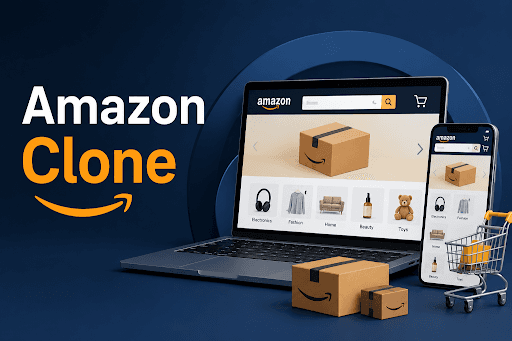
The eCommerce landscape has matured into one of the most competitive and profitable arenas in the digital economy, and startups everywhere are looking for a faster, smarter way to enter it. Building a marketplace from absolute scratch can consume years of engineering effort and a budget most early-stage founders simply do not have. This is precisely why the demand for an Amazon clone has surged among entrepreneurs who want a proven marketplace blueprint without reinventing the wheel. An Amazon clone gives you the architectural foundation, the multi-vendor logic, and the user experience patterns that already drive billions in transactions, allowing you to focus your energy and capital on differentiation, growth, and customer acquisition.
In this guide, we will walk through everything a founder needs to understand before investing in Amazon clone development, from what the product actually is, to the features that matter, the technology that powers it, the realistic cost of building it, and the strategies that turn a launched marketplace into a scalable business. Whether you are validating an MVP or planning an enterprise-grade platform, this article is designed to give you clarity, direction, and a confident next step.
Why Startups Are Investing in Amazon Clone Development
The decision to build an app like Amazon is rarely about copying a brand. It is about adopting a battle-tested commercial model that has already proven it can scale across categories, geographies, and millions of users. For startups, the appeal lies in speed-to-market and risk reduction. Rather than spending eighteen months designing a marketplace architecture and discovering its flaws in production, founders can launch on a structure that already accounts for inventory management, multi-vendor onboarding, secure payments, and order fulfilment. That head start is often the difference between capturing a market window and missing it entirely.
There is also a strong financial logic at play. Venture funding has tightened, and investors increasingly reward founders who can demonstrate traction quickly and capital-efficiently. An Amazon clone app lets you reach revenue-generating operations sooner, which strengthens your fundraising narrative and reduces your burn rate during the most fragile phase of the business. Below, we explore the three macro forces driving this investment trend.
Growing eCommerce Industry
Global eCommerce continues to expand at a pace that few other industries can match, and the momentum shows no sign of slowing as mobile penetration deepens and digital payment infrastructure becomes universal. Consumers have grown comfortable purchasing everything from groceries to electronics to luxury goods online, and this behavioral shift has created room for a vast number of specialized and regional marketplaces to thrive alongside the giants. A startup launching an Amazon clone website today is not trying to displace Amazon globally; it is carving out a focused niche: a country, a product vertical, a community, or an underserved demographic where a tailored marketplace can win decisively.
This expanding pie matters because it means the opportunity is not zero-sum. As more buyers move online and as logistics networks reach previously inaccessible regions, the total addressable market keeps widening. Founders who enter now with a well-built clone platform position themselves to ride this structural growth rather than fight for scraps in a saturated category. The industry tailwind effectively de-risks the venture, provided the execution is sound and the positioning is sharp.
Increasing Demand for Multi-Vendor Marketplaces
One of the most important shifts in modern commerce is the move away from single-seller stores toward multi-vendor marketplaces where hundreds or thousands of independent sellers list their products under one trusted brand. This model is powerful because it allows the platform owner to scale catalog depth and category breadth without holding inventory or managing fulfilment for every product. The marketplace becomes an aggregator of supply and demand, earning commission on every transaction while the vendors handle sourcing and shipping. This is the exact engine that made Amazon a trillion-dollar company, and it is the engine a quality clone replicates.
For startups, the multi-vendor structure is attractive because it creates network effects. Every new vendor brings their own customer base and product range, which makes the platform more valuable to buyers, which in turn attracts more vendors. When you develop an app like Amazon with robust vendor management built in, you are building a self-reinforcing growth loop rather than a static catalog. The challenge is doing this without compromising buyer trust, which is why mature vendor verification, ratings, and dispute resolution must be designed into the platform from day one.
AI and Automation in eCommerce
Artificial intelligence has moved from a competitive luxury to a baseline expectation in eCommerce. Shoppers now expect personalized recommendations, intelligent search that understands intent rather than keywords, and dynamic experiences that adapt to their behavior in real time. Behind the scenes, automation handles fraud detection, demand forecasting, pricing optimization, and customer support at a scale no human team could match. A modern Amazon clone development project that ignores these capabilities risks shipping a product that feels dated the moment it launches.
The good news for startups is that AI infrastructure has become dramatically more accessible. Recommendation engines, natural language search, and conversational support that once required dedicated machine-learning teams can now be integrated through APIs and modular services. This means a lean startup can offer genuinely intelligent shopping experiences without building a research lab. We will return to specific AI features later in this guide, but the strategic point is simple: automation is no longer optional if you intend to compete on customer experience and operational efficiency.
What Is an Amazon Clone?
An Amazon clone is a ready-to-deploy eCommerce marketplace solution that replicates the core functionality, user flows, and architectural principles of Amazon while allowing complete customization of branding, features, and business rules. It is not a literal copy of Amazon's proprietary code or trademark; rather, it is a purpose-built platform that mirrors the proven structure of a multi-vendor marketplace so that founders can launch quickly and adapt confidently. Think of it as a sophisticated framework that already understands how buyers, sellers, and administrators need to interact, leaving you free to shape the business around your own vision.
The value of an Amazon clone script lies in how much foundational work it eliminates. Product catalogs, shopping carts, secure checkout, order tracking, vendor dashboards, commission logic, and admin controls are intricate systems that take significant time to engineer correctly. A well-architected clone delivers these as a cohesive whole, tested and integrated, so your development team spends its time on differentiation and refinement instead of rebuilding commodity infrastructure. For founders, this translates into faster launches, lower upfront risk, and a clearer path from idea to revenue.
Types of Amazon Clone Platforms
Not every marketplace ambition is the same, and the type of clone you choose should align with your business model rather than a generic template. Some founders want a horizontal marketplace that sells across many categories, much like Amazon itself, while others are building a vertical marketplace focused on a single domain such as fashion, electronics, handmade goods, or industrial supplies. There are also hyperlocal marketplaces that connect buyers with nearby sellers for fast delivery, and B2B marketplaces designed around bulk ordering, negotiated pricing, and business account management. Each variant shares the same multi-vendor DNA but emphasizes different features and workflows.
Choosing the right type early is a strategic decision because it shapes everything downstream, from the search and filtering logic to the payment terms and the onboarding experience for sellers. A startup that clearly defines its marketplace type before beginning clone app development avoids costly mid-project pivots and ends up with a platform that feels purpose-built rather than generic. The best clone partners will help you map your business model to the appropriate architecture so the technology serves your strategy rather than constraining it.
Core Features of an Amazon Clone App
The strength of any marketplace lies in how seamlessly its three core stakeholders, customers, vendors, and administrators can accomplish their goals. A successful Amazon clone app is essentially three connected products working in harmony, each with its own panel, permissions, and priorities. When these panels are well designed, the platform feels effortless to everyone who touches it, and that frictionlessness is what drives repeat usage and word-of-mouth growth. Below we break down the essential capabilities of each panel and why they matter to the health of the marketplace.
It is worth noting that feature completeness is not about cramming in every conceivable option; it is about delivering the right capabilities reliably. A lean, polished feature set that works flawlessly will always outperform a bloated platform riddled with half-finished functions. As you plan your build, prioritize the features that directly enable transactions and trust, then layer enhancements once you have validated demand.
Customer Panel Features
The customer panel is where revenue is ultimately generated, so its design deserves the most careful attention. Shoppers need intuitive product discovery through powerful search and filtering, clear and trustworthy product pages with images, descriptions, specifications, and genuine reviews, and a checkout process so smooth that abandonment becomes rare. Beyond the basics, customers expect personalized recommendations, wishlists, saved addresses, multiple payment options, real-time order tracking, and a straightforward way to request returns or refunds. Every one of these touchpoints either builds or erodes the confidence that turns a browser into a buyer.
What separates a forgettable marketplace from a beloved one is often the small details of the customer experience, how quickly pages load, how relevant the search results feel, how reassuring the post-purchase communication is. When you create an app like Amazon, investing in a refined, responsive, and emotionally reassuring customer journey pays compounding dividends because satisfied customers return, spend more, and recommend the platform to others. The customer panel is not just a feature list; it is the heart of your retention engine.
Vendor Panel Features
Vendors are the supply side of your marketplace, and their experience determines whether your catalog grows or stagnates. A strong vendor panel gives sellers everything they need to manage their business independently: streamlined onboarding and verification, easy product listing with bulk upload options, inventory and stock management, order processing and shipping tools, and transparent earnings dashboards that show commissions, payouts, and performance metrics. When vendors can operate efficiently and clearly see their revenue, they list more products, stay engaged, and treat your platform as a primary sales channel rather than an afterthought.
The most successful marketplaces treat their vendors as partners and build tools that actively help them succeed, such as sales analytics, promotional capabilities, and responsive support. This vendor-centric thinking is strategically important because acquiring and retaining quality sellers is often harder than acquiring buyers. A platform built with a thoughtful vendor panel reduces seller churn and strengthens the supply that, in turn, attracts demand. In a marketplace, healthy supply and healthy demand are two sides of the same coin, and the vendor panel is how you nurture the supply side.
Admin Panel Features
The admin panel is the command center of the entire marketplace, giving the platform owner complete visibility and control over operations. From here, administrators manage vendor approvals and verification, oversee product moderation and category structures, configure commission rates and payment rules, handle disputes and refunds, and monitor the overall health of the marketplace through analytics and reporting. This panel is where business strategy meets day-to-day operations, and its sophistication directly affects how efficiently the platform can be run as it scales.
A well-built admin panel does more than expose controls; it surfaces actionable insights that help owners make better decisions about pricing, promotions, vendor incentives, and category expansion. As your marketplace grows from hundreds to thousands of transactions per day, the quality of your admin tooling becomes the difference between a business that scales smoothly and one that drowns in operational chaos. When evaluating any Amazon clone development solution, scrutinize the admin panel closely, because it is the system you will live in every single day.
Launch Your Amazon Clone Faster
Build a scalable multi-vendor marketplace with advanced features, modern UI, and secure architecture designed for startup growth.
Advanced AI Features for Amazon Clone Development
Artificial intelligence is what elevates a competent marketplace into a truly modern one, and it is where forward-thinking startups can build a durable edge. The most impactful AI feature is personalized recommendation, where the platform analyzes browsing and purchase behavior to surface products each shopper is genuinely likely to want, increasing average order value and engagement in the process. Closely related is intelligent search powered by natural language understanding, which interprets what a customer means rather than merely matching keywords, dramatically improving the odds that a shopper finds what they came for and completes a purchase.
Beyond discovery, AI transforms operations in ways that directly protect margins and improve trust. Automated fraud detection identifies suspicious transactions and fake reviews before they damage the platform, dynamic pricing tools help vendors stay competitive without constant manual adjustment, and demand forecasting reduces stockouts and overstocking. AI-powered chatbots and virtual assistants handle a large share of customer inquiries instantly, freeing human support to focus on complex cases. When you develop an app like Amazon with these capabilities woven in from the start, you are not just matching customer expectations, you are building an operationally efficient business that can scale without a proportional increase in headcount, which is exactly the kind of leverage early-stage startups need.
Technology Stack for Amazon Clone App Development
The technology stack underpinning your marketplace determines its performance, scalability, security, and long-term maintainability, so it deserves deliberate consideration rather than defaulting to whatever is familiar. On the front end, modern frameworks such as React or Next.js for web and React Native or Flutter for mobile deliver fast, responsive interfaces across devices while allowing efficient code reuse. The back end typically relies on robust, scalable languages and frameworks like Node.js, Python with Django, or Laravel, chosen for their ability to handle concurrent transactions and integrate cleanly with third-party services. The database layer often combines a relational database such as PostgreSQL or MySQL for structured transactional data with caching and search technologies like Redis and Elasticsearch to keep the experience fast at scale.
Equally important is the infrastructure and the surrounding ecosystem of services. Cloud platforms such as AWS, Google Cloud, or Azure provide the elasticity to handle traffic spikes during sales events, while containerization and microservices architecture allow individual components to scale independently as demand grows. Secure payment gateway integrations, reliable cloud storage for media, content delivery networks for speed, and well-structured APIs for vendor and logistics integrations round out a production-ready stack. The right combination depends on your budget, your scale ambitions, and your team's expertise, but the guiding principle is consistent: choose technologies that can grow with you so that early architectural decisions do not become expensive constraints later.
Step-by-Step Amazon Clone Development Process
Building a marketplace is a structured journey, and understanding the sequence helps founders set realistic expectations and collaborate effectively with their development partner. The process begins with discovery and planning, where your business model, target market, marketplace type, and core feature priorities are defined in detail. This phase produces the blueprint that guides everything that follows, and the clarity it provides is what prevents scope creep and budget overruns down the line. Skipping or rushing this stage is one of the most common reasons marketplace projects falter.
From there, the project moves through UI/UX design, where the look, feel, and flow of all three panels are crafted and validated, followed by development, where front end, back end, and integrations are built and connected. Rigorous quality assurance testing then verifies functionality, security, and performance across devices and scenarios, because a marketplace handling real money and real customer data cannot afford avoidable failures. Finally comes deployment and launch, followed by ongoing maintenance, monitoring, and iterative enhancement based on real user behavior. The most successful Amazon clone development projects treat launch not as the finish line but as the beginning of a continuous improvement cycle, refining the product as the business learns what its market truly wants.
Amazon Clone Website vs Amazon Clone App
A frequent question among founders is whether to prioritize a web platform or a mobile application, and the honest answer is that the two serve different but complementary purposes. An Amazon clone website offers broad reach, is easily discoverable through search engines, and requires no installation, making it ideal for first-time visitors and for capturing organic traffic. It is often the most cost-effective starting point and provides the responsive experience that desktop and mobile-web shoppers expect. For many startups, launching the web platform first allows them to validate demand and refine the experience before committing to native app development.
The Amazon clone app, by contrast, excels at retention and engagement. Native mobile apps load faster, support push notifications that bring customers back, integrate with device features like cameras and location, and generally convert browsers into buyers at higher rates among loyal users. The strategic ideal for most marketplaces is eventually to offer both, with the website driving discovery and the app deepening loyalty. The practical sequencing, however, should follow your budget and your audience; if your target market is mobile-first, an app may take priority, whereas a broad consumer marketplace often benefits from leading with web. A good development partner will help you decide based on data rather than assumption.
Monetization Strategies
A marketplace can only thrive if it has clear, sustainable revenue streams, and one of the advantages of the Amazon model is that it supports several at once. The most fundamental is commission on sales, where the platform takes a percentage of every transaction completed between buyer and vendor. This aligns the platform's revenue directly with the value it creates and scales naturally as transaction volume grows. Many marketplaces complement this with subscription plans for vendors, offering tiered memberships that unlock enhanced visibility, lower commission rates, or premium selling tools in exchange for recurring fees that smooth out revenue predictability.
Beyond these core models, marketplaces frequently earn through featured listings and sponsored placements, where vendors pay to have their products appear more prominently in search results and category pages, essentially an internal advertising business that can become enormously profitable at scale. Additional streams include delivery and service fees, premium customer memberships that bundle benefits like free shipping, and value-added services such as fulfillment or marketing support sold to vendors. The strategic art of monetization lies in balancing these streams so that the platform earns sustainably without making the experience feel expensive or exploitative to either buyers or sellers. When you build an app like Amazon, designing flexible monetization logic into the platform from the outset gives you the freedom to experiment and optimize as you learn what your market will bear.
Estimated Cost to Build an App Like Amazon
Cost is understandably one of the first questions founders ask, and the honest answer is that it depends heavily on scope, complexity, and the level of customization you require. As a practical range, Amazon clone development typically costs between $5,000 and $30,000 or more, with the lower end reflecting a streamlined MVP built on a proven clone script and the upper end representing a heavily customized, feature-rich, enterprise-grade marketplace. This range is wide precisely because marketplaces can be built at very different levels of sophistication, and the right investment for you depends on where your business sits on that spectrum.
An MVP, or minimum viable product, is designed to validate your marketplace concept in the real market with the smallest responsible investment. It includes the essential customer, vendor, and admin functionality needed to facilitate transactions and gather genuine user feedback, typically landing toward the lower-to-middle of the cost range. An enterprise-level marketplace, on the other hand, incorporates advanced AI features, deep customization, sophisticated analytics, high-scale infrastructure, multiple integrations, and polished design across web and native apps, which pushes the investment toward and beyond the upper end. Choosing between these is a strategic decision about how much you want to prove before you invest fully, and a thoughtful partner will help you find the right balance for your stage and your funding.
Factors Affecting Development Cost
Several variables determine where a given project falls within the cost range, and understanding them helps founders make informed trade-offs. The breadth and complexity of features is the largest driver, since every additional capability, advanced AI, multiple payment gateways, complex commission structures, or sophisticated logistics integrations, adds design, development, and testing effort. The platforms you target also matter significantly; building for web alone is more economical than simultaneously developing polished native applications for both iOS and Android. Design complexity, the degree of customization away from the base clone, and the level of scalability you engineer for at launch all influence the final figure as well.
The development team's location and expertise is another meaningful factor, as is the extent of post-launch support and maintenance you require. Third-party services such as premium payment processors, SMS and email providers, cloud infrastructure, and specialized AI APIs carry their own ongoing costs that should be factored into your total cost of ownership rather than just the initial build. Being clear-eyed about these factors during the planning phase allows you to prioritize ruthlessly, investing in what drives transactions and trust while deferring nice-to-have enhancements until the business has the revenue to justify them.
Cost Breakdown Table
The table below offers an illustrative breakdown to help you visualize how investment maps to capability across different build tiers. Actual figures vary by partner and scope, but the proportions and tiers reflect typical real-world marketplace projects.
Development Tier | Description | Typical Features | Estimated Cost |
Basic MVP | Lean launch to validate the concept and gather early user feedback | Core customer, vendor, and admin panels; standard search; single payment gateway; web-focused | $5,000 – $10,000 |
Standard Marketplace | A production-ready marketplace for serious early-stage operations | Full three-panel functionality; multiple payment options; basic recommendations; responsive web plus a mobile app | $10,000 – $18,000 |
Advanced Platform | A competitive, feature-rich marketplace built for growth | AI search and recommendations, advanced analytics, multiple integrations, native iOS and Android apps | $18,000 – $30,000 |
Enterprise Solution | A highly customized, large-scale marketplace engineered for high volume | Deep customization, sophisticated AI and automation, microservices architecture, premium scalability and security | $30,000+ |
These tiers are not rigid boxes but a spectrum, and many startups begin in one tier and graduate to the next as they prove demand and secure funding. The most capital-efficient path is usually to launch lean, validate the model with real transactions, and then reinvest revenue and investment into the features and scale that the market has shown it wants.
How to Scale an Amazon Clone Business?
Launching a marketplace is an achievement, but scaling it into a thriving business is where the real work and the real rewards lie. Scaling begins with solving the chicken-and-egg problem of supply and demand, which usually means seeding one side first-often vendors, so that buyers arrive to a catalog worth browsing. Targeted vendor acquisition, attractive early commission terms, and white-glove onboarding for your first sellers create the critical mass of supply that makes the platform genuinely useful. Once supply is healthy, customer acquisition through SEO, paid advertising, content marketing, and referral incentives can compound the network effects that make marketplaces so powerful.
Operationally, scaling demands that your infrastructure and processes keep pace with growth so that performance and trust never degrade under load. This is where the architectural decisions made early, cloud elasticity, microservices, caching, and robust admin tooling pay off, allowing the platform to absorb traffic spikes and transaction volume without breaking. Strategically, growth also comes from expanding thoughtfully into adjacent categories, new geographies, or complementary services, always guided by data about where demand is strongest. The marketplaces that scale most successfully treat growth as a disciplined, measured process of strengthening the flywheel rather than chasing every opportunity at once, and they continuously reinvest in the customer and vendor experiences that keep the flywheel spinning.
Ready to Build an App Like Amazon?
Turn your eCommerce idea into a powerful marketplace platform with custom Amazon clone development solutions.
Common Challenges in Amazon Clone Development
Building a marketplace is rewarding, but founders should enter the journey with clear eyes about the challenges involved so they can plan for them rather than be surprised by them. The most persistent challenge is the cold-start problem of attracting both buyers and sellers simultaneously, since a marketplace with no products attracts no buyers and a marketplace with no buyers attracts no sellers. Overcoming this requires a deliberate go-to-market strategy and often a willingness to subsidize one side early, which has implications for both budget and operational focus. Underestimating this dynamic is one of the most common reasons well-built marketplaces struggle to gain traction.
Other significant challenges include maintaining trust and quality as the vendor base grows, managing payment and dispute complexity fairly, ensuring security and compliance with data and payment regulations, and keeping the platform performant as transaction volume increases. There is also the ongoing challenge of differentiation, because launching on a proven model means you must compete on experience, niche focus, or service quality rather than novelty alone. None of these challenges is insurmountable, but each requires foresight and the right technical and strategic partner. Anticipating them during planning, rather than reacting to them in production, is what separates marketplaces that endure from those that stall.
How CloneAppz Helps Businesses Build Amazon Clone Platforms
CloneAppz exists to remove the friction, risk, and guesswork from launching a marketplace, partnering with startups and established businesses alike to turn marketplace ambitions into market-ready products. Rather than handing over a generic template and walking away, CloneAppz works closely with founders to understand their business model, target market, and growth goals, then delivers an Amazon clone solution tailored to that specific vision. This consultative approach means you get a platform engineered around your strategy, built on a foundation that is already proven, tested, and ready to scale, so you launch faster and with far greater confidence.
The CloneAppz team brings together experienced designers, developers, and strategists who understand not just how to build marketplaces but how to build marketplaces that succeed commercially. From the intuitive customer experience and the empowering vendor tools to the powerful admin command center and the AI-driven features that keep the platform modern, every component is crafted to support real business outcomes. Whether you need a lean MVP to validate your idea or an enterprise-grade platform engineered for high volume, CloneAppz scales its solution to your stage, your budget, and your ambition, and stays with you beyond launch to support the iterative growth that turns a product into a business.
Why Choose CloneAppz?
Choosing the right clone app development company is one of the most consequential decisions a founder will make, because the quality of your platform and the speed of your launch depend directly on the team behind it. CloneAppz distinguishes itself through a combination of proven marketplace expertise, genuine customization rather than cookie-cutter delivery, transparent communication throughout the project, and a commitment to scalability that ensures the platform you launch today can support the business you grow tomorrow. The focus is always on delivering tangible outcomes faster time-to-market, lower risk, and a marketplace that customers and vendors actually love to use.
Beyond technical capability, CloneAppz offers something equally valuable: a partner that understands the startup journey and engineers solutions that respect both your budget and your timeline. The combination of modern technology, AI-ready features, secure and scalable architecture, and dependable post-launch support means founders can move from idea to operational marketplace without the usual pitfalls. When the goal is to create an app like Amazon that competes on experience and scales with demand, CloneAppz provides the expertise, the technology, and the partnership to make it happen.
Future Trends in Amazon Clone App Development
The marketplace of the near future will be defined by even deeper personalization, smarter automation, and richer, more immersive shopping experiences. Artificial intelligence will move from suggesting products to anticipating needs, with predictive commerce that surfaces the right item at the right moment based on context and behavior. Conversational and voice-driven shopping will become more prevalent as natural language interfaces mature, allowing customers to discover and purchase products through dialogue rather than navigation. These shifts will raise the baseline of what shoppers expect, and marketplaces built with flexible, AI-ready architecture will adapt while rigid platforms struggle.
Several other forces will shape the next generation of marketplaces, including the rise of immersive technologies and the growing importance of sustainability and ethical sourcing as purchasing factors. Founders building today should keep these trends in mind:
AI-native experiences where personalization, search, and support are intelligent by default rather than bolted on.
Headless and composable architecture that lets marketplaces adopt new technologies and channels without rebuilding the core.
Embedded fintech and flexible payments including buy-now-pay-later, wallets, and seamless cross-border transactions.
Sustainability and transparency as differentiators that increasingly influence where conscious consumers choose to shop.
Building on a modern, adaptable foundation today is the single best way to remain competitive as these trends unfold, because the marketplaces that win will be those that can evolve quickly rather than those locked into yesterday's assumptions.
Conclusion
Launching a marketplace has never been more achievable for ambitious startups, and an Amazon clone offers the fastest, most capital-efficient path from idea to operational business. By adopting a proven multi-vendor architecture, founders sidestep years of foundational engineering and focus their energy where it truly matters: differentiation, customer experience, vendor success, and growth. Throughout this guide we have explored why startups are investing in Amazon clone development, what the product actually is, the features and technology that power it, the realistic cost of building it, and the strategies that turn a launch into a scalable enterprise.
The opportunity is real, the tailwinds are strong, and the tools have never been more accessible, but execution and the right partner make all the difference between a marketplace that thrives and one that stalls. Whether you are validating an MVP or planning an enterprise platform, the key is to start with clarity, build on a solid and scalable foundation, and commit to the continuous improvement that great marketplaces demand. With the right approach, your Amazon clone app can become the foundation of a business that captures its market and grows with it.